Tallinn Soviet History & the Singing Revolution — Occupation, Resistance & Independence
Estonia experienced two Soviet occupations (1940-41 and 1944-1991) and one Nazi occupation (1941-44), losing 20 percent of its pre-war population to deportation, execution, and wartime death. The recovery and the peaceful Singing Revolution of 1987-1991 that restored independence is the defining story of modern Estonia.
- 1
The Soviet Occupation — Deportations and Resistance
The first Soviet occupation (1940-41, following the Molotov-Ribbentrop Pact secret protocol that assigned Estonia to the Soviet sphere, the Soviet ultimatum of June 16 1940 demanding a Soviet-friendly government, the subsequent occupation by the Red Army, the forced incorporation into the USSR, the mass deportation of June 14 1941 in which 10,205 Estonians were deported to Siberia in a single night — the largest single deportation in Estonian history, the victims including the entire Estonian civil and military leadership, the intellectuals, and the families of anyone deemed a class enemy) and the second Soviet occupation (1944-1991, the restoration of Soviet control after the Nazi occupation, the mass deportations of March 1949 in which 20,713 Estonians — 3 percent of the entire population — were deported to Siberia in 3 days, the deportations aimed at breaking the rural resistance to collectivization, the Forest Brothers — the Estonian armed resistance fighters hiding in the forests until the last ones surrendered in 1978): documented at the Vabamu Museum of Occupations and Freedom (see below).
- 2
Vabamu — the Museum of Occupations and Freedom
Vabamu (Toompea 8, at the foot of Toompea Hill, the Museum of Occupations and Freedom, €10 adults, Tuesday-Sunday 10am-6pm, Thursday until 8pm, the museum presenting the full story of the Soviet and Nazi occupations of Estonia 1940-1991): the most important exhibits (the original KGB interrogation records — the NKVD/KGB files on Estonian citizens held by the Estonian Internal Security Service and partially digitized, the specific fates of individual Estonians traceable through the records — the suitcase collection: the suitcases and the few personal objects brought by the deportees to Siberia, each suitcase labeled with the name and fate of the owner, the most immediately humanizing exhibits in the museum, the 1991 independence objects: the barricades built in front of the Estonian Parliament building when Soviet forces attempted to seize the Parliament in January 1991, the television broadcasting materials used to maintain Estonian public broadcasting during the Soviet intervention, the personal testimonies of the people who stood at the barricades). The museum's design (the building designed by Finnish architects, the exhibition flowing from the occupation period through the resistance to the restoration of independence in 1991, the final gallery opening to a panoramic window overlooking Tallinn — the restored capital visible as the conclusion of the exhibition arc).
- 3
The Singing Revolution — Music as Political Resistance
The Singing Revolution (the Estonian term for the non-violent independence movement of 1987-1991, named for the role of mass choral singing in the resistance — Estonia has the most developed choral tradition of any country in the world relative to population size, with 100,000+ choir singers in a country of 1.3 million, the tradition dating to the 19th-century national awakening when singing was the socially acceptable form of Estonian national expression under Russian Imperial censorship): the Tallinn Song Festival (Lauluväljak, the 1960 open-air amphitheatre on the Pirita coast, the site of the historic 1988 gathering when 300,000 Estonians — one quarter of the entire population — gathered to sing patriotic songs, the moment marking the transition of the independence movement from underground to mass public resistance), the 1989 Baltic Way (the human chain of 2 million people linking Tallinn to Riga to Vilnius — 675km — on 23 August 1989, the 50th anniversary of the Molotov-Ribbentrop Pact, the largest non-violent political demonstration in history to that date, the human chain the clearest possible statement of the three Baltic nations' rejection of the Soviet occupation). The documentary film 'The Singing Revolution' (the 2006 American documentary by James and Maureen Tusty, available on streaming platforms, the most accessible international introduction to the Estonian independence movement).
- 4
Maarjamäe Memorial and History Museum
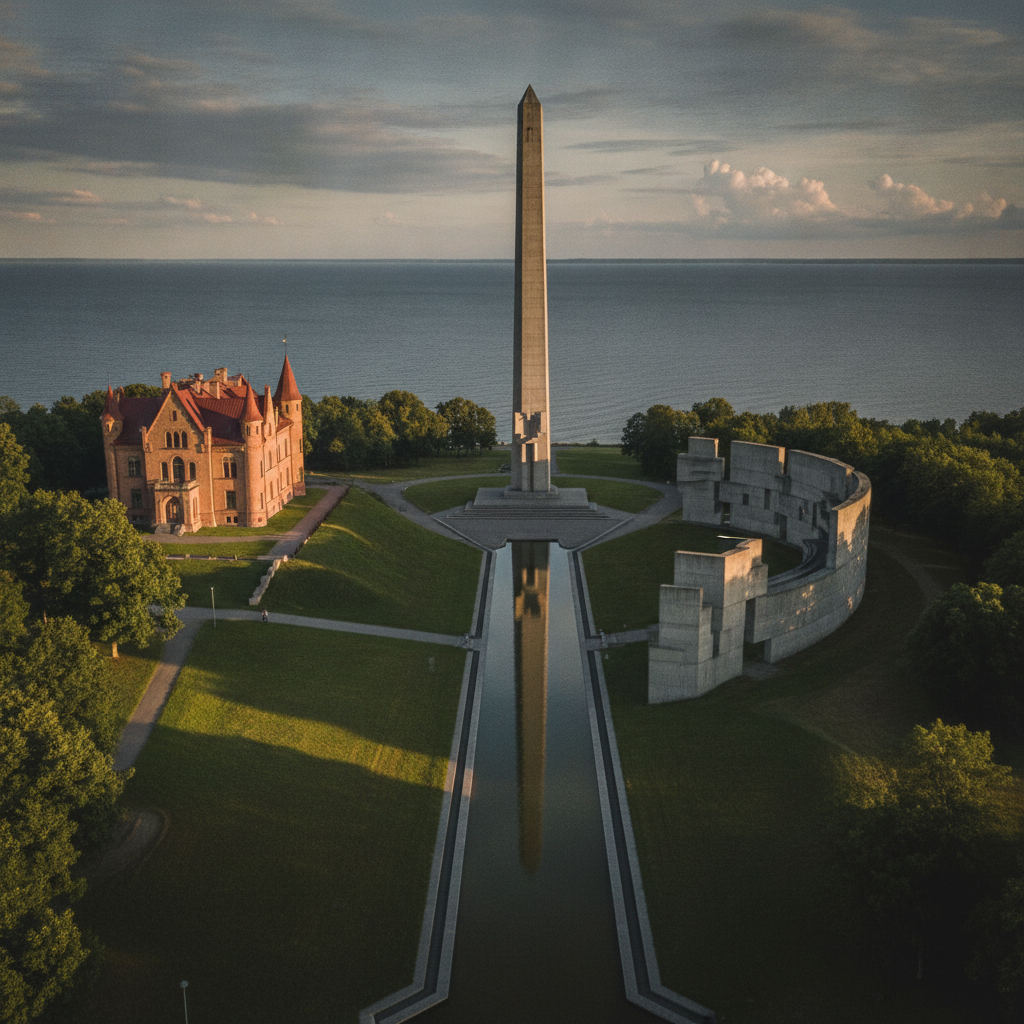
Maarjamäe (the coastal district 5km east of the Old Town, accessible by bus 35 or 38 from the city centre in 20 minutes, the district containing both a 19th-century manor house and a Soviet-era war memorial): the Maarjamäe Palace (the neo-Gothic manor house built 1874 for the Russian count Anatoly Orlov-Davydov, the building now housing the second branch of the Estonian History Museum, €8 adults, Tuesday-Sunday 10am-6pm, the collection focused on the 20th-century history — the Estonian Republic 1918-1940, the Soviet and Nazi occupations, and the restoration of independence) and the Soviet War Memorial (the concrete monument and reflecting pool built 1975 to commemorate Soviet soldiers killed in the 1941-44 period, the memorial now in the context of independent Estonia representing the contested memory of the Soviet period — the Estonian state maintaining the memorial as a historical monument while the Russian community continues to use it as a place of commemoration). The Pirita Convent ruins visible from the Maarjamäe palace garden (the 15th-century Bridgettine convent ruins 1km north, the Gothic walls standing to full height, the most dramatic medieval ruin in Estonia, free and always accessible from the Pirita riverside path) and the coastal walk from Maarjamäe to Pirita (the 2km path along the Baltic Sea coast between the two sites, the walk combining the Soviet memorial, the coastal forest, and the Gothic ruins in a single 45-minute route).
- 5
KGB Headquarters and the Hotel Viru Museum
The Hotel Viru KGB Museum (Hotel Viru, Viru väljak 4, the 23-storey Intourist hotel built 1972 as the first Western-style hotel in Soviet Estonia, the hotel the central node of the Soviet surveillance state in Tallinn — the KGB operated a dedicated monitoring floor on the 23rd floor, the listening devices installed in every room, the microphones in the curtain rods and the bedside lamps, the hotel staff trained as KGB informers, the entire enterprise discovered and partially dismantled before independence, the floor preserved as a museum, €12 adults including guided tour, Tuesday-Sunday 10am-6pm, tours every hour): the preserved KGB surveillance equipment (the original listening devices, the photographic surveillance equipment, the radio communication apparatus of the Soviet security service, the logbooks of monitored conversations), the decoded communications (the partial records of the monitoring operations, the identities of some of the monitored foreign diplomats and journalists revealed in the post-independence declassification), and the hotel context (the Hotel Viru currently operating as a standard 4-star hotel, the 22 normal floors completely renovated while the 23rd floor is preserved as the museum — the contrast between the contemporary hotel and the Soviet surveillance apparatus 50m above creating the most immediate material encounter with the KGB system available in the Baltic states).
- 6
August 20, 1991 — the Restoration of Estonian Independence
The restoration of Estonian independence (20 August 1991, the date the Estonian Supreme Soviet voted to restore full state independence in the middle of the failed coup attempt against Mikhail Gorbachev in Moscow — the coup plotters seizing the Moscow television and radio broadcasting facilities on 19 August, the Estonian government calculating that the chaos of the coup provided the final window for independence, the vote at 11:03pm on 20 August 1991 in the Toompea Castle chamber, the result announced to the crowd gathered in the castle courtyard, the Estonian flag raised on the Long Hermann tower at midnight): the Long Hermann tower (Pikk Hermann, the medieval tower at the corner of the Toompea Castle, the tower where the national flag is raised at sunrise and lowered at sunset every day — the raising ceremony at 6:45am in winter and 4:45am in summer, the ceremony the most concrete daily expression of Estonian statehood, the exact same tower where the Soviet flag was lowered and the Estonian flag raised by hand on the night of independence, the specific masonry of the tower and the flagpole unchanged from that night), and the Independence Square Memorial (the Vabadussõja võidusammas — the Liberty Column, the granite and glass monument on Vabaduse väljak — Freedom Square — at the foot of Toompea Hill, erected 2009, the 23.5m column commemorating the Estonian War of Independence 1918-1920 and by extension all Estonian independence, the column the most visited memorial in contemporary Tallinn, the square the gathering point for national celebrations on 24 February — Estonian Independence Day — and 20 August — Restoration of Independence Day).
Walk this route with audio
Stories play automatically as you reach each stop — no tapping needed.
More in tallinn
Tallinn Practical Guide — the Helsinki Ferry, Seasons, Access & the Estonian Experience
Tallinn Medieval Crafts & Culture — St. Catherine's Passage, the Dominican Monastery & Estonian Design
Tallinn Beyond the Old Town — Kadriorg Palace, KUMU Museum & the World's Most Digital Society
Tallinn Old Town — Town Hall Square, Toompea Castle & the Best-Preserved Medieval City in Northern Europe