The Quran Stained With the Caliph's Blood Returned by Lenin, the Earthquake That Killed 10 People While Destroying 100,000 Homes & the Metro Banned From Photography for 40 Years Due to Nuclear Shelter Function
The Othman Quran stained with Caliph Uthman's 656 CE assassination blood returned by Lenin in 1924 as a political gesture; the 1966 earthquake killing only 10 people from 100,000 destroyed homes because it struck at dawn; the Tashkent Metro photography ban lifted in 2018 due to the stations' civil defense shelter designation; the Tashkent Plov Centre's daily kazan sold out by noon; the Afrosiyob high-speed train to Samarkand in 2h10m; and Uzbek Som convertibility restored only in 2017 after 25 years of black market exchange.
- 1
Chorsu Bazaar – Central Asia's Oldest Market
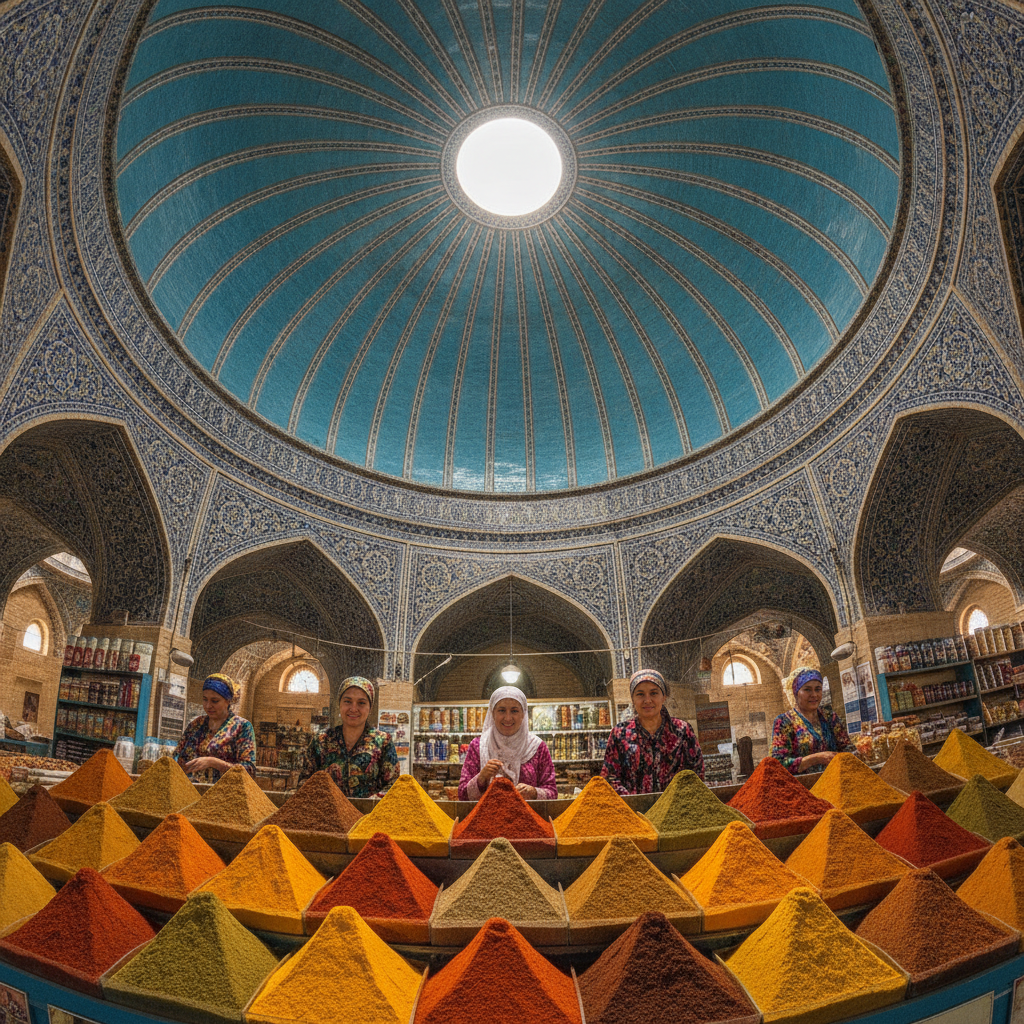
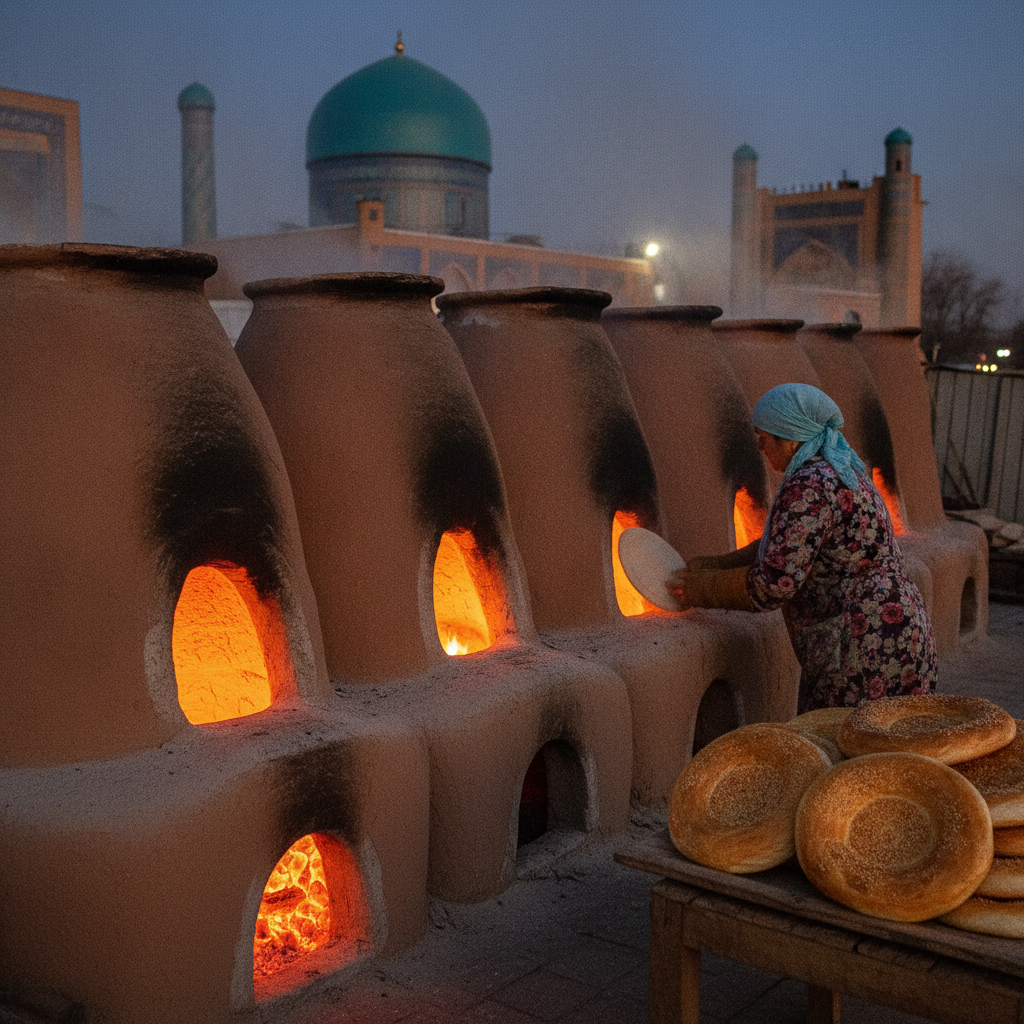
Chorsu Bazaar (Чорсу бозори—'Crossroads Market'): the oldest continuously operating market in Central Asia and the sensory center of Tashkent—the blue-domed covered market building at the heart of the Old City that has served as the primary trading hub of the region for 2,000 years. The architecture (the Chorsu Bazaar is housed under a series of reinforced concrete blue-tiled domes (built in the Soviet era, 1980s) that contain the permanent market stalls—the domes reference the Timurid architectural tradition of Samarkand and Bukhara while using Soviet construction techniques): the market organization (the Chorsu divides by product category: the spice section (the most visually spectacular—conical mounds of cumin (zira—the primary Uzbek spice, used in plov), coriander, turmeric, dried chili, and the distinctive Uzbek dried fruit (apricots, figs, raisins, mulberries)—the dried fruit of Uzbekistan is the finest in Central Asia due to the high-sun, low-humidity summer drying conditions): the meat section (the freshly butchered lamb hanging from hooks in the covered sections—the smell of fresh meat, sawdust, and cumin that is the olfactory signature of the Chorsu)). The lepeshka (the Uzbek bread (non—нон): the large round flatbread baked in a clay tandoor oven, stamped with a decorative pattern before baking—the freshest lepeshka in Tashkent is baked 100m from the Chorsu in the cluster of tandoor bakeries on the market perimeter—the smell of fresh tandoor bread is the primary olfactory memory of Tashkent for most visitors).
- 2
The Khast Imam Complex – The Islamic Heart of Tashkent
The Khast Imam Complex (Хаст Имом мажмуаси—'The Holy Imam Precinct'): the religious center of Tashkent and the home of the Mufti of Uzbekistan—the most important Islamic complex in the country. The Hazrati Imam Mosque (Хазрати Имом масжиди—the primary Friday mosque of Tashkent): the history (the original mosque on this site was established in honor of Abu Bakr Muhammad Kaffal Shashi (904–976 CE)—the renowned Islamic scholar and the first Imam of Tashkent, buried on the site in 976 CE): the Muyi Muborak Library (Муйи Мубарак кутубхонаси—the library within the Khast Imam complex): the Othman Quran (the Samarkand Quran (Самарканд Қуръони)—the oldest Quran in the world, believed to date to the reign of Caliph Uthman (644–656 CE)—the Quran is reportedly stained with Uthman's blood from his assassination in 656 CE while he was reading it): the provenance (the Quran was taken from Samarkand to St. Petersburg by the Russian Tsarist government in 1869, returned to Tashkent in 1924 by Lenin as a political gesture to the Muslim population of the new Soviet Union—the most politically charged religious object in Central Asia). The Barak Khan Madrasah (the 16th-century theological school within the complex—the restored Timurid-era facade with the characteristic muqarnas (honeycomb) portal decoration).
- 3
The 1966 Earthquake – Tashkent Rebuilt
The 1966 Tashkent earthquake (the earthquake of April 26, 1966 (7:23 AM local time, magnitude 7.5): the event that destroyed 80% of the historic city center of Tashkent and triggered the most complete Soviet urban reconstruction project in Central Asia. The earthquake (the epicenter was directly beneath the Old City of Tashkent—the earthquake destroyed approximately 100,000 homes, leaving 300,000 people homeless: the death toll was remarkably low (approximately 10 deaths) because the quake struck at dawn when most residents were still in bed on lower floors rather than in the upper stories of the mud-brick buildings that collapsed). The Soviet reconstruction (the Soviet government mounted the most ambitious reconstruction in Central Asian history: workers and construction brigades from all 15 Soviet republics were dispatched to Tashkent in the weeks after the earthquake—the reconstruction created the modern Tashkent: the wide boulevards, the monumental public buildings, the metro system (built simultaneously with the reconstruction, opened 1977), and the residential microrayons (Soviet housing estate districts) that form the majority of the city today). The architectural loss (the earthquake destroyed the majority of the historic Old City—the clay and brick structures of the pre-Soviet mahalla (neighborhood) system were the most vulnerable building type in the quake: what survives of the Old City (the Chorsu Bazaar area and the Khast Imam Complex) is the most valuable remaining fabric of historic Tashkent).
- 4
Plov – Uzbekistan's National Dish & Tashkent's Best Tables
Plov (плов—Uzbek: palov—the rice dish cooked in a kazan (cast-iron cauldron) with lamb, carrots, onion, cumin, and cotton-seed oil): the national dish of Uzbekistan, the UNESCO Intangible Cultural Heritage (inscribed 2016), and the social institution around which the most important events of Uzbek life are organized. The Tashkent plov (the Tashkent variety of plov is distinct from the Samarkand and Fergana Valley varieties—the Tashkent plov uses lamb tail fat (dumbha yog) instead of or in addition to cotton-seed oil (giving a richer, fattier flavor): the Tashkent plov center (Plov Centre (Марказий плов—the Tashkent Plov Center, 50 Beruni Street): the most famous plov restaurant in Uzbekistan—the single large kazan cooks the daily batch of plov from 08:00; the plov sells out by approximately 12:00—the arrival protocol is to queue, pay (approximately UZS 25,000/USD 2.50 per portion), collect the tray, and find a seat at the communal tables: the plov is served with a raw onion salad, a green salad, and nan bread (lepeshka)). The plov ceremony (the traditional Uzbek plov is served at all life events: weddings (toy plov), funerals (aza plov), and the morning plov feast (Osh-Osh) prepared by the community elders at dawn for neighborhood gatherings).
- 5
The Tashkent Metro – The Most Beautiful Subway in the World
The Tashkent Metro (Тошкент метрополитени): the underground railway opened in 1977 (the first metro in Central Asia)—the subway system that is routinely cited as one of the most beautiful in the world for its Soviet-era station decoration. The station design (each of the 32 stations on the 3 lines was designed by a different Uzbek architect and decorated with a distinct artistic theme—the most celebrated stations: Kosmonavtlar Station (Космонавтлар—'Cosmonauts'): the station with the mosaic ceiling depicting the Soviet space program (Sputnik, Vostok, cosmonauts in spacesuits)—the most photogenic station; Alisher Navoi Station (Алишер Навоий—the station dedicated to the 15th-century Uzbek poet, with the intricate muqarnas (honeycomb stalactite) ceiling in deep blue ceramic—the most technically accomplished single architectural element in the Tashkent Metro; Pakhtakor Station (Пахтакор—'Cotton Harvester'): the station with the stained-glass panels depicting Uzbek cotton cultivation—the most politically explicit Soviet-era decoration in the system). The photography history (the Tashkent Metro prohibited photography until 2018—the ban was attributed to the government's concern about the metro's military fortification role (the metro stations were designed as civil defense shelters): photography of the decorated station interiors is now permitted and is the primary motivation for tourist visits to the system).
- 6
Tashkent Practical Guide – Central Asia's Largest City
The Tashkent practical guide. Access: Islam Karimov International Airport (TAS—the primary international hub for Uzbekistan and the busiest airport in Central Asia): direct flights: Istanbul 4h30m (Turkish Airlines, 4× daily), Dubai 3h30m, Moscow 4h, Frankfurt 6h30m, Seoul 8h, Beijing 5h30m: the Uzbekistan Airlines (O'zbekiston Havo Yo'llari) network operates the most Central Asian domestic routes from Tashkent (to Samarkand 50 minutes; to Bukhara 1h15m; to Urgench/Khiva 1h30m). The Tashkent-Samarkand high-speed rail (Afrosiyob express—the 344 km journey in 2h10m by the Talgo high-speed train: the most traveled train route in Central Asia—the train runs 4× daily and must be booked 1 day in advance for the most desirable departures). Currency (Uzbek Som (UZS)—USD 1 ≈ UZS 12,800 (2024)—the currency was non-convertible until 2017 (the black market exchange was the primary currency exchange mechanism for 25 years): the 2017 liberalization (the Som became fully convertible in 2017—ATMs and bank exchanges now offer the official rate): the cash economy (Tashkent remains primarily a cash economy—Visa and Mastercard are accepted at major hotels and some restaurants but not at bazaars, smaller restaurants, or taxis). Visa (electronic visa available for citizens of 90+ countries at e-visa.gov.uz—USD 20, processed in 3–5 business days).
Walk this route with audio
Stories play automatically as you reach each stop — no tapping needed.
More in Tashkent
The Unauthorized Military Conquest Ratified Because the Tsar Couldn't Undo It, the Cotton Boycott by 250 International Brands & the IT Park Targeting USD 5 Billion in Exports From a USD 300 Million Base
The Battle of Ankara Where Timur Captured the Ottoman Sultan, the Solar Furnace That Reaches 3,000°C Using Only Mirrors & the Hashar Community Labor Tradition Where Neighbors Build Your House Together
The 2,500-Year Jewish Community Now Mostly in Queens New York, the Fedchenko Glacier Retreating 1.3 km Since 1990 & the Authentication Trick of Turning the Suzani Over to Check the Back
The Cotton Monoculture That Emptied the World's 4th Largest Lake, the Rusting Ship Fleet Stranded 100 km From the Sea & the Suzani Embroidered Collectively by Every Woman in the Bride's Family