The 172,000 Koreans Deported to Central Asia in 3 Weeks Who Taught Fergana Valley Farmers How to Grow Vegetables, the Poet Who Proved Chaghatai Turkic Was Equal to Persian & the Globe Building on Independence Square
Stalin's 1937 3-week deportation of 172,000 Koreans to Central Asia due to suspected Japanese spy risk; the Koryo-Saram market gardening techniques improving Fergana Valley vegetable production as the most economically consequential cultural contribution; Navoi's Khamsa proving Chaghatai literary equality with Persian; the Chach mint coins as the primary evidence of Tashkent's 4th-8th century Silk Road commercial importance; the 2016 Karimov death triggering the most significant Central Asian cultural liberalization; and the Som convertibility restored in 2017 ending 25 years of mandatory black market exchange.
- 1
The Old City Mahalla – Traditional Uzbek Neighborhoods
The mahalla (маҳалла—the traditional Uzbek neighborhood unit): the community organizational structure that has persisted from the Timurid period through the Soviet era to the present—the most distinctive social institution of Central Asian urban life. The mahalla system (the mahalla is a defined residential neighborhood (typically 50–200 households) with its own collective governance (the mahalla committee), its own mosque, and the social obligations of collective mutual support (hashar—the tradition of community labor for neighborhood projects)): the Old City mahallas (the area around the Chorsu Bazaar and the Khast Imam Complex retains the most intact mahalla structure in Tashkent—the narrow lanes between walled compound houses (hovli—the traditional Uzbek courtyard home), the neighborhood teahouses (choyxona—the most important social institution of the Uzbek mahalla), and the neighborhood mosques). The choyxona (the Uzbek teahouse): the function (the choyxona is the primary social space for Uzbek men—a space for conversation, card games, and the ritual drinking of green tea (kok choy) served in small porcelain bowls (piyola) at low tables with cushioned benches (tapchan)—the architectural form of the choyxona always includes a shaded outdoor terrace above or beside water (a pool, channel, or fountain) for the hot summer months). The Beshyog'och Choyxona (the oldest surviving teahouse in Tashkent, near the Chorsu—the most authentic traditional choyxona experience in the capital).
- 2
Soviet Tashkent – Monumental Architecture & Broad Boulevards
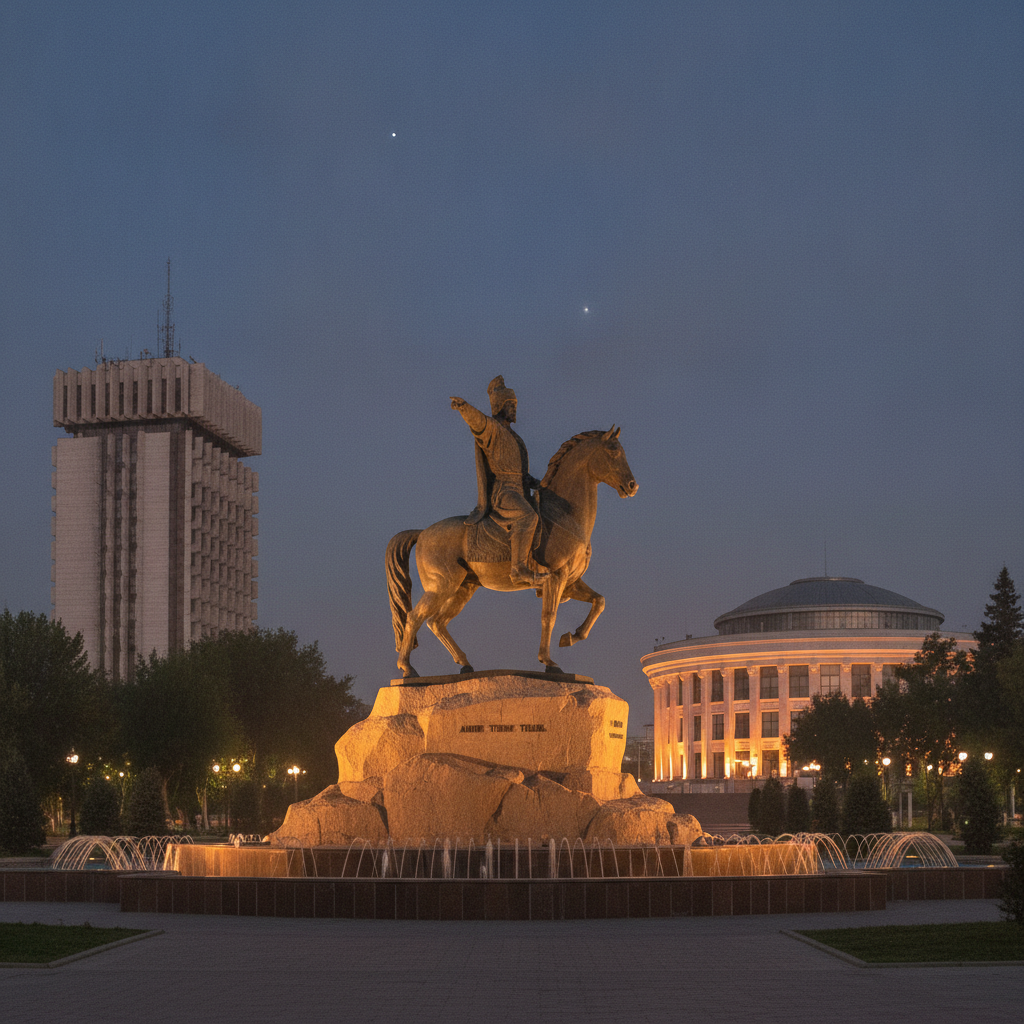
Soviet Tashkent (the city that the Soviet reconstruction of 1966–1980 created): the monumental urban landscape of the largest Central Asian capital. The urban plan (the Soviet-era Tashkent was designed as a showcase capital for the Soviet presence in Central Asia—the wide ceremonial boulevards (the Amir Timur Avenue (Амир Темур кўчаси)—the primary north-south axis of the city, lined with Soviet-era ministry buildings, the Amir Timur Monument (the equestrian statue replacing the previous Lenin statue in 1994), and the Palace of Friendship (Дустлик саройи)): the Independence Square (Мустақиллик майдони—the largest public square in Central Asia, redesigned from Soviet Lenin Square after independence in 1991): the Globe building (the distinctive spherical building on Independence Square—the most photographed building in Tashkent after the independence redesign): the Soviet residential housing (the Chilanzar district (Чиланзор—the primary Soviet microrayon (housing estate) development southwest of the city center)—the largest Soviet-era residential development in Uzbekistan with 15 residential districts of standardized 5 and 9-story apartment blocks built between 1958 and 1978).
- 3
Alisher Navoi & Uzbek Literary Heritage
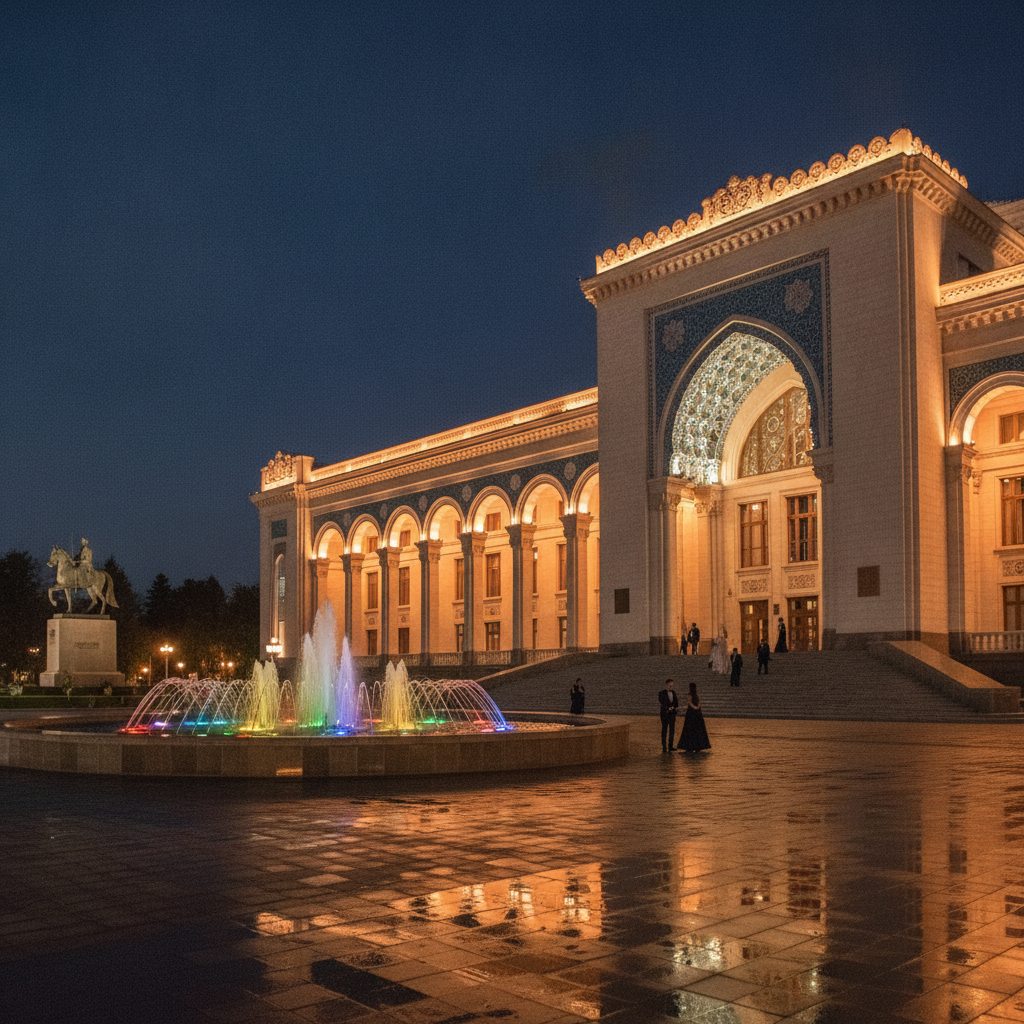
Alisher Navoi (Алишер Навоий, 1441–1501): the most important poet, philosopher, and statesman in Uzbek history—the man who established the Chaghatai Turkic language as a literary medium and who governed the Timurid court at Herat as the vizier of Sultan Husayn Bayqara. The life (Navoi was born in Herat (modern Afghanistan) and was a childhood friend of Sultan Husayn Bayqara—the friendship that later gave Navoi the political position to patronize a generation of artists, architects, and scholars from the Timurid Renaissance): the Khamsa (the Five Poems—the 5 long narrative poems (masnavi) that constitute Navoi's primary literary legacy: Hayrat ul-Abror (Wonder of the Righteous), Farhad va Shirin, Layli va Majnun, Sab'ai Sayyar (The Seven Planets), Saddi Iskandariy (The Rampart of Alexander)—the 5 poems written as a deliberate response to the Persian poet Nizami Ganjavi's Khamsa, demonstrating that the Chaghatai language was equal to Persian for literary expression): the legacy (every city in Uzbekistan has a street, park, library, or cultural institution named after Navoi—the Alisher Navoi Opera and Ballet Theatre (Алишер Навоий номидаги Ўзбек давлат академик опера ва балет театри) in Tashkent is the primary cultural institution of the Uzbek capital (built 1939–1947, the building's design blends Soviet neoclassicism with traditional Uzbek architectural ornament)).
- 4
Tashkent's Korean Community – The Koryo-Saram
The Koryo-Saram (고려사람—'Korean people'—the ethnic Korean community of Central Asia): the Korean diaspora of Uzbekistan whose presence is one of the most unusual historical legacies of Soviet internal deportation. The history (the Koryo-Saram are the descendants of approximately 172,000 ethnic Koreans who were deported from the Soviet Far East (Vladivostok and the Maritime Province) to Central Asia in 1937 by Stalin's NKVD—the deportation was ordered because Stalin suspected the Korean population might act as Japanese spies (Japan had controlled Korea since 1910)): the deportation (the deportation occurred in 3 weeks (September–October 1937): the entire Korean population of the Far East was loaded onto freight trains and transported approximately 6,000 km to Kazakhstan and Uzbekistan, arriving in October as winter began—the mortality rate in the first winter was approximately 10% from cold and disease): the community today (approximately 110,000 ethnic Koreans (Koryo-Saram) live in Uzbekistan (2020 census), primarily in Tashkent and the Fergana Valley—the community maintains Korean language, cuisine, and cultural practices while also fully participating in Uzbek society): the Koryo-Saram contribution (the Koryo-Saram introduced Korean market gardening techniques to the Fergana Valley, significantly improving the vegetable cultivation productivity—the most economically consequential cultural contribution of the deported community).
- 5
The Silk Road Through Tashkent – History & Trade
Tashkent on the Silk Road (the ancient city known as Chach (Чач) or Shash (Шаш) in pre-Islamic period and Binkath in the early Islamic period (7th–10th centuries CE)): the Silk Road history of one of the oldest continuously inhabited cities in Central Asia. The Chach (the pre-Islamic oasis city of Tashkent—the archaeological evidence shows continuous urban settlement from at least the 3rd century BCE—the Chach coinage (the Chach coins—the silver coins minted at the Shash mint from the 4th to 8th centuries CE) are the primary evidence of Chach's commercial importance as an intermediate stop on the Silk Road between Samarkand and Fergana): the Arab conquest (712 CE—the Arab general Qutayba ibn Muslim conquered the Sogdian oasis cities of Central Asia including Chach in 712 CE, bringing Islam to the region and replacing the Zoroastrian and Buddhist religious traditions): the Mongol destruction and recovery (Chinggis Khaan destroyed Tashkent in 1219 CE—the city recovered within a generation due to its position as the obligatory trading stop between the Fergana Valley and Samarkand): the Silk Road goods through Tashkent (the primary products traded through the Chach/Tashkent market: Chinese silk (eastbound (Chinese raw silk fabric); Central Asian lapis lazuli (westbound); Indian spices (pepper, cardamom—westbound through Tashkent to the Black Sea ports); Mongolian horses (southbound to the Indian subcontinent)).
- 6
Tashkent Nightlife & Contemporary Culture
Contemporary Tashkent (the cultural and social scene of the city that has been the most rapidly modernizing capital in Central Asia since 2016): the contemporary guide. The post-Karimov opening (the death of President Islam Karimov in 2016 and the succession of President Shavkat Mirziyoyev has produced the most significant political and cultural liberalization in Uzbekistan since independence): the changes (the tourist visa was simplified (e-visa introduced 2018); the Uzbek Som was made convertible (2017); international retail entered Tashkent (IKEA, international luxury brands, and international food chains have opened since 2019)): the restaurant scene (the Tashkent restaurant scene has transformed rapidly—the most notable: Caravan Restaurant (the most acclaimed contemporary Uzbek cuisine restaurant in Tashkent serving updated versions of plov, dimlama (slow-cooked lamb and vegetable stew), and the Fergana Valley noodle dishes); the Bozorboshi (the rooftop restaurant above the Chorsu Bazaar with the panoramic view of the Old City domes)). The art scene (the Tashkent Biennale (Ташкент биеннале)—the biennial contemporary art exhibition launched in 2019 (paused during COVID) as the first major contemporary art biennial in Central Asia—the most ambitious cultural event produced by the post-Karimov cultural opening): the music (the Tashkent jazz scene—the Soviet-era Tashkent jazz tradition (the Yunusabad jazz clubs)).
Walk this route with audio
Stories play automatically as you reach each stop — no tapping needed.
More in Tashkent
The Unauthorized Military Conquest Ratified Because the Tsar Couldn't Undo It, the Cotton Boycott by 250 International Brands & the IT Park Targeting USD 5 Billion in Exports From a USD 300 Million Base
The Battle of Ankara Where Timur Captured the Ottoman Sultan, the Solar Furnace That Reaches 3,000°C Using Only Mirrors & the Hashar Community Labor Tradition Where Neighbors Build Your House Together
The Quran Stained With the Caliph's Blood Returned by Lenin, the Earthquake That Killed 10 People While Destroying 100,000 Homes & the Metro Banned From Photography for 40 Years Due to Nuclear Shelter Function
The 2,500-Year Jewish Community Now Mostly in Queens New York, the Fedchenko Glacier Retreating 1.3 km Since 1990 & the Authentication Trick of Turning the Suzani Over to Check the Back