Shibuya & Harajuku: Youth Culture, Sacred Forests & the World's Busiest Crossing
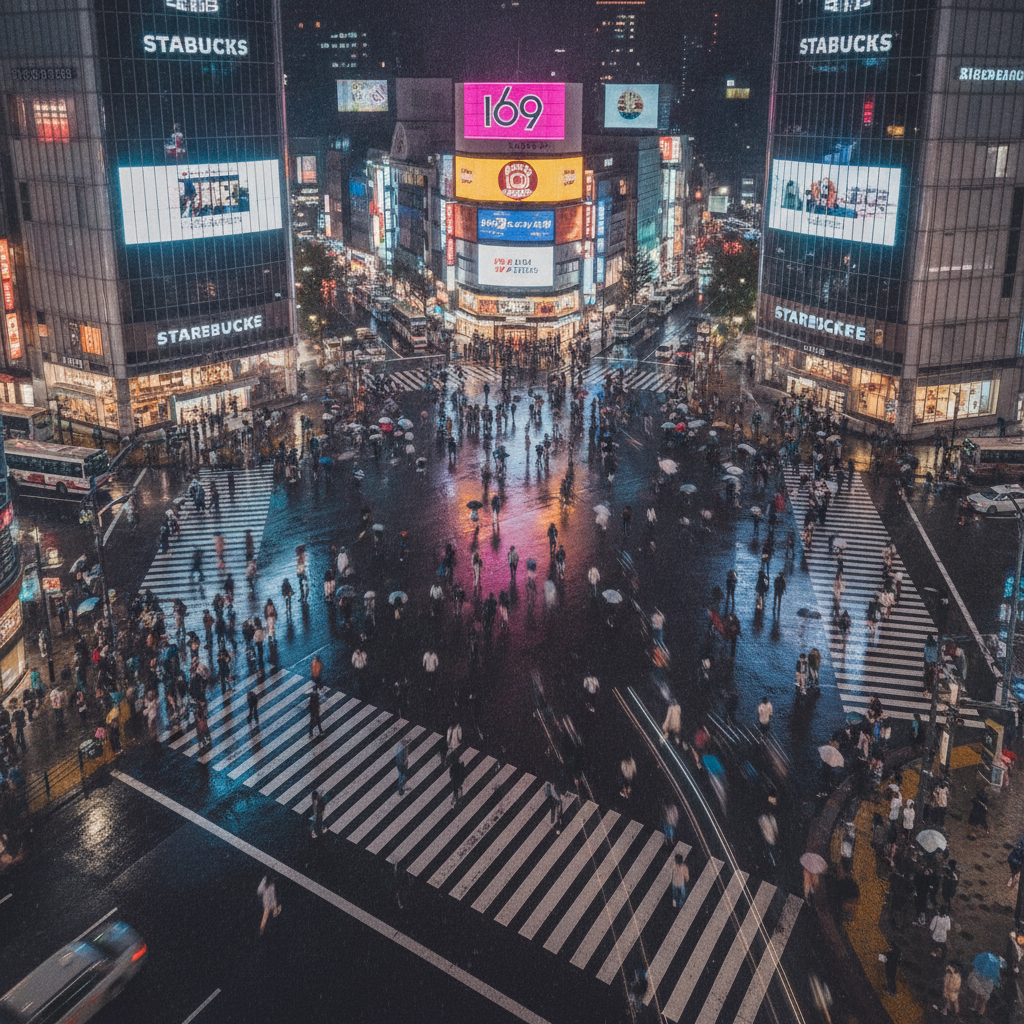
The Shibuya-Harajuku axis—the stretch of western Tokyo between Shibuya Station and Harajuku Station along the Yamanote Line—is the global capital of youth fashion, street culture and consumer spectacle. Shibuya Crossing (the 'scramble' intersection outside Shibuya Station) is the busiest pedestrian crossing in the world, with up to 3,000 people crossing simultaneously from all directions every two minutes. Five minutes north, behind the neon and fashion towers, lies Meiji Shrine—2.2 million trees planted in 1920 to create an artificial ancient forest in the middle of the city. This walk moves between the sacred and the secular, the ancient and the hypermodern.
- 1
Shibuya Scramble Crossing — The World's Busiest Intersection
Shibuya Scramble Crossing, outside the Hachiko exit of Shibuya Station, is the most photographed intersection in the world and the defining image of contemporary Tokyo: when the lights change, pedestrians cross from all corners simultaneously—up to 3,000 people per cycle at peak hours. The crossing is best viewed from above: the Starbucks on the second floor of the Q-Front building on the northwest corner, or the Mag's Park observation area on the 6th floor of the Shibuya Magnet by Shibuya109 building, both offer elevated views (the Starbucks is always packed; arrive early). The Hachiko statue, outside the Hachiko exit, commemorates the Akita dog who waited at Shibuya Station every day for nine years for his deceased owner (1923–1935) and is the most popular meeting point in Tokyo. The surrounding area—Shibuya 109 (the cylindrical fashion building), Center Street, Spain Slope, and the vast underground shopping complex of Shibuya Hikarie—is the commercial heart of Tokyo's youth fashion industry.
- 2
Shibuya Sky — Tokyo from Above
Shibuya Sky is an outdoor observation deck on the roof of Shibuya Scramble Square (the 47-story tower above Shibuya Station, opened 2019): at 229 meters, it provides a 360-degree view of Greater Tokyo—from Mount Fuji on a clear day to the bay and Odaiba in the south, Shinjuku's skyscraper forest to the north, and directly below, the Shibuya Scramble Crossing and Shibuya's tightly-packed urban fabric. The roof deck is fully open to the sky (no glass barrier, only a wire mesh safety fence) which makes it genuinely vertiginous. The 45th-floor indoor viewing area ('Sky Gallery') has large windows. Paid entry; book online in advance to avoid queues. Best at sunset or at night.
- 3
Meiji Shrine — The Sacred Forest in the City
Meiji Shrine (Meiji Jingū), dedicated to Emperor Meiji (1852–1912) and Empress Shoken, was completed in 1920 after a national effort to plant 100,000 trees from across Japan and the empire on 70 hectares of former farmland in Yoyogi. The trees have matured over 100 years into a dense, cathedral-like forest that is completely silent inside—an extraordinary experience given that it is surrounded by some of the busiest neighborhoods in Tokyo. The main approach (the gravel path from Harajuku Station) passes through a series of torii gates of increasing size, the largest (the Great Torii, 12 meters tall, made from a 1,500-year-old Taiwanese cypress) being visible from Harajuku Station. The inner precinct (Naien) contains the main shrine buildings, the Meiji Memorial Picture Gallery, and the Iris Garden (peak bloom in June). Free entry. On weekends, traditional Japanese weddings take place in the shrine precincts—a frequently photographed sight.
- 4
Takeshita Street — The Cradle of Japanese Street Fashion
Takeshita Street (Takeshita Dōri), a 350-meter pedestrian alley running from Harajuku Station into the Harajuku neighborhood, is the birthplace of Japanese street fashion: the narrow lane is packed wall-to-wall with the shops, stalls and cafés that have defined Tokyo's youth culture since the 1970s. The fashions on display range from Lolita (Victorian-inspired frilly dresses and petticoats), to decora (maximalist accessory layering), to vintage American (second-hand Levi's and Nike from the 1980s). On weekend afternoons the street is so crowded it is almost impossible to move. Permanent fixtures include Marion Crêpes (standing crêpes, the original Harajuku crêpe stand, here since 1976—the strawberry cream crêpe is a Tokyo institution), Daiso (Japan's largest ¥100 store, multiple floors of every imaginable item at fixed price), and La Foret (the upmarket fashion building at the Omotesando end of Harajuku, 8 floors of avant-garde Japanese fashion designers).
- 5
Omotesando Hills — Japanese Architecture Meets Luxury Retail
Omotesando, the tree-lined boulevard running from Harajuku to Aoyama, is often called 'Tokyo's Champs-Élysées': it is lined with the flagship stores of every major luxury fashion brand (Louis Vuitton by Jun Aoki, Prada by Herzog & de Meuron, Tod's by Toyo Ito, Dior by SANAA) along with a concentration of high-end Japanese restaurants and cafés. The centerpiece is Omotesando Hills (by Tadao Ando, 2006): a six-story spiraling retail complex built over the site of the Dojunkai Aoyama Apartments—a pioneering 1927 reinforced concrete apartment complex that Ando was required to preserve (the original façade is preserved inside the new structure). Ando's signature raw concrete interior is a masterwork; the building is worth visiting even if you have no intention of shopping. The side streets of Omotesando (the 'Ura-Harajuku' area of Cat Street, Gaienmae) have the best concentration of independent Japanese boutiques and vintage shops in Tokyo.
- 6
Yoyogi Park — Tokyo's Largest Green Space
Yoyogi Park, adjacent to Meiji Shrine and covering 54 hectares of the former site of the 1964 Tokyo Olympics (and before that, Washington Heights, the US military housing complex that occupied the site from 1945 to 1964), is Tokyo's largest and most democratic green space: on any given weekend afternoon it contains joggers, cyclists, picnickers, amateur musicians, frisbee players, dog walkers, and whatever outdoor event or festival happens to be taking place (there are nearly always one or two). The park is famous for its cherry blossoms in late March–early April (it is one of the top hanami—flower-viewing—spots in Tokyo) and its golden-leaved ginkgo trees in November. The Yoyogi National Gymnasium (by Kenzo Tange, built for the 1964 Olympics, with its distinctive suspended roof structure) is on the park's eastern edge.
Walk this route with audio
Stories play automatically as you reach each stop — no tapping needed.
More in tokyo
Asakusa & Tokyo Skytree: Ancient Temple, Nakamise Street & the World's Tallest Tower
Akihabara & Ueno: Electric Town, Japan's Greatest Museum Mile & Ameyoko Market
Shinjuku: Golden Gai, Kabukicho & the Garden at the Heart of the Neon City
Roppongi Arts District & Tokyo Tower: World-Class Museums, Contemporary Architecture & the City's Most Iconic Silhouette
Tsukiji, Hamarikyu & Ginza: Dawn Seafood, the World's Most Expensive Shopping Street & a Garden by the Bay