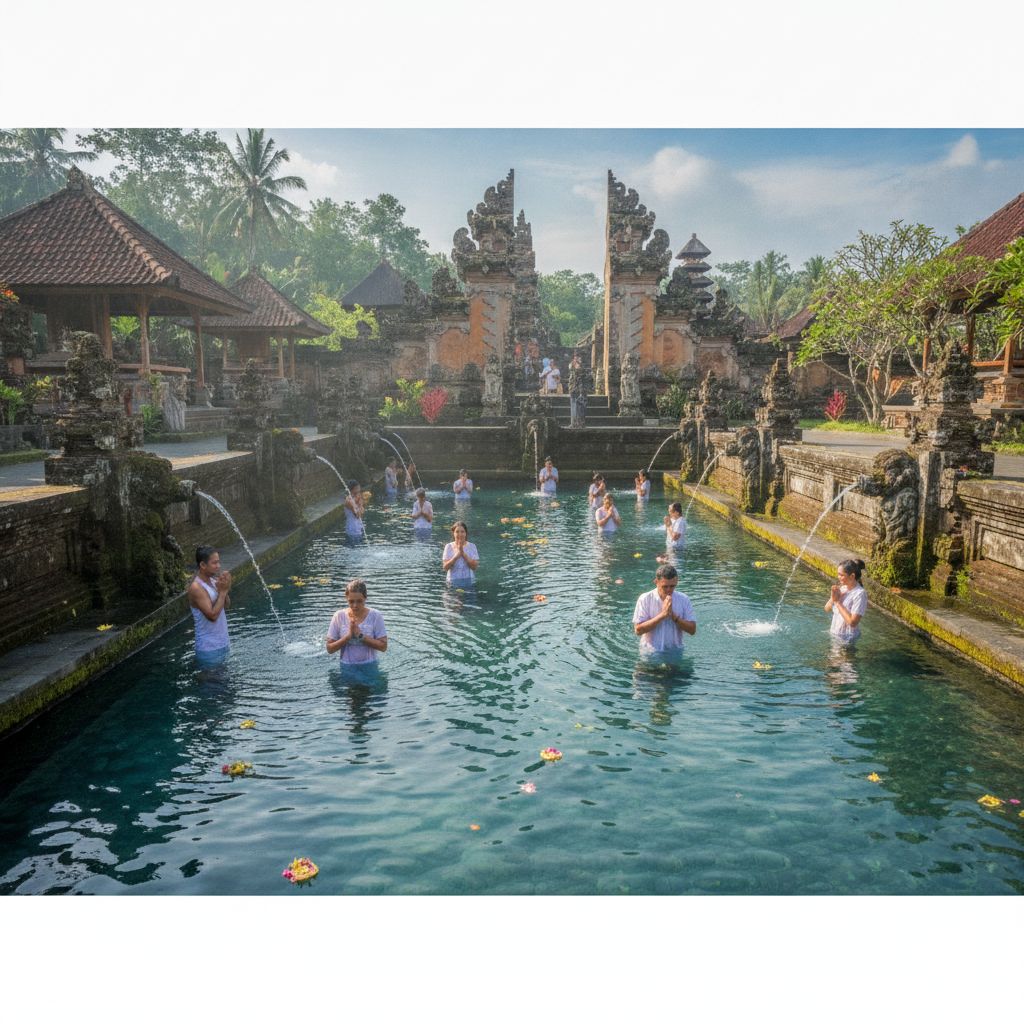
Ubud's Future: Tourism Carrying Capacity, Besakih's Mother Temple & the Eastern Indonesia Archipelago Beyond Bali
The 6.3 million visitor question—Bali's 1970 figure was under 25,000, the subak water system now competes with hotel spas, rice paddies convert to villa developments at the edge of Ubud each rainy season, and 'Bali needs a break' surfaces periodically in Indonesian policy discourse; Besakih's 23-temple complex on Mount Agung's slope (which erupted 2017–2019 forcing 100,000+ evacuations while Besakih remained in the exclusion zone); Nusa Penida's Kelingking T-Rex cliff in 10 million Instagram photographs reached on roads so rough that scooter casualties are the island's leading tourist statistic; Nyepi's island-wide Day of Silence with airport closed and tourists confined to hotels while Ogoh-Ogoh demon effigies burn the night before; the Bali Spirit Festival's 8,000-person gamelan-meets-kirtan event; and the Lombok-Flores-Sumba eastern chain where you get Rinjani's crater lake, Komodo's dragons, and Sumba's Pasola cavalry festival with 5% of Bali's tourist traffic.
- 1
Bali's Tourism Transformation – Mass Market vs. Cultural Preservation
Bali received approximately 6.3 million international visitors in 2019 (pre-COVID peak), with approximately 20% visiting the Ubud area—a visitor volume that creates both the economic foundation of the region and the most significant threat to the cultural and environmental qualities that attract visitors in the first place. The transformation since 1970: in 1970, Bali had fewer than 25,000 international visitors; the development of the Ngurah Rai Airport international terminal (1969) and the Indonesian government's promotion of Bali as a tourism product through the 1970s–1980s created the foundation; the Kuta-Legian beach resort corridor developed in the 1980s as the primary mass-market destination, while Ubud developed as the cultural and arts tourism alternative. The current tension: development pressure in the Ubud area (rice paddy conversion to villa resort developments, traffic congestion on the single two-lane road that forms the Ubud main street, water scarcity driven by the hotel and spa industry's demand against the subak agricultural water allocation) has reached a point where the Balinese regional government has attempted—with mixed success—to restrict further hotel development. The 'Bali needs a break' discourse: periodically surfacing in Indonesian and international media, arguing that Bali's carrying capacity has been exceeded and that a managed reduction in visitor numbers is necessary.
- 2
Besakih – The Mother Temple on Mount Agung
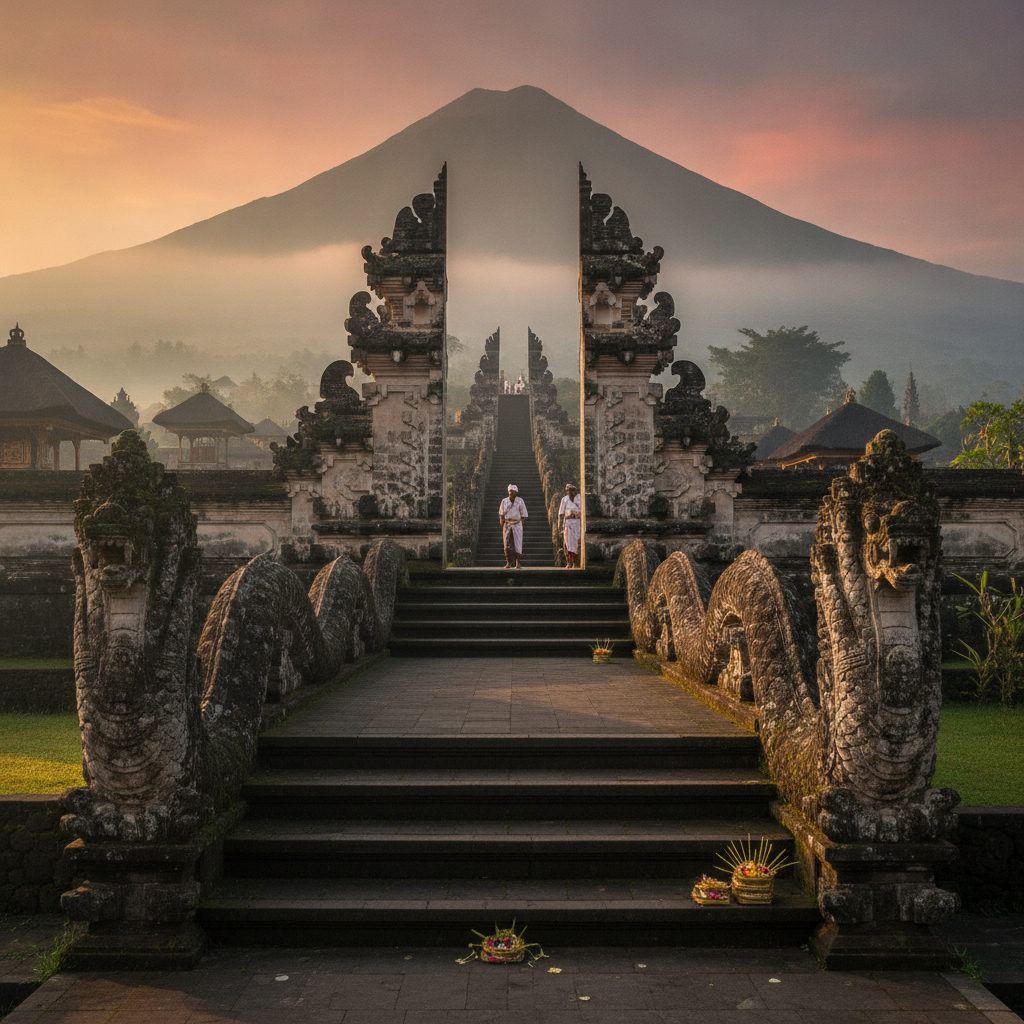
Pura Besakih (the 'Mother Temple'—or more precisely, the temple complex on the southwestern slope of Mount Agung, Bali's highest and most sacred volcano at 3,031 metres)—is the most important Hindu temple in Bali: a complex of 23 related temples on the Agung slope at approximately 1,000 metres altitude, the principal temple being Pura Penataran Agung Besakih. The scale: the Besakih complex covers approximately 3 hectares, with the main temple compound accessible via a steep ceremonial staircase flanked by split gates and naga (serpent) balustrades—a visual approach considered the finest in Bali. The spiritual significance: Besakih is the 'navel of Bali' in Balinese Hindu cosmology—the point where the mountain's sacred energy (gunung—mountains are the abode of gods in Balinese-Hindu cosmology) meets the ceremonial life of the island; major island-wide rituals (the Eka Dasa Rudra—a once-per-century purification ritual; the Panca Wali Krama—every 10 years) are held here. The Mount Agung eruption of 2017–2019: the volcano erupted intermittently over two years, forcing evacuation of 100,000+ people from the exclusion zone and disrupting Bali's tourism industry for months; Besakih itself was not damaged but remained within the evacuation zone for extended periods.
- 3
Nusa Penida & the Offshore Islands
Nusa Penida—an island 20 km southeast of Bali (accessible by fast boat from Sanur in 45 minutes—Rp 150,000–200,000 one way)—is the most dramatic day trip or overnight from Ubud, and has transformed from a destination known primarily to divers (the best manta ray encounter site in Asia, at Manta Point on the island's southwestern coast) into Bali's fastest-growing tourism area. The Instagram sites: Kelingking Beach (the 'T-Rex cliff'—a headland eroded into the shape of a reptile head, with a terrifyingly steep descent to a white sand beach below, visible in probably 10 million photographs); Angel's Billabong (a natural infinity pool at the island's west coast, where seawater pools in a rock basin at low tide with the open ocean visible beyond—extremely dangerous at high tide or with swell); Broken Beach (Pasih Uug—a natural arch where the ocean enters a circular bay through a stone passage). The practical reality: Nusa Penida's roads are unpaved, steep, and extremely rough; the rental scooters typically supplied for the island are underpowered for the gradients; tourist casualties from scooter accidents are among the highest of any Indonesian island; private jeep or local driver (Rp 500,000–600,000 for a full day covering all sites) is the safer choice. Nusa Lembongan (a smaller, calmer island adjacent to Penida): better infrastructure, the mangrove channel (Dream Beach, Mushroom Bay) as alternatives to Penida's extremes.
- 4
The Balinese Calendar, Nyepi & the Festival Year
The Balinese calendar system—one of the most complex in the world—operates simultaneously on two calendar cycles: the Gregorian solar calendar (used for administrative purposes), the Hindu lunar-solar calendar (Saka—which determines the dates of major religious festivals including Galungan, Kuningan, and Saraswati), and the unique Pawukon cycle (a 210-day year of 10 concurrent 'weeks' of different lengths from 1–10 days—the intersections of these weeks determining auspicious and inauspicious days for various activities). The result: the Balinese ceremonial calendar has no 'off-season'—major ceremonies occur year-round, with Galungan (the 10-day period celebrating the victory of dharma over adharma—marked by the installation of penjor, bamboo poles with offerings, along every street in Bali—one of the most visually extraordinary transformations of the Balinese landscape) occurring every 210 days. Nyepi (Balinese New Year's Day of Silence—usually falling in March, on the Saka new year): the most distinctive day in the Balinese calendar—a full 24-hour silence across the entire island; the airport closes, traffic stops, electricity is minimised, and all residents (including tourists, who must remain in their hotels) observe silence and self-reflection; the night before Nyepi, the Ogoh-Ogoh parade (enormous hand-carried demon effigies paraded through the streets and then burned) is Bali's most spectacular public spectacle.
- 5
Ubud's Music – Gamelan & the World Music Intersection
Balinese gamelan—the percussion orchestra that provides the soundtrack to virtually all Balinese ceremonial life, temple festivals, and traditional dance performances—is one of the world's great musical traditions, and Ubud is the most concentrated location for both traditional performance and for the international intersection of gamelan with world and experimental music. The Balinese gamelan: bronze metallophones, gongs, drums, and bamboo flutes played by a group of 10–30 musicians in an interlocking technique (kotekan—two musicians split a melody between them, each playing only the 'off-beats' of the other's part) that creates extraordinary rhythmic density. The Bali Spirit Festival: an annual music, yoga, and dance festival held in Ubud (typically in March/April)—the most internationally attended music festival in Indonesia, attracting 5,000–8,000 visitors from 30+ countries with performances mixing gamelan, kirtan, world music, and yoga sessions. The most significant connection: the influence of Balinese gamelan on Western composers—Claude Debussy encountered gamelan at the 1889 Paris Exposition and the textural influence is audible in his piano works; Steve Reich's 'Music for 18 Musicians' (1976) directly references the interlocking technique. The specific Ubud music scene: the Ubud gamelan groups that perform regularly at the palace (Sekaa Gong Peliatan, various temple groups) represent the living tradition.
- 6
Leaving Ubud – Onwards to Lombok, Flores & Eastern Indonesia
Ubud's position as Bali's cultural centre makes it the natural base from which to understand the island deeply before moving to other Indonesian destinations—but it also sits at the threshold of one of the world's most extraordinary island archipelagos: the eastern Indonesian islands that most Bali visitors never reach. From Bali Airport (DPS): Lombok (40 minutes by air—the island immediately east of Bali, with the Rinjani volcano trek, the Gili Islands for diving, and a majority Muslim population creating a completely different cultural atmosphere from Hindu Bali); Flores (1.5 hours—a Catholic-majority island in East Nusa Tenggara with the Komodo National Park and its Komodo dragons, Kelimutu's three-coloured crater lakes, and Ende's traditional ikat textile villages); Sumba (1.5 hours—the most remote of the main eastern islands, with megalithic tombs, elaborate traditional architecture, the Pasola cavalry battle festival in February, and the finest traditional textiles in Indonesia). The Lombok comparison: Lombok's Mount Rinjani (3,726 metres—a full 3-day trek to the crater rim and lake, with the caldera lake and the cone of the new volcano visible from the rim) is the most challenging and rewarding volcano trek in western Indonesia. The suggestion: if Ubud's density of visitors creates cultural fatigue, the eastern Indonesian islands offer the same spiritual depth, handcraft tradition, and natural beauty with 5% of the tourist traffic.
Walk this route with audio
Stories play automatically as you reach each stop — no tapping needed.
More in Ubud
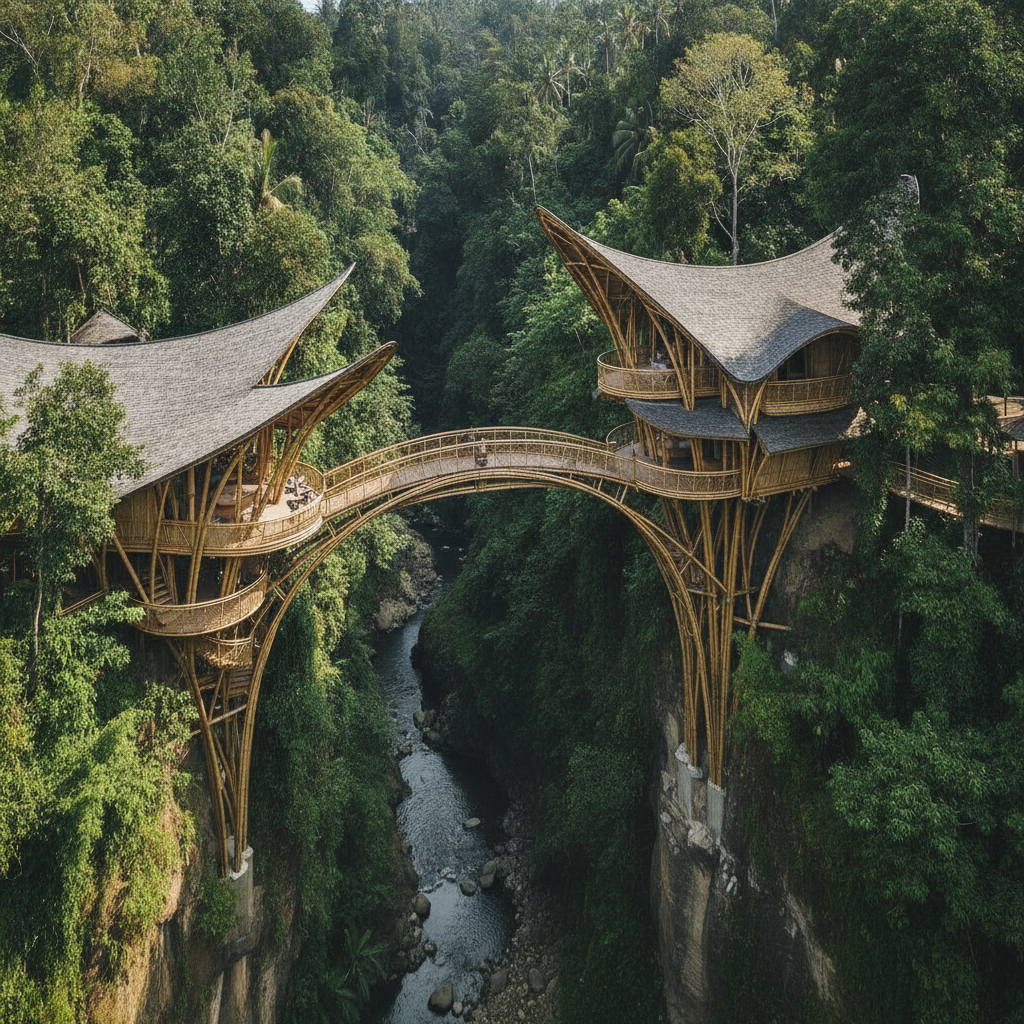
Ubud's Built Future: IBUKU Bamboo Architecture, Ayung Gorge Rafting & the Water Crisis Threatening the Subak System
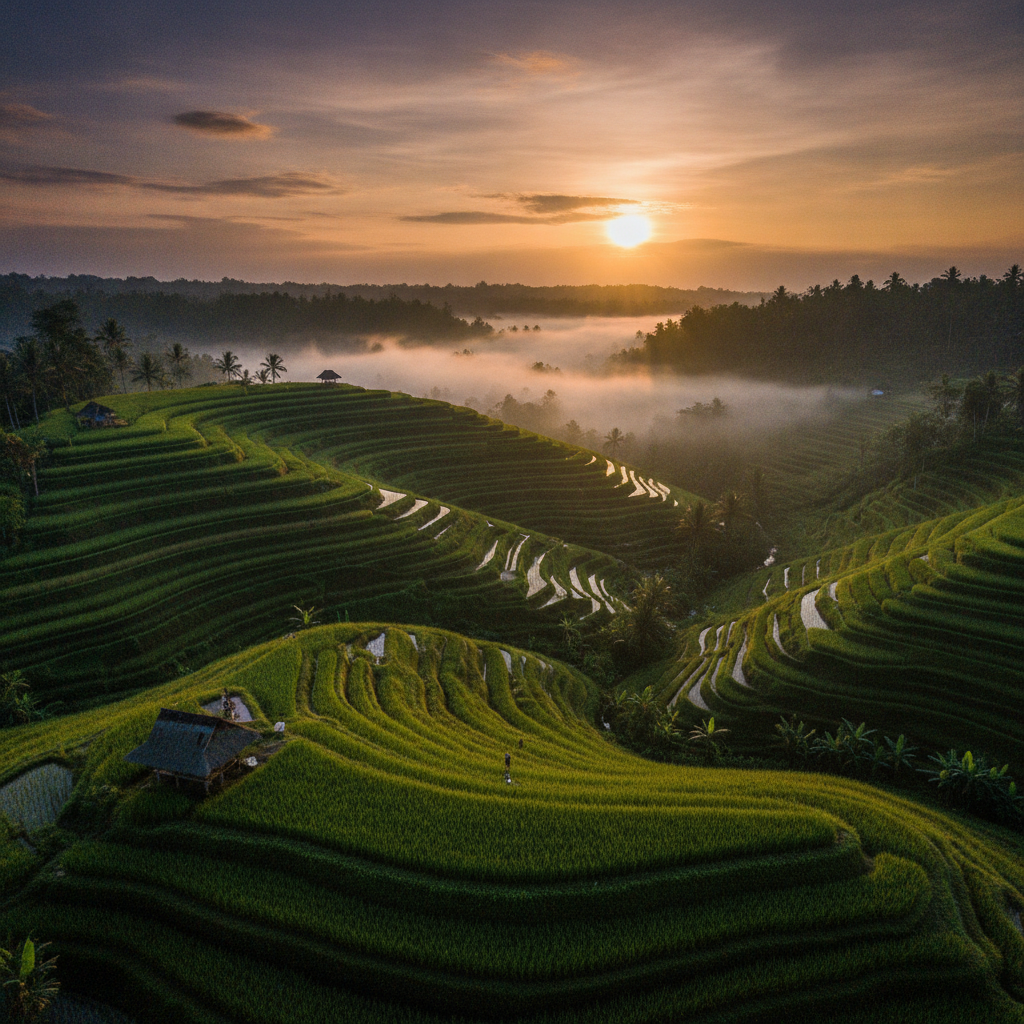
Ubud: Sacred Monkey Forest Temples, UNESCO Subak Rice Terraces & Walter Spies' 1930s Art Revolution
Ubud Off the Beaten Track: Tjokorda Dynasty's Art Patronage, Wayang Kulit's UNESCO Puppetry & Tenganan's Double-Ikat Aga Village
Ubud Beyond the Swing Photos: Batur Crater Sunrise Trek, Geringsing Double-Ikat & Green School's Bamboo Campus