Ubud's Built Future: IBUKU Bamboo Architecture, Ayung Gorge Rafting & the Water Crisis Threatening the Subak System
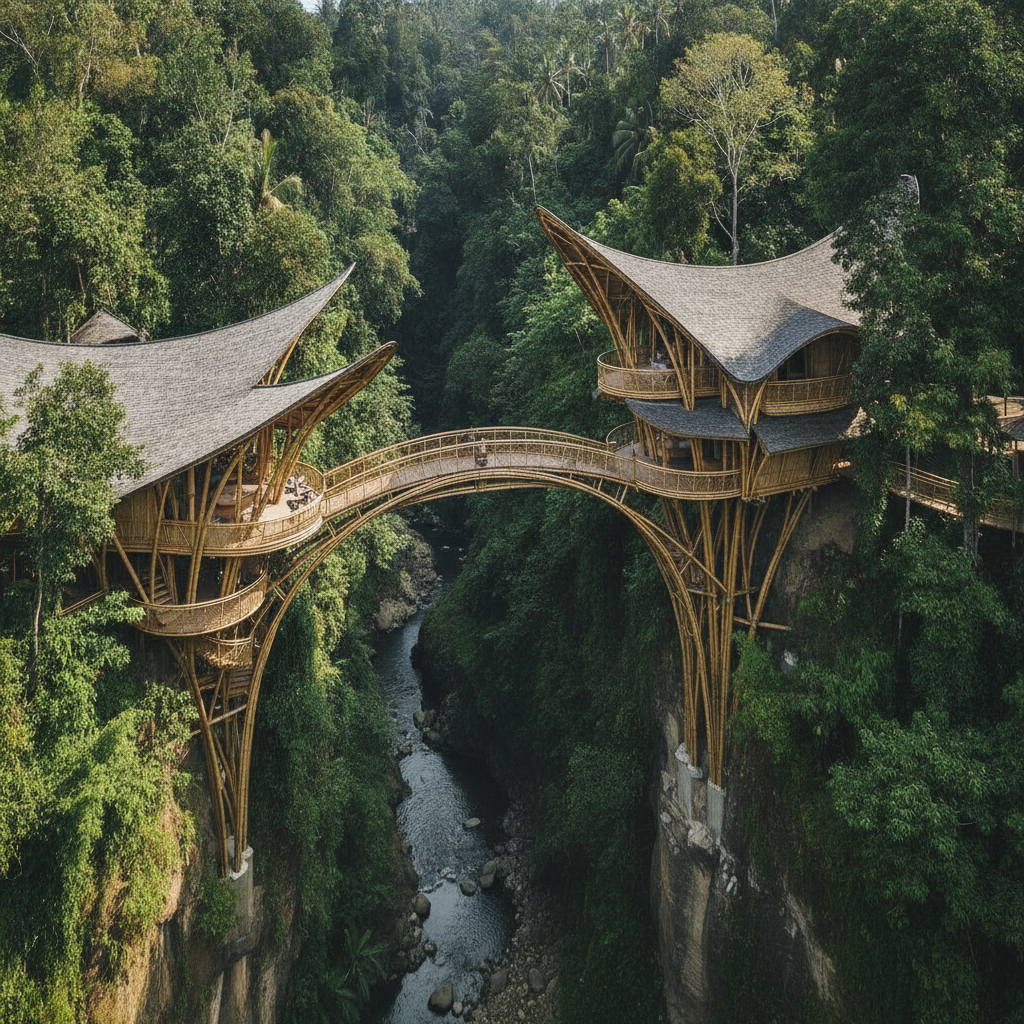
The most internationally recognised Indonesian architecture firm working exclusively in bamboo—IBUKU's Elora Hardy designing the Green School's Heart of School spiral pavilion and the Sharma Springs treehouse cantilevered 30 metres above the Ayung gorge—a material renewable in 3–5 years sequestering carbon as it grows; the Ayung River's Class II–III rafting past Balinese stone carvings in the gorge walls where Colin McPhee composed in the 1930s studying gamelan in Sayan village above; the Ubud Food Festival positioning babi guling and bebek betutu in the same conversation as Noma and Osteria Francescana; 300 spa operations from Rp 60,000 street massage to €500 COMO Shambhala Ayurvedic programme; and the aquifer depletion, rice-paddy-to-villa conversion rates, and 20,000 daily vehicle movements on an 8-metre road that constitute Ubud's actual development crisis.
- 1
Ubud's Green Architecture – Bamboo, Sustainability & IBUKU
The architectural practice most associated with Ubud—and the most internationally recognised Indonesian contribution to sustainable architecture—is the work of Elora Hardy and IBUKU, a design firm working exclusively in bamboo in a studio in the Ubud hills (the firm's name, IBUKU, means 'my mother' in Indonesian—a reference to Hardy's mother Linda Garland, who pioneered bamboo architecture in Bali in the 1990s). The canonical IBUKU project: the Green School (founded by Elora Hardy's father John Hardy, a jewellery designer, and opened 2008)—a K–12 international school on 20 hectares of rice-paddy and riverside forest, with all structures built from Balinese petung bamboo (Dendrocalamus asper—the largest bamboo species in Indonesia): spiral staircases in bamboo columns, open-air pavilions with bamboo vaulting, bridges over the Ayung River, and the 'Heart of School' structure (a three-storey bamboo spiral with no straight walls—among the most complex bamboo structures ever built). The IBUKU design philosophy: bamboo as a structural material equal to steel and concrete, but renewable in 3–5 years (versus 50–100 years for timber), sequestering carbon as it grows, and adaptable to curvilinear forms impossible in conventional construction. The Sharma Springs villa: IBUKU's most-viewed design globally (several hundred million YouTube and Instagram views)—a six-storey bamboo treehouse villa on the Ayung River gorge wall, with a swimming pool cantilevered over the gorge.
- 2
The Ayung River – White Water Rafting & Jungle Gorge
The Ayung River—flowing south from the Batur watershed through the western side of the Ubud highlands before entering the Badung regency and reaching the sea near Denpasar—is the longest river in Bali (75 km) and the most significant for tourism: the Ayung gorge between Sayan and Kedewatan (2 km west of Ubud centre) provides Bali's best white-water rafting (Class II–III, 9–11 km run, approximately 2 hours—suitable for beginners, no kayaking experience required). The Ayung gorge environment: the river cuts through a steep gorge of volcanic soil with 20-metre walls, the banks lined with tropical rainforest (the water flow protects the gorge from development that has changed most of the Ubud landscape), with carved stone faces and relief sculptures cut into the gorge walls by Balinese artists (the Kampung Cahaya stone carvings—accessed by river or steep trail). The Sayan terrace: the ridge above the Ayung gorge at Sayan village (the setting for Colin McPhee's 'A House in Bali'—his 1944 memoir of living in Ubud in the 1930s as a composer studying gamelan) has the finest valley views in the Ubud area—the Four Seasons Resort Sayan occupies the commanding position (breakfast with the gorge view, pool over the valley, prices accordingly). The eco-rafting operations: several operators run sustainable rafting programmes that support gorge conservation.
- 3
Ubud's Literary Culture – Walter Spies, Colin McPhee & Miguel Covarrubias
Ubud's literary heritage—the body of writing about Bali produced by the international artists, anthropologists, and writers who lived in Ubud in the 1930s–1940s—is one of the most influential collections of 'exotic destination' writing in the 20th century, and shaped the international perception of Bali more profoundly than any subsequent work. The three foundational texts: Colin McPhee's 'A House in Bali' (1944)—the most intimate and musically sophisticated of the Bali memoirs, by a Canadian composer who learned gamelan and lived in Sayan with his wife, the anthropologist Jane Belo; Miguel Covarrubias's 'Island of Bali' (1937)—the most comprehensive early account, by a Mexican artist who came to Bali in 1930 and produced both an ethnographic study and a visual document (his illustrations remain the most vivid depictions of 1930s Balinese life); and the writings of Margaret Mead and Gregory Bateson (who conducted fieldwork in Bali in 1936–1938, producing the first systematic photographic and film documentation of Balinese child-rearing and trance practices). The continuing tradition: the 'Bali memoir' is a publishing genre that persists—Eat Pray Love (2006) is the most commercially successful, but Vicki Baum's 'Love and Death in Bali' (1937—a historical novel of the 1906 Puputan, when the Badung royal family walked into Dutch gunfire rather than surrender) remains the most historically significant fictional treatment.
- 4
The Ubud Food Festival & Balinese Culinary Heritage
The Ubud Food Festival (UFF)—established 2016, held annually in May (3 days, the week before the Singapore Food Festival and positioned as Indonesia's answer to it)—is the most internationally ambitious food festival in Indonesia: 80+ chefs from 15+ countries, demonstrations, dinners, and market events spread across venues in central Ubud (the main stage at Taman Kuliner, the Kampung Tinggi rice-paddy dining experience, and individual restaurant dinners). The UFF's achievement: elevating Indonesian cuisine (long underseen internationally relative to Thai, Vietnamese, and Japanese food) through a combination of celebrated Indonesian chefs (Petty Elliott, William Wongso, Sri Owen), international guest chefs (from Noma, Osteria Francescana, and similar establishments in previous years), and the food media presence that the Ubud location attracts. Balinese culinary heritage: Balinese food is distinct from the Indonesian mainstream (which is largely Javanese, Sundanese, and Minang/Padang)—babi guling (spit-roasted suckling pig, the ceremonial dish that is also Ubud's most famous street food—available daily at Ibu Oka on Jl. Suweta and several other specialists); bebek betutu (duck slow-cooked for up to 36 hours in a sealed package of spices—the most time-intensive Balinese preparation); lawar (a ceremonial dish of finely chopped meat, coconut, and spices—traditionally prepared for temple festivals).
- 5
Ubud's Spa & Bodywork Culture
The spa and bodywork industry in Ubud—the most developed of any small town in Asia—reflects both the wellness tourism demographic and the Balinese tradition of therapeutic massage: approximately 300 spas and massage establishments operate within the Ubud area, ranging from street-level Rp 60,000 (€3.50) one-hour massage operations to €300+ treatments at the Four Seasons or Komaneka resort spas. The Balinese massage tradition: a full-body massage technique using both deeper pressure (similar to Thai massage) and gentler effleurage strokes, with coconut or rice bran oil, typically including the scalp and face. The Javanese boreh: a traditional body scrub using a paste of rice, spices, and medicinal plants (originally developed in Java for cooling the body after agricultural work in cold highland fields)—widely offered in Ubud spas. The luxury spa leaders: the COMO Shambhala Estate (a purpose-built wellness retreat in the Ayung River valley, offering Ayurvedic programmes, nutritional medicine, and a range of bodywork at €200–500 per night accommodation with spa included); Komaneka Bisma (boutique hotel spa with infinity pool overlooking the Campuhan gorge—the most photogenic spa setting in Ubud). The ethical consideration: the Rp 60,000 street massage vs. the €300 resort treatment represents a 100x price differential for what may be comparable technical skill—the premium is for setting, not necessarily for quality of treatment.
- 6
Ubud's Future – Development, Water Scarcity & the Next Decade
Ubud faces a convergence of structural challenges that will determine whether it remains a functioning cultural and agricultural community alongside a tourism economy, or completes a transition to a tourism-only monoculture. The water crisis: the Ubud highlands receive 2,500–3,500mm of rain annually (one of the highest in Bali), but the aquifer system is under severe stress—hotel and villa development has converted impermeable surfaces, reducing recharge; groundwater pumping by the tourism industry has lowered the water table in many areas; the subak irrigation system's allocation to rice agriculture competes directly with the hospitality industry's demand. The rice paddy conversion: Bali's provincial government has attempted to legislate protection of rice agricultural land (Peraturan Daerah—regional regulation—restricts conversion of subak-registered agricultural land to non-agricultural use), but enforcement is inconsistent and the economic pressure on Balinese rice farmers to lease or sell to villa developers is intense. The traffic problem: Jl. Raya Ubud (the single main road) carries 20,000+ vehicle movements daily in peak season—a figure the road's 8-metre width cannot accommodate; the proposed Ubud bypass has been debated for 15 years without resolution. The positive trajectory: the Ubud Food Festival, the IBUKU bamboo architecture movement, and the Green School's 10th anniversary represent genuine innovation within Ubud's cultural economy—evidence that Ubud can produce cultural capital rather than simply consume it.
Walk this route with audio
Stories play automatically as you reach each stop — no tapping needed.
More in Ubud
Ubud's Future: Tourism Carrying Capacity, Besakih's Mother Temple & the Eastern Indonesia Archipelago Beyond Bali
Ubud: Sacred Monkey Forest Temples, UNESCO Subak Rice Terraces & Walter Spies' 1930s Art Revolution
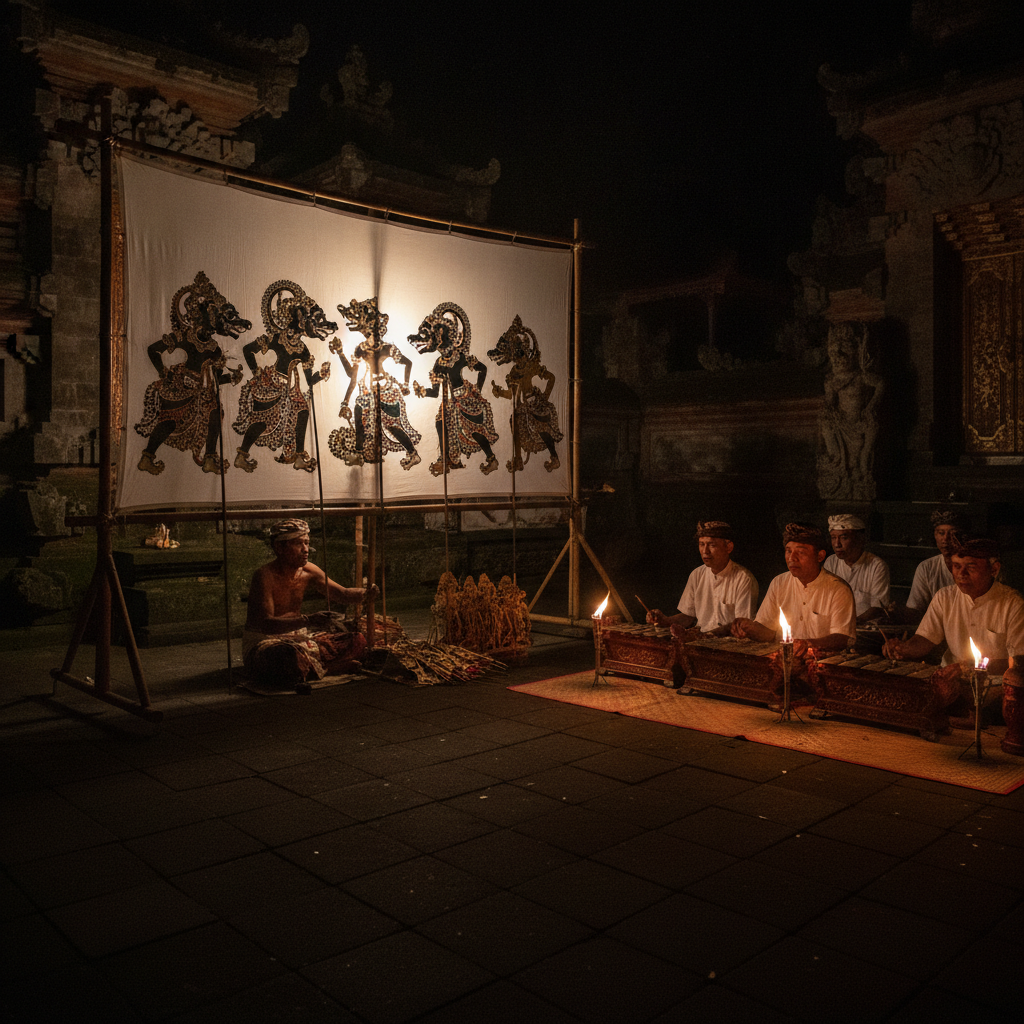
Ubud Off the Beaten Track: Tjokorda Dynasty's Art Patronage, Wayang Kulit's UNESCO Puppetry & Tenganan's Double-Ikat Aga Village
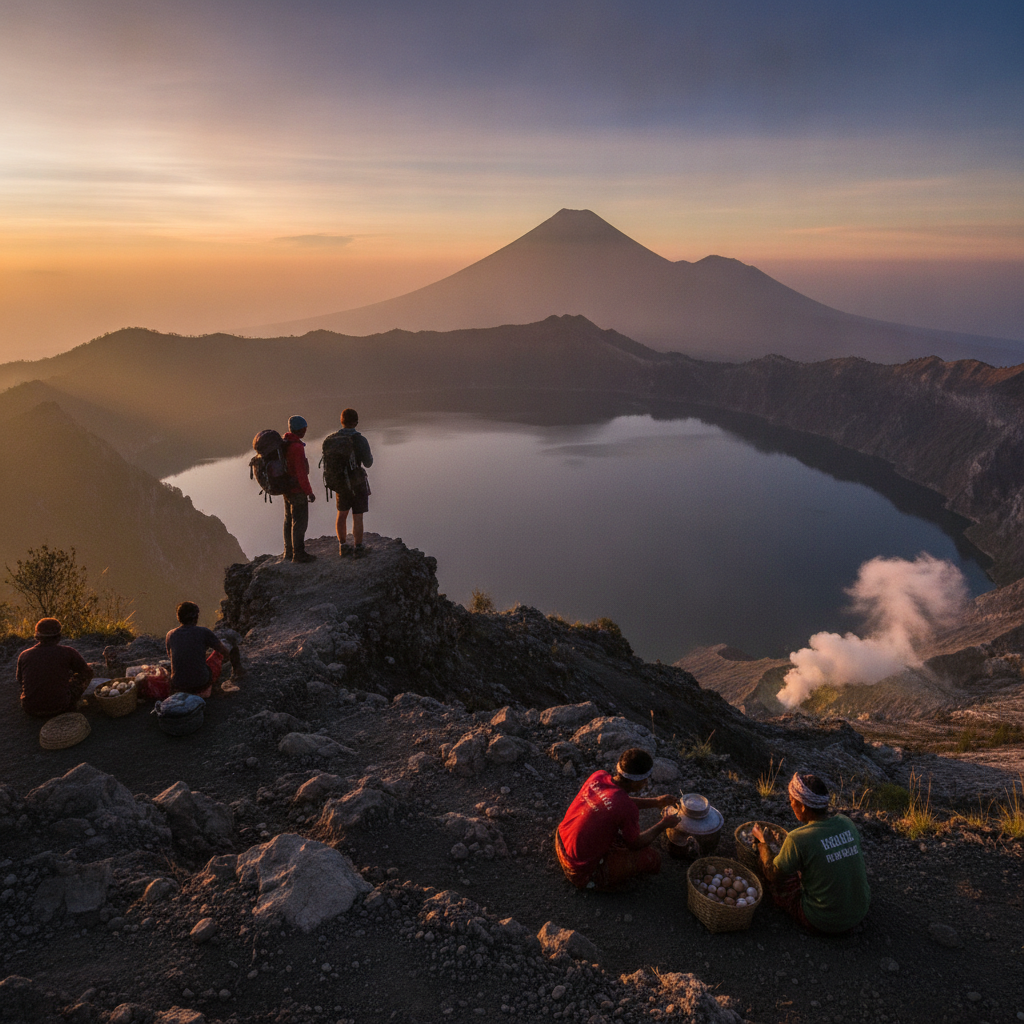
Ubud Beyond the Swing Photos: Batur Crater Sunrise Trek, Geringsing Double-Ikat & Green School's Bamboo Campus