Udaipur's Layers: Bhil Tribal Crafts, Haveli Hotels with Lake Views & the Sanskrit Inscription That Covers 25 Ghats
Go deeper into Udaipur—the Bhil tribe's warli-style paintings and silver jewellery from the Aravalli Hills they inhabited before the Rajputs arrived, haveli guesthouses giving lake views at ₹1,500 a night that palace hotels in other cities can't match, the Mewar Festival's boat procession of Gangaur and Issar across Lake Pichola, the Maharana's constitutional role as 'prime minister of Lord Shiva' at Eklingi Temple, and the seven-lake system engineered across six centuries where the 25-ghat Rajsamand Lake carries the longest Sanskrit inscription in India on its marble embankments.
- 1
Udaipur's Blue City Rival – The Real 'Most Romantic' Debate
Udaipur is marketed as 'the most romantic city in India' and 'the Venice of the East'—epithets applied to several Indian cities but most convincingly to Udaipur given Lake Pichola and the palace backdrop. The competing claims: Jaisalmer (the golden sandstone fort city in the Thar Desert, entirely intact and inhabited), Jodhpur (the Blue City—a hilltop fort above a sea of blue-painted houses), and Bundi (the least visited, arguably most authentic, blue-painted Rajput town). Each serves a different travel style; the serious Rajasthan traveller visits all four. Udaipur works for: first-time Rajasthan visitors, honeymooners, luxury travellers. Jaisalmer works for: desert trekkers, camel safari enthusiasts, those wanting the most 'movie-set' Rajasthan. Jodhpur works for: Mehrangarh Fort obsessives, the blue rooftop photograph, food travellers.
- 2
The Bhil Tribe – Udaipur's Indigenous Community
The Bhil—Rajasthan's largest tribal community (approximately 6 million in Rajasthan, 40% of the state's tribal population)—are the original inhabitants of the Aravalli Hills before Rajput settlement. Traditionally hunter-gatherers and forest dwellers, the Bhil were gradually pushed into marginal forest land; they are recognised as a Scheduled Tribe (ST) with reservation benefits in education and employment. The Bhil have distinctive crafts: painted warli-style art, tribal silver jewellery, and textile weaving with traditional geometric patterns. The area around Udaipur and the Dungarpur district has significant Bhil population; the Tribal Research Institute in Udaipur maintains the most comprehensive archive of Rajasthani tribal culture. The Shilpgram Crafts Village gives the Bhil and other tribal communities (Garasia, Rabari) a market for their crafts.
- 3
Udaipur's Haveli Hotels & Heritage Accommodation
Udaipur has the finest concentration of heritage hotel accommodation in India outside of Jaipur and Jodhpur: the City Palace complex alone contains three heritage hotels (Fateh Prakash Palace, Shiv Niwas Palace, and the highest-end Taj Lake Palace on the island). Beyond the palace hotels, the old city around Lal Ghat contains dozens of converted havelis and traditional mansions operating as boutique hotels and guesthouses: Jagat Niwas Palace Hotel (budget-friendly, lake views, rooftop restaurant), Kankarwa Haveli (City Palace-side, antique furniture), and Amet Haveli (northern lake view). Even at budget levels (₹1,500–3,000/€16–33/night), these properties provide lake or palace views that 5-star hotels in other cities cannot match. Booking in advance (especially October–March peak season) is essential.
- 4
Udaipur's Festivals – Mewar Festival & Shilpgram Fair
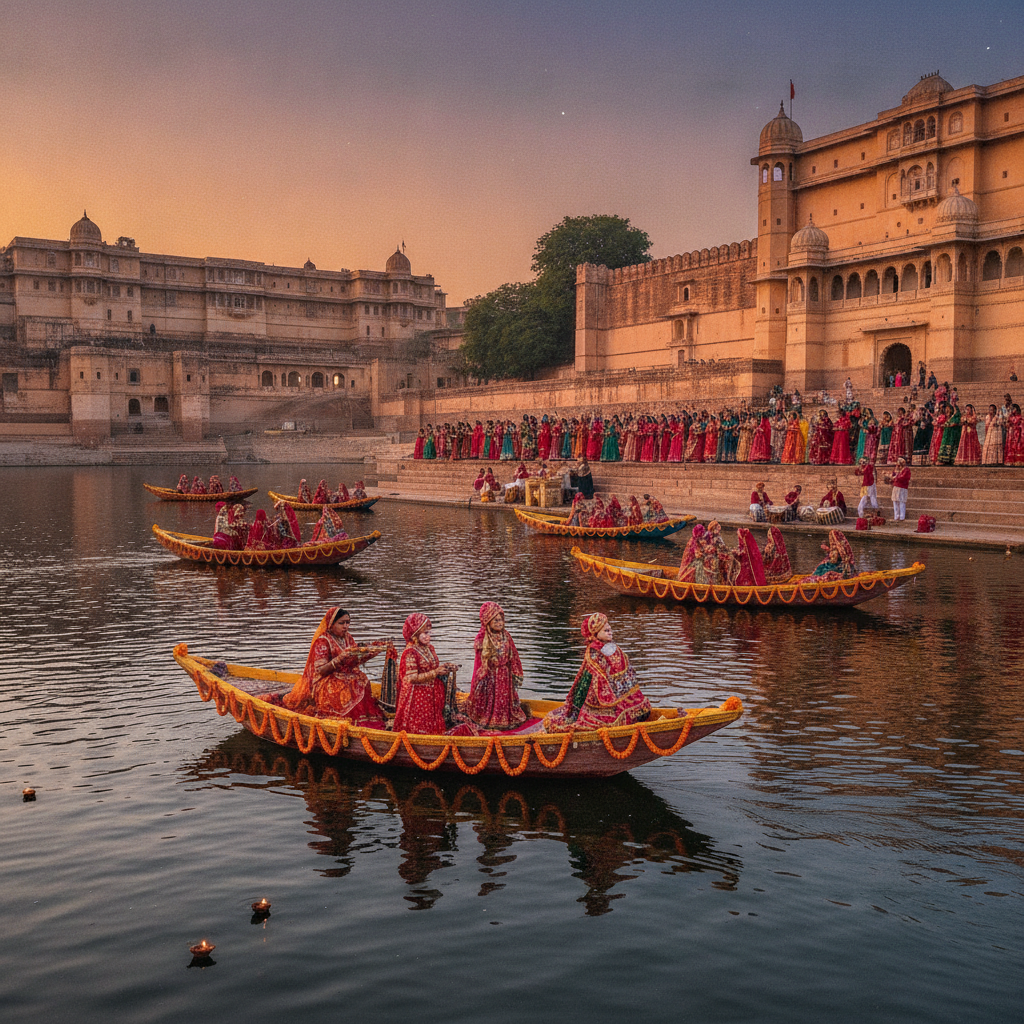
Udaipur's festival calendar is among the richest in Rajasthan. The Mewar Festival (March–April, 2–3 days)—celebrating Gangaur, the goddess of marital happiness—involves a procession of women in traditional dress carrying clay idols of Gangaur and Issar (Parvati and Shiva) from the palace to the lake on decorated boats; the procession is accompanied by Rajasthani folk music and dance. The Shilpgram Fair (December, 10 days)—at the Shilpgram Crafts Village, 3 km west of Udaipur—is the most important tribal arts fair in Rajasthan: 400+ artisans from the five desert states (Rajasthan, Gujarat, Goa, Maharashtra, Madhya Pradesh), performances of tribal dance (Ghoomar, Chari, Bhavai), puppet shows, and craft demonstrations. The Jal Jhulni Ekadashi festival (monsoon, September) involves the procession of deities on Lake Pichola by decorated boats.
- 5
Udaipur & Nearby Temples – Eklingi & Nathdwara
Eklingi Temple—22 km north of Udaipur, the most important temple in Mewar—is dedicated to Shiva (Eklingi—'the one-phallus lord'). The Maharana of Mewar holds the title 'Diwan of Eklingi'—meaning he is the prime minister of Lord Shiva, who is the real ruler of Mewar. The current temple was built in the 15th century; the black marble Shiva idol is decorated with silver and draped in cloth. The temple complex has 108 temples; the main shrine has four faces (Chaturbhuj) and is the most actively worshipped Hindu temple in Udaipur district. Nathdwara (48 km north)—the temple city of Shrinathji, a form of Krishna—is one of the most visited Vaishnava pilgrimage sites in India: 20,000+ pilgrims daily. The Srinathji idol (holding up a mountain) was brought from Mathura in 1672 to protect it from Aurangzeb's iconoclasm.
- 6
Udaipur's Water Conservation Legacy – The Johad Tradition
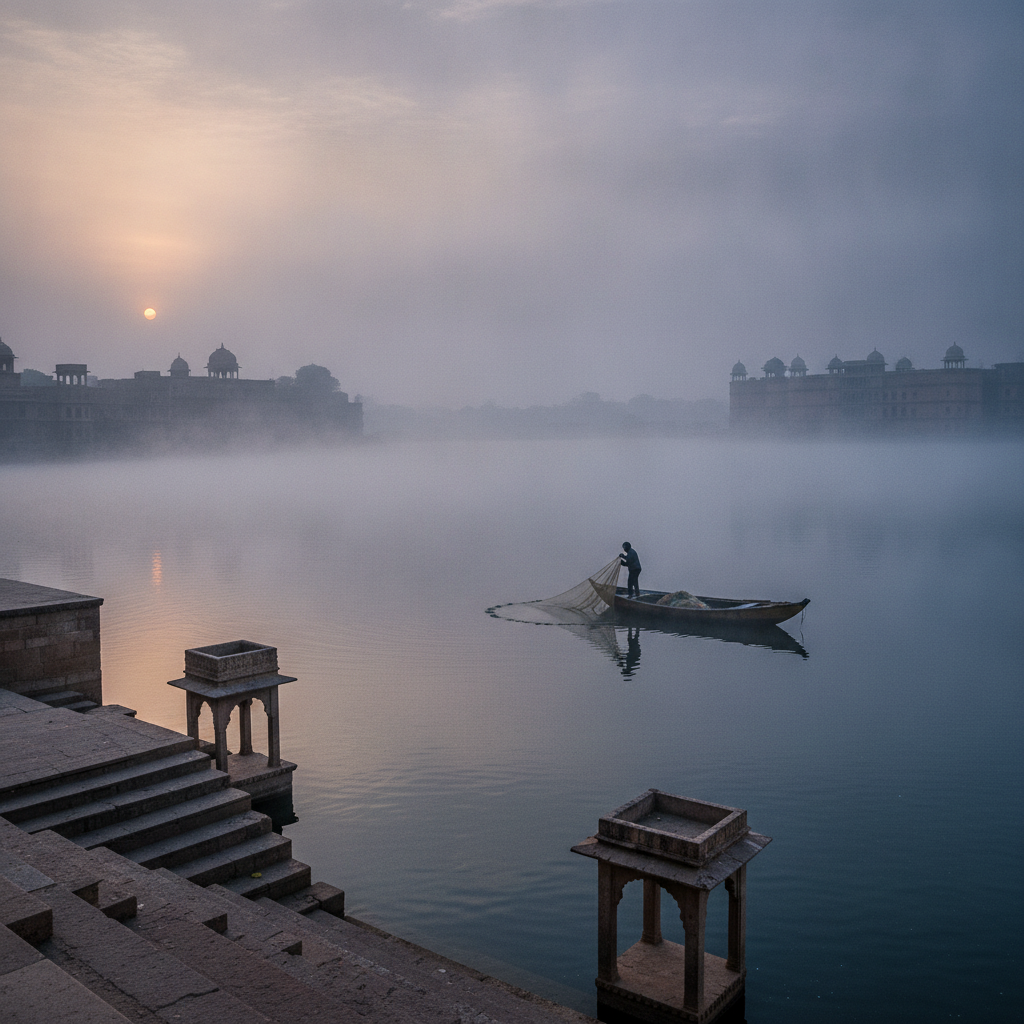
The Aravalli Hills around Udaipur receive only 600–700 mm of annual rainfall; the seven-lake system of Udaipur (built across six centuries by Mewar rulers) represents one of the most sophisticated traditional urban water management systems in pre-modern India. Each lake was carefully engineered: overflow from one lake feeds the next in sequence; the lakes collectively provided drinking water, agricultural irrigation, and a microclimate that made Udaipur significantly cooler than the surrounding desert. The Rajsamand Lake (65 km north, 1662, built by Maharana Raj Singh after a devastating famine) is the largest of the region's artificial lakes: 7 km wide, 6.5 km long, with 25 ghats built along its southern bank. The inscriptions on the ghats—historical chronicles of Mewar carved in Sanskrit on marble slabs—constitute the longest Sanskrit inscription in India.
Walk this route with audio
Stories play automatically as you reach each stop — no tapping needed.
More in Udaipur
Udaipur Essentials: Lake Pichola at Sunset, James Bond's Floating Palace Hotel & 400 Years of Mewar Architecture
Udaipur's Mewar Legacy: Maharana Pratap's Battle of Haldighati, Ranakpur's 1,444 Pillar Temple & the 36km Fort Wall
Udaipur Deeper: Chittorgarh's Three Mass Self-Immolations, India's Most Spectacular Destination Wedding City & Kathputli Puppets