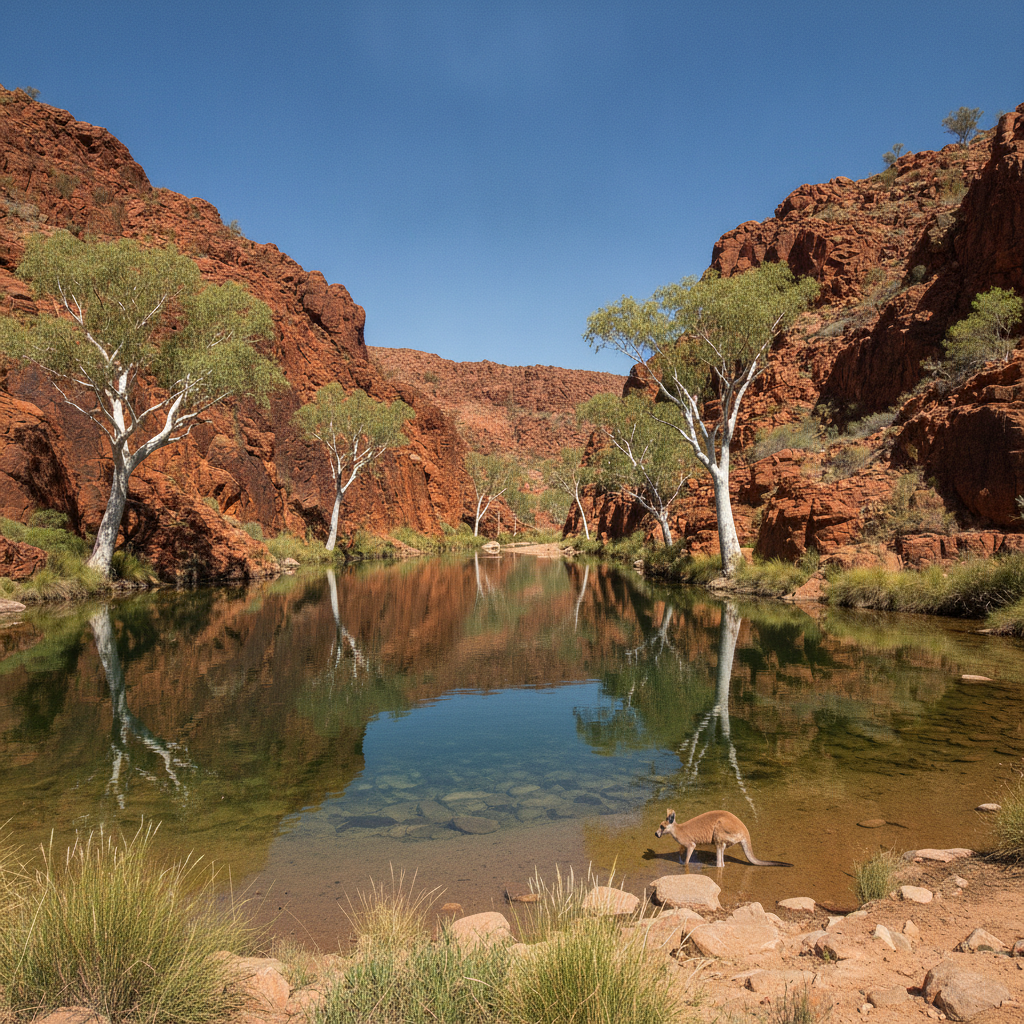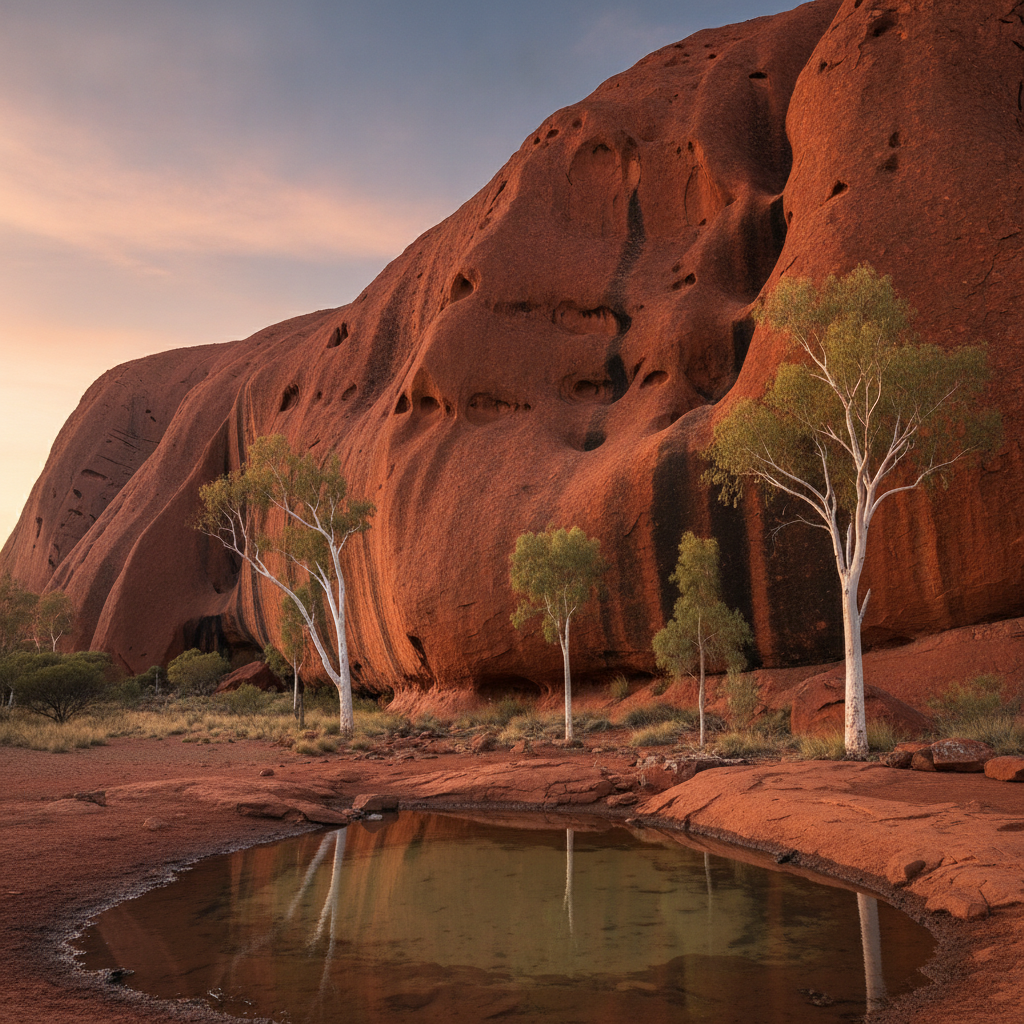
Uluru: Simpson Desert and Lake Eyre, Overland Telegraph Line and Afghan Cameleers, Uluru Base Walk and Mala Walk Cultural Tjukurpa Sites, Western Desert Art Movement (Papunya Tula and Emily Kngwarreye), Yulara Accommodation from Longitude 131 to Campground
Uluru final: Simpson Desert red dunes and Lake Eyre (fills three times per century), Overland Telegraph Line history and Afghan cameleers (the Ghan railway), Uluru Base Walk and Mala Walk with Tjukurpa site explanations, Western Desert dot painting art movement (Papunya 1971, Clifford Possum, Emily Kngwarreye), and complete Yulara accommodation guide (Longitude 131 luxury tents to camping), dining and the Sounds of Silence dinner.
- 1
The Simpson Desert - Red Dunes to Lake Eyre
The Simpson Desert (the large sand dune desert in the centre of Australia, stretching across the Northern Territory, Queensland, and South Australia borders): the largest parallel sand dune desert in the world. The Simpson Desert dunes: approximately 1,100 parallel longitudinal dunes, running southwest to northeast, with the largest dune being Big Red (Nappanerica, 40 m high, the most famous dune in the Simpson), near Birdsville in Queensland. The Simpson Desert crossing (from the Alice Springs-Uluru region east to Birdsville, approximately 600 km on unsealed tracks requiring high-clearance 4WD and convoy arrangements): one of the most challenging and remote 4WD routes in Australia. Lake Eyre (Kati Thanda, the vast salt lake approximately 600 km south of Uluru): the lowest point in Australia (-15 m), the largest lake in Australia when full (9,690 sq km), and the terminal basin for the Lake Eyre drainage basin (1.14 million sq km, covering approximately 15% of Australia). Lake Eyre fills approximately three times per century during exceptional inland flood events (most recently in 2009, 2011-2012, and 2021). When Lake Eyre fills, it creates a temporary but extraordinary ecosystem (millions of birds, including pelicans that breed nowhere else, arrive within days of the lake filling). The scenic flight from Uluru over the Simpson Desert and Lake Eyre: one of the most extraordinary aerial landscapes on earth.
- 2
The Overland Telegraph Line and Australian Desert History
The Overland Telegraph Line (the 3,200 km telegraph line from Port Augusta to Darwin, completed in 1872): the most significant infrastructure project in Australian history to that date. The construction: the line was built in 18 months through previously unexplored desert (the Stuart Highway follows the route of the Telegraph Line for most of its length). The repeater stations (every 200-300 km along the line): the stations at Alice Springs, Tennant Creek, and Darwin were the primary European settlements of central Australia for decades after the telegraph. The discovery of the interior: the construction of the Overland Telegraph Line opened the interior of Australia to European exploration for the first time; the stations became the bases for the pastoral stations (cattle and sheep) that occupied the interior from the 1870s. The Afghan cameleers: between 1860 and 1920, approximately 2,000-3,000 Afghan and Pakistani cameleers operated the camel trains that were the primary freight transport through central and western Australia. The camels (approximately 10,000 imported over this period) were the only animals that could survive the desert heat and carry loads over the long, waterless stages. The Ghan railway (the Adelaide to Darwin railway, completed 2004): named after the Afghan cameleers. The Alice Springs Afghan Mosque (built 1901): the last remaining mosque built by the Afghan cameleers in Australia, now a heritage site.
- 3
Uluru Walking Tracks - the Base Walk and Cultural Sites
The Uluru Base Walk (the 10.6 km circuit walk around the base of Uluru, taking approximately 3-4 hours): the primary way to experience Uluru at ground level, passing the waterholes, the caves, and the natural sculptures of the rock surface. The Mala Walk (the 2 km section of the Base Walk on the northwest side of Uluru): the guided walk (offered free by the park rangers at 8 am daily in the dry season) that explains the Tjukurpa stories of the Mala (rufous hare-wallaby) people who created the features of this section of the rock. The Mutitjulu Walk (the 1 km walk from the Mutitjulu car park to the Mutitjulu Waterhole): the most accessible short walk at Uluru, visiting the permanent waterhole and the ancient Aboriginal art site (hand stencils and figurative paintings on the cave walls, believed to be thousands of years old). The restricted photography areas: several sections of the Uluru base are marked as restricted photography areas because the rock features visible from those points are sacred and the Anangu do not wish them to be photographed; the signs are clear and the request should be respected. The Lungkata section: the east face of Uluru, the site of the Tjukurpa story of Lungkata (the blue-tongue lizard man) who stole a emu and was punished by the other beings. The rock surface: at close range, Uluru reveals an extraordinary texture of fluting, caves, overhangs, and waterholes invisible from the viewing areas.
- 4
Uluru Three-Route Complete and Red Centre Final Verdict
Uluru three-route complete summary and Red Centre final verdict. Route 1: Uluru geology, Anangu people and Tjukurpa, sunrise and sunset, Kata Tjuta (Valley of the Winds and Walpa Gorge), Kings Canyon Rim Walk, practical guide and cultural protocols (climbing ban, photography restrictions). Route 2: Alice Springs and Arrernte country, West MacDonnell Ranges gorges and Larapinta Trail, Red Centre desert ecology, Uluru dark sky astronomy and emu constellation, Uluru Statement from the Heart and Australian national identity. Route 3 (this route): Simpson Desert and Lake Eyre, Overland Telegraph Line and Afghan cameleer history, Uluru Base Walk and Mala Walk cultural sites. Red Centre three-route final verdict: the Red Centre of Australia (the region centred on Alice Springs and Uluru) is the most concentrated ancient landscape on earth accessible to visitors from a functioning airport and resort infrastructure. Uluru itself is a 550-million-year-old geological formation standing above a landscape shaped by Anangu Tjukurpa stories 10,000 or more years old. The desert ecology, the dark sky, the Aboriginal art traditions (Namatjira and the Western Desert art movement), and the silence of the Red Centre create an experience of geological and cultural depth unmatched anywhere in the southern hemisphere. Allocate at minimum 3 full days (Uluru sunrise/base walk/cultural centre; Kata Tjuta Valley of the Winds; Kings Canyon or MacDonnell Ranges); a week gives the full Red Centre experience.
- 5
Western Desert Art Movement - Papunya Tula and the Dot Painting Revolution
The Western Desert Art Movement (origin: Papunya, approximately 240 km northwest of Alice Springs, 1971): the most significant development in Australian art in the twentieth century. The Papunya Tula Artists cooperative (established 1972, still operating): the first Aboriginal art company to represent the Western Desert artists. The art movement began in 1971 when the Aranda and Luritja artists at Papunya (a government settlement established in the 1950s to relocate desert Aboriginal people) began painting traditional Dreaming stories on canvas and board, adapting the dot painting technique (originally used on bodies and in sand drawings) to a new medium. The dot painting style: the complex patterns of dots and circles represent landscape features (waterholes, ceremonial grounds, travel routes) viewed from above, creating a form of map-art encoding Dreaming geography. The key figures: Clifford Possum Tjapaltjarri, Tim Leura Tjapaltjarri, and Johnny Warangkula Tjupurrula were the primary Papunya artists. Clifford Possum Tjapaltjarri painting Man's Love Story (1978, now in the Art Gallery of South Australia): the first Western Desert painting to sell at major auction for over AUD 1 million (sold for AUD 2.4 million in 2007). The Emily Kame Kngwarreye (from Utopia Station, 230 km northeast of Alice Springs): the most celebrated Aboriginal artist of the late twentieth century, who began painting at age approximately 80 and produced approximately 3,000 works before her death in 1996.
- 6
Uluru Accommodation, Dining, and the Yulara Resort Township
The Ayers Rock Resort (Yulara): the only accommodation base for visiting Uluru, located 18 km from the rock. The Yulara township was purpose-built in 1984 (designed by Philip Cox) to consolidate the tourist infrastructure that had previously been spread around the base of the rock, causing significant environmental damage. The resort accommodation options: the Longitude 131 (the luxury tented camp adjacent to the sand dunes with direct views of Uluru from the private deck of each tent: AUD 2,000-5,000 per night, all-inclusive); the Sails in the Desert Hotel (the primary 5-star hotel in Yulara, AUD 500-1,000 per night); the Desert Gardens Hotel (the mid-range option with views of Uluru from the garden, AUD 300-600 per night); the Outback Pioneer Hotel and Lodge (the budget option, AUD 150-300); and the Ayers Rock Campground (AUD 40-60 per night for powered sites). The Yulara dining: the resort restaurants include Tali Wiru (the outdoor dining under the stars with Uluru visible in the dark, a private dining experience for small groups), the Sounds of Silence dinner (the outdoor buffet dinner with Uluru views and an astronomy presentation), and the Ilkari Restaurant (the resort buffet). The IGA supermarket in Yulara: the only grocery store for 300 km in any direction; stock up before arriving. The Uluru entry fee (included in accommodation charge for some operators, otherwise AUD 38 per adult for 3 days): the fee contributes to the park management and Anangu programs.
Walk this route with audio
Stories play automatically as you reach each stop — no tapping needed.
More in uluru
Uluru: Anangu People and Living Tjukurpa Law, Sacred Monolith Geology, Sunrise and Sunset Light Show, Kata Tjuta Valley of the Winds, Kings Canyon Rim Walk, and Complete Practical Guide with Cultural Respect
Uluru: Pitjantjatjara Homelands and Anangu Economy, Climate Change in the Red Centre, Tourism Economics and Post-Climbing-Ban Trends, East MacDonnell Ranges and N'Dhala Rock Art, Henley-on-Todd Regatta, and Four-Route Final Ultimate Verdict