Olympic Village, East Van Arts & Mount Pleasant Creative District
The Olympic Village (the 2010 Winter Olympics Athletes' Village on the south shore of False Creek in Southeast False Creek, converted to the Millennium Water residential development after the Games) and Mount Pleasant (the 'East Van' neighbourhood south of False Creek, centred on the Main Street commercial strip) together represent the most dynamic and creative district in Vancouver — the area where the city's art galleries, craft breweries, coffee roasters, and independent restaurants are concentrated.
- 1
Olympic Village & Southeast False Creek
The 2010 Winter Olympics Athletes' Village (the residential development built on the south shore of False Creek in the Southeast False Creek neighbourhood for the 2010 Winter Olympics — the development that housed approximately 2,800 athletes and officials during the Games and was converted after the Games to the Millennium Water residential community (the most ambitious sustainable residential development in the history of Canadian real estate, with LEED Gold certification for the entire neighbourhood, on-site renewable energy generation, a community centre (the Hillcrest Community Centre — the LEED Platinum recreation centre built as the combined Olympic skating oval during the Games), and the False Creek waterfront promenade that connects the Olympic Village to the Granville Island bridge and the Kitsilano waterfront to the west): the Olympic Village Square (the public plaza at the centre of the development — the commercial street-level retail and restaurant strip along Olympic Village Square that is now one of the most vibrant neighbourhood retail streets in Vancouver).
- 2
Main Street & Mount Pleasant Arts District
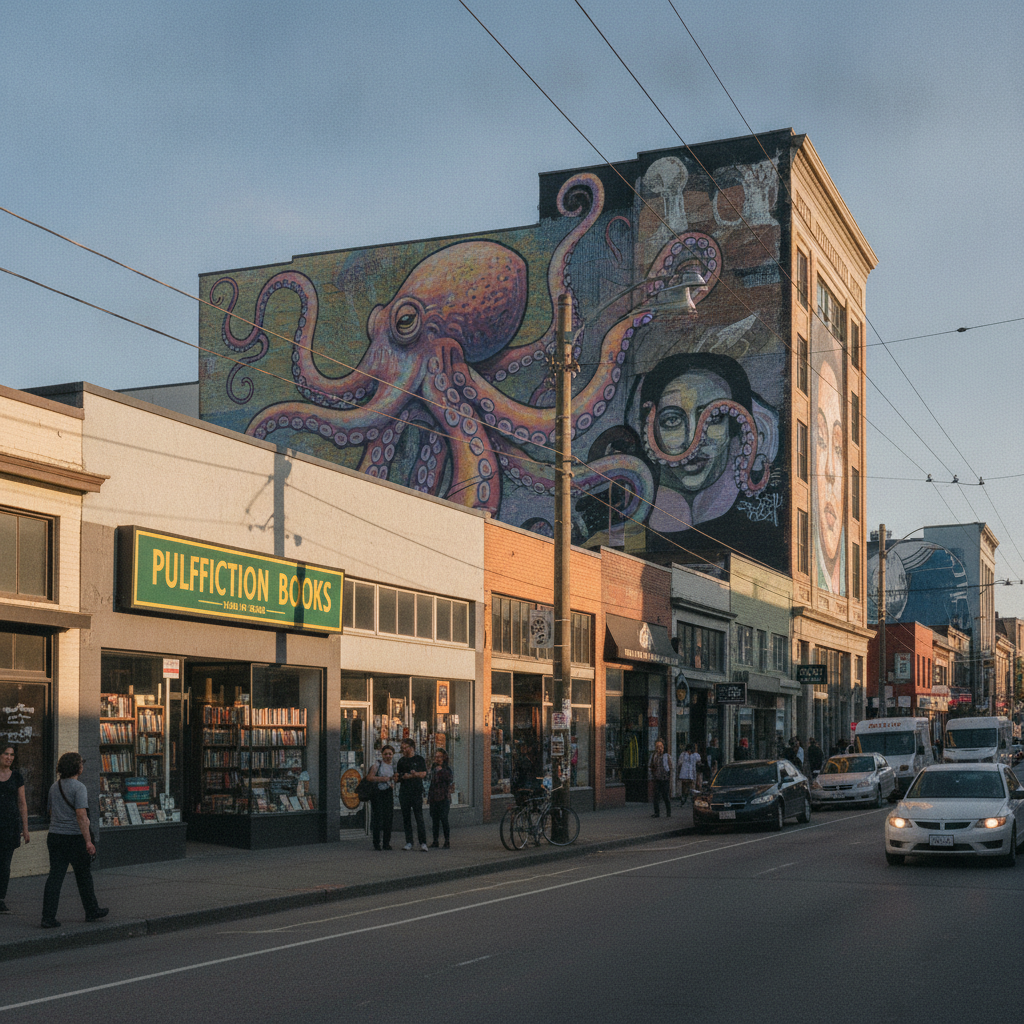
Mount Pleasant (the neighbourhood south of False Creek centred on the Main Street commercial strip — the neighbourhood that has emerged in the 2010s as the most creative and most rapidly changing neighbourhood in Vancouver): the Main Street strip (the stretch of Main Street between Broadway (10th Avenue) and 33rd Avenue — the 'antique row' of the 1990s (the stretch of Main Street that was lined with second-hand furniture and antique shops in the 1990s) that has transformed into the arts and culture district of Vancouver in the 2010s and 2020s, with independent coffee shops (Kafka's Coffee, the iconic East Van coffee roaster at 2525 Main Street), independent bookstores, vintage clothing shops, record stores, and the restaurants that have made the Mount Pleasant restaurant scene one of the most innovative in Vancouver): the Vancouver Mural Festival (the annual festival that has painted over 150 large-scale murals on the exterior walls of buildings in Mount Pleasant, making the neighbourhood the open-air street art gallery of Vancouver).
- 3
The East Van Cross & Neighbourhood Identity
The East Van Cross (the 'East Van Cross' — the graphic symbol of the 'East Van' identity, the cross formed by the intersection of the letters E, A, S, T, V, A, N in the distinctive block-letter style that is the most recognizable neighbourhood identity symbol in Canada): the East Van identity (the 'East Van' identity — the fierce neighbourhood pride of the residents of the neighbourhoods east of Ontario Street in Vancouver (the neighbourhoods of Mount Pleasant, Commercial Drive, Strathcona, Grandview-Woodland, Renfrew-Collingwood, and others): the history of the East Van identity (the division of Vancouver into the 'West Side' (the wealthy residential neighbourhoods west of Ontario Street — Kitsilano, Point Grey, Kerrisdale, Shaughnessy) and the 'East Side' (the working-class and immigrant neighbourhoods east of Ontario Street — Mount Pleasant, Commercial Drive, Strathcona, Grandview-Woodland) that has defined Vancouver's social and cultural geography since the early 20th century): the East Van Cross artwork (the cross that appears on everything from tattoos to murals to hoodies to the backyards of East Van homes — the symbol designed by Ken Lester in 1983 for the Vancouver punk band the Young Canadians (later popularized by Ken Lester's other punk band, DOA)).
- 4
Strathcona — Vancouver's Oldest Neighbourhood
Strathcona (the neighbourhood in the southeast corner of downtown Vancouver, immediately east of Chinatown and south of the port — the oldest surviving residential neighbourhood in Vancouver, with the oldest houses in the city (the Victorian and Edwardian houses built from the 1880s through the 1910s that line the streets of Strathcona)): the Strathcona history (the neighbourhood that was the first residential area of Vancouver, the neighbourhood where the early working-class families of Vancouver settled in the 1880s and 1890s (the families of the CPR railway workers, the sawmill workers of Burrard Inlet, and the fishing industry workers of the Fraser River), and that received successive waves of immigrant communities from the early 20th century through the present (the Chinese, Japanese, and Italian immigrants of the early 20th century, the Japanese-Canadian community that was concentrated in the Powell Street neighbourhood (the 'Japantown' of Vancouver) before the forced relocation of Japanese-Canadians to internment camps in 1942)): the Strathcona Community Garden (the garden at Prior Street and Hawks Avenue — the largest community garden in Vancouver, established in 1985 on the site of a former city works yard, with over 150 individual garden plots maintained by Strathcona residents).
- 5
Vancouver Craft Coffee Culture
Vancouver's coffee culture (the city that has one of the most sophisticated specialty coffee cultures in North America — the city where the independent specialty coffee roaster has completely displaced the chain coffee shop as the default choice of the coffee-drinking population): the Vancouver specialty coffee roasters (the independent roasters that have made Vancouver one of the premier coffee cities in North America — Revolver Coffee (325 Cambie Street, Gastown — the specialty coffee bar that is the most respected espresso bar in Vancouver, the bar famous for the rotating single-origin filter coffee program and the strict no-wifi, no-laptop policy that enforces the coffee-tasting experience), Matchstick Coffee (Chinatown, Railtown, and Fraser neighbourhoods — the roaster known for the direct trade sourcing relationships with farmers in Ethiopia, Colombia, and Guatemala), Pallet Coffee Roasters (various East Van locations — the roaster that has been the most influential in the development of the East Van specialty coffee scene since 2012), and Kafka's Coffee (2525 Main Street, Mount Pleasant — the East Van coffee institution that has been the social centre of the Mount Pleasant arts community since 2011)): the coffee shop culture (the coffee shops of Vancouver that function as the co-working spaces, art gallery overflow spaces, and social hubs of the city's creative class).
- 6
Commercial Drive Market & Cultural Mosaic
Commercial Drive (the most ethnically diverse commercial strip in Vancouver — the 2-kilometre stretch of Commercial Drive from Broadway to Venables Street in the Grandview-Woodland neighbourhood): the Commercial Drive food market culture (the Bosa Foods (1465 Commercial Drive — the Italian grocery store that has been the anchor of the Drive's Italian food culture since 1956, the store that stocks the finest selection of Italian olive oils, pastas, cheeses, and cured meats in western Canada), the Fratelli Bakery (1795 Commercial Drive — the Italian bakery in continuous operation since 1968, the bakery that makes the panini, focaccia, and Italian pastries that are the defining food of the Drive), the Mercato (1590 Commercial Drive — the Italian deli counter in the heart of the Drive), and the Latin American grocery stores, Ethiopian restaurants, and Japanese ramen shops that now share the Drive with the Italian establishments): the Saturday and Sunday farmers' markets (the Trout Lake Farmers' Market (at the John Hendry Park / Trout Lake Park, 4 blocks east of Commercial Drive at Victoria Drive — the most beloved farmers' market in East Vancouver, held every Saturday from May through October)).
Walk this route with audio
Stories play automatically as you reach each stop — no tapping needed.
More in vancouver
Whistler, Mountain Skiing & Vancouver's Outdoor Adventure Culture
Gastown, the Steam Clock & Vancouver's Historic Neighbourhood
Yaletown, False Creek & Vancouver's Urban Design Success
Davie Village, LGBTQ+ Culture & Vancouver Pride
Stanley Park, the Seawall & Vancouver's Urban Wilderness