Dorsoduro: Gallerie dell'Accademia, Peggy Guggenheim Collection & Santa Maria della Salute
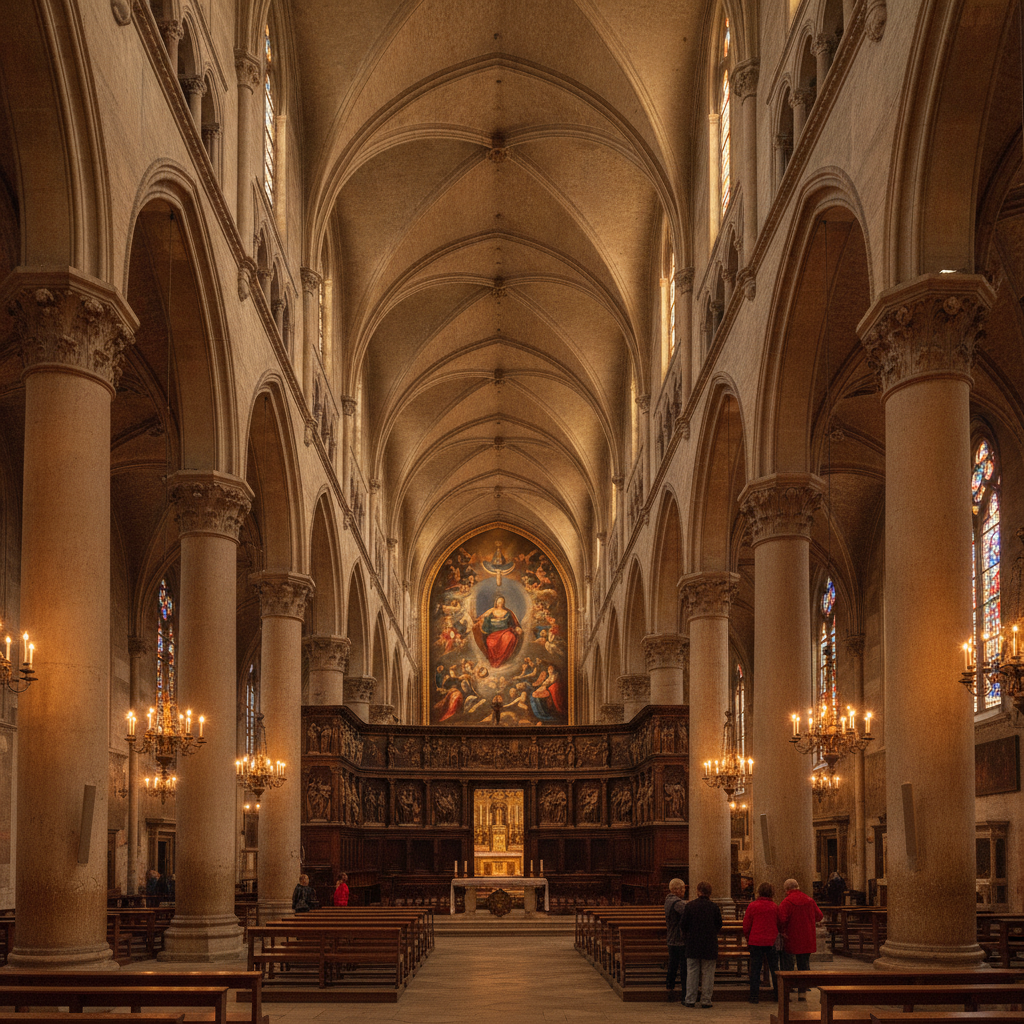
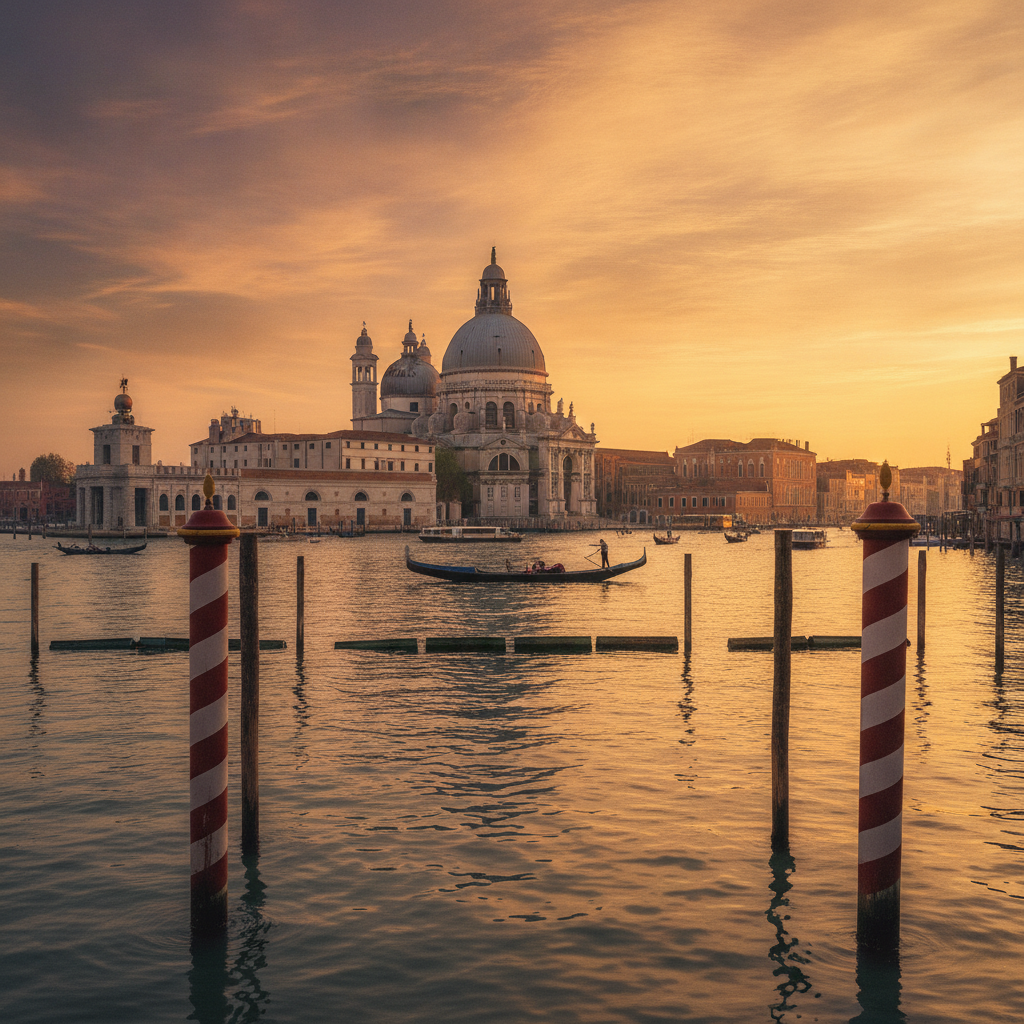
The sestiere of Dorsoduro — literally 'hard back' (referring to the compacted clay subsoil that made this the most stable of Venice's original islands) — is the cultural and artistic quarter of Venice, home to the two most important art museums in the city (the Gallerie dell'Accademia with the greatest collection of Venetian painting and the Peggy Guggenheim Collection with one of Europe's finest collections of 20th-century art), the most dramatic church in Venice's skyline (Santa Maria della Salute), the contemporary art space at Punta della Dogana, and the quiet waterfront of the Zattere.
1. Gallerie dell'Accademia — The Greatest Collection of Venetian Painting
- 1
Gallerie dell'Accademia — The Greatest Collection of Venetian Painting
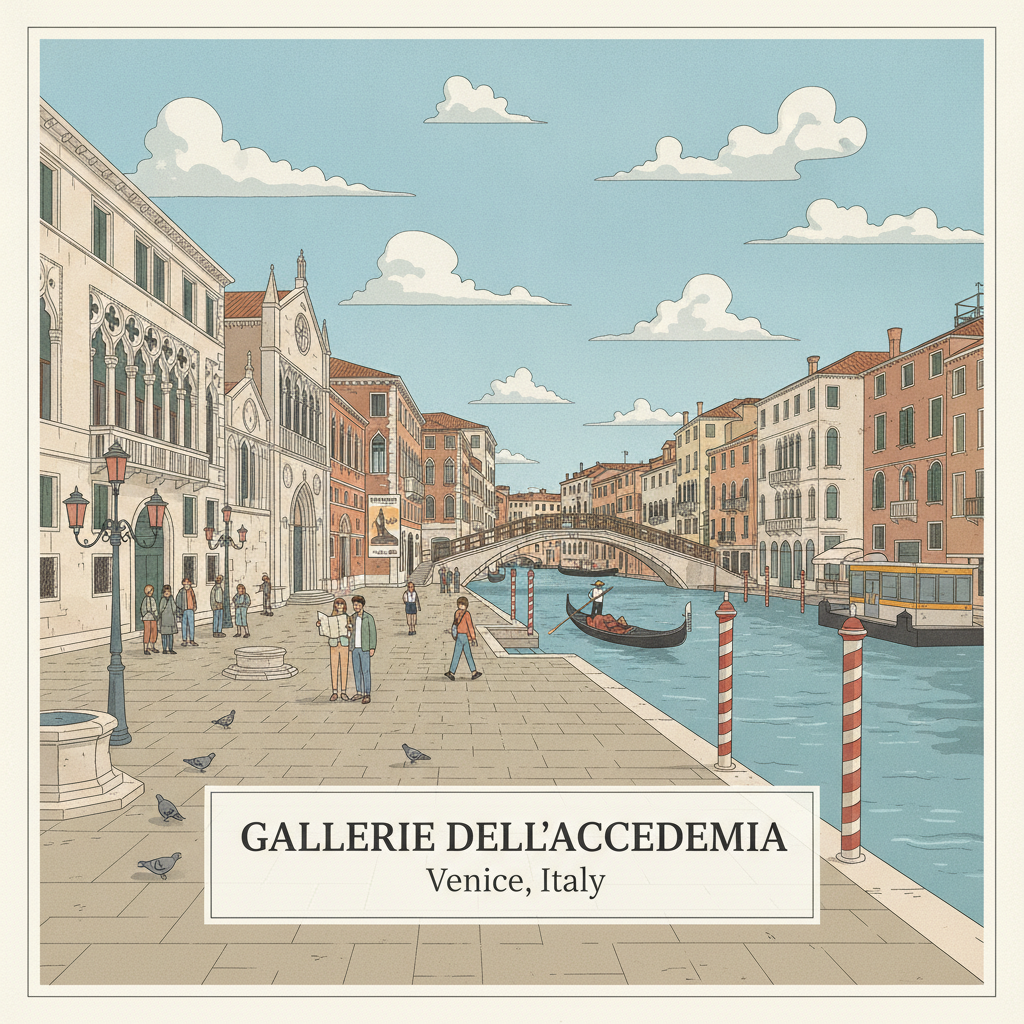
Gallerie dell'Accademia (Campo della Carità, Sestiere Dorsoduro, Venice — the principal art museum of Venice, housed in the former monastery, church, and scuola grande of Santa Maria della Carità (a charitable brotherhood of Venetian citizens), which were converted into gallery space following Napoleon's suppression of the religious orders in 1807: the collection was established at this location in 1807 by the Viceroy of Italy Eugène de Beauharnais, initially with works transferred from the suppressed churches and monasteries of Venice and subsequently enriched by gifts, purchases, and transfers from other collections; the Accademia collections now span the history of Venetian painting from the 14th century Byzantine-influenced Gothic (the 'gold ground' altarpieces of Paolo Veneziano, the founder of the Venetian school of painting) through the full arc of Venetian Renaissance painting (Gentile and Giovanni Bellini's altarpieces, Andrea Mantegna's 'St George', Giorgione's 'The Tempest' — the enigmatic and endlessly discussed painting of 1508 that is considered the first 'modern' painting in European art history, in which the landscape is the subject rather than a backdrop for human figures, and in which the figures themselves are mysterious rather than narratively identified, Titian's 'Presentation of the Virgin in the Temple' painted directly on the wall of the Sala dell'Albergo, Tintoretto's 'Miracle of the Slave', and Paolo Veronese's enormous 'Feast in the House of Levi' (originally painted as 'The Last Supper' but renamed at the order of the Inquisition after Veronese's famous reply that painters 'use the same licence that poets and madmen use') to the 18th-century masters of Venetian Rococo painting (Tiepolo, Canaletto, Guardi, Longhi, and Rosalba Carriera).
- 2
Peggy Guggenheim Collection — The Finest Collection of 20th-Century Art in Europe
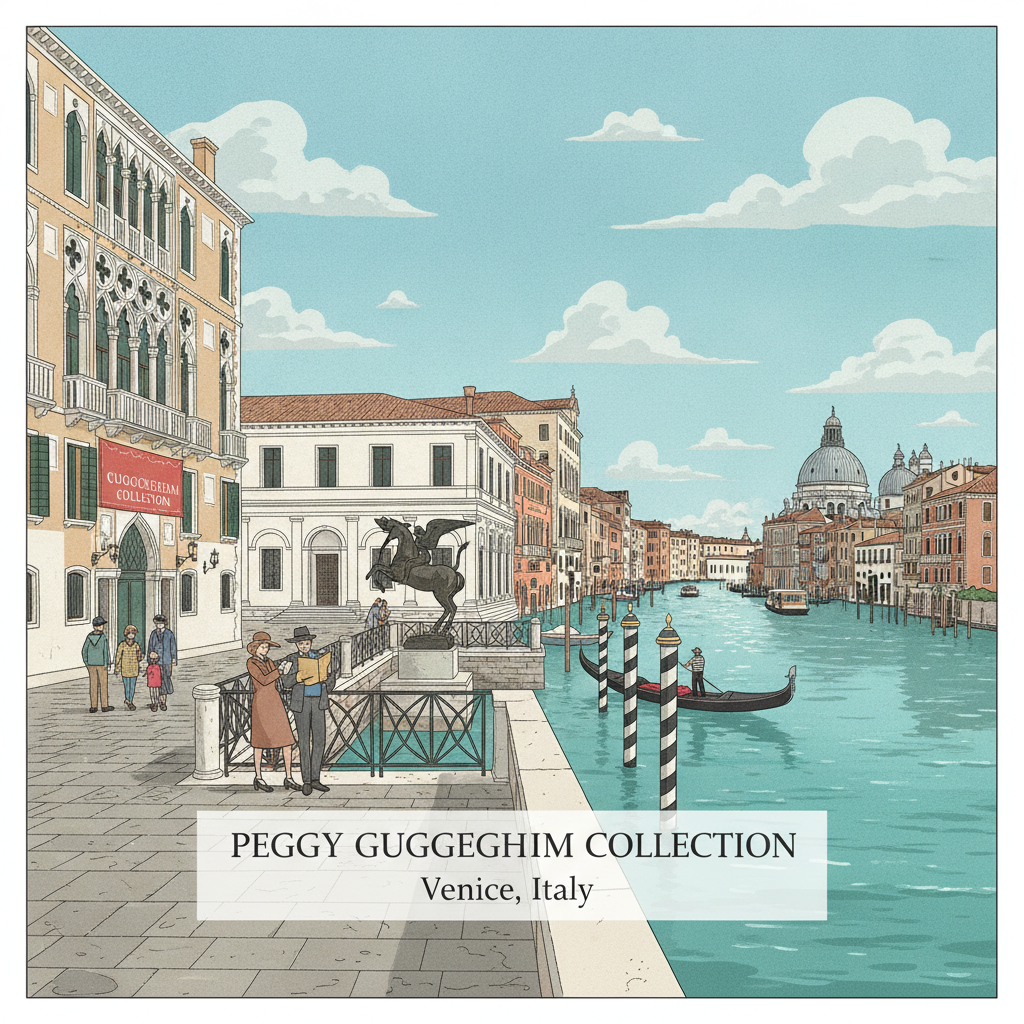
Peggy Guggenheim Collection (Palazzo Venier dei Leoni, Fondamenta Venier dai Leoni, Sestiere Dorsoduro, Venice — the museum occupying the unfinished 18th-century palazzo that Peggy Guggenheim (1898-1979) purchased in 1949 and lived in until her death, converting the ground floor into an art museum open to the public from 1951: the palazzo is known as the 'Nonfinito' (the unfinished) because construction was halted after the first floor due to a financial dispute among the building's original owners, leaving the building unusually low-lying for a Grand Canal palazzo; the collection was assembled by Peggy Guggenheim over the 1930s and 1940s, primarily through her close personal relationships with many of the most important artists of the European and American avant-garde — she purchased paintings directly from artists, often at very low prices during the chaos of the Second World War (she made a famous bet with herself to buy one painting a day during the German occupation of Paris, purchasing Surrealist and abstract works for minimal prices from artists desperate to leave Europe); the collection includes major works by Pablo Picasso ('The Poet', 1911), Georges Braque, Piet Mondrian, Wassily Kandinsky, Paul Klee, Marc Chagall, Salvador Dalí ('Birth of Liquid Desires', 1931-32), Max Ernst (whom Guggenheim married in 1941), René Magritte, Jean Arp, Alberto Giacometti, Jackson Pollock ('Alchemy', 1947), Alexander Calder, and many others; Marino Marini's sculpture 'Angel of the Citadel' (the bronze equestrian figure on the canal terrace, whose arms are raised in a gesture of greeting/ecstasy and whose anatomy was scandalously explicit at the time of its installation) is one of the most recognizable public sculptures in Venice.
- 3
Basilica di Santa Maria della Salute — Longhena's Baroque Masterpiece
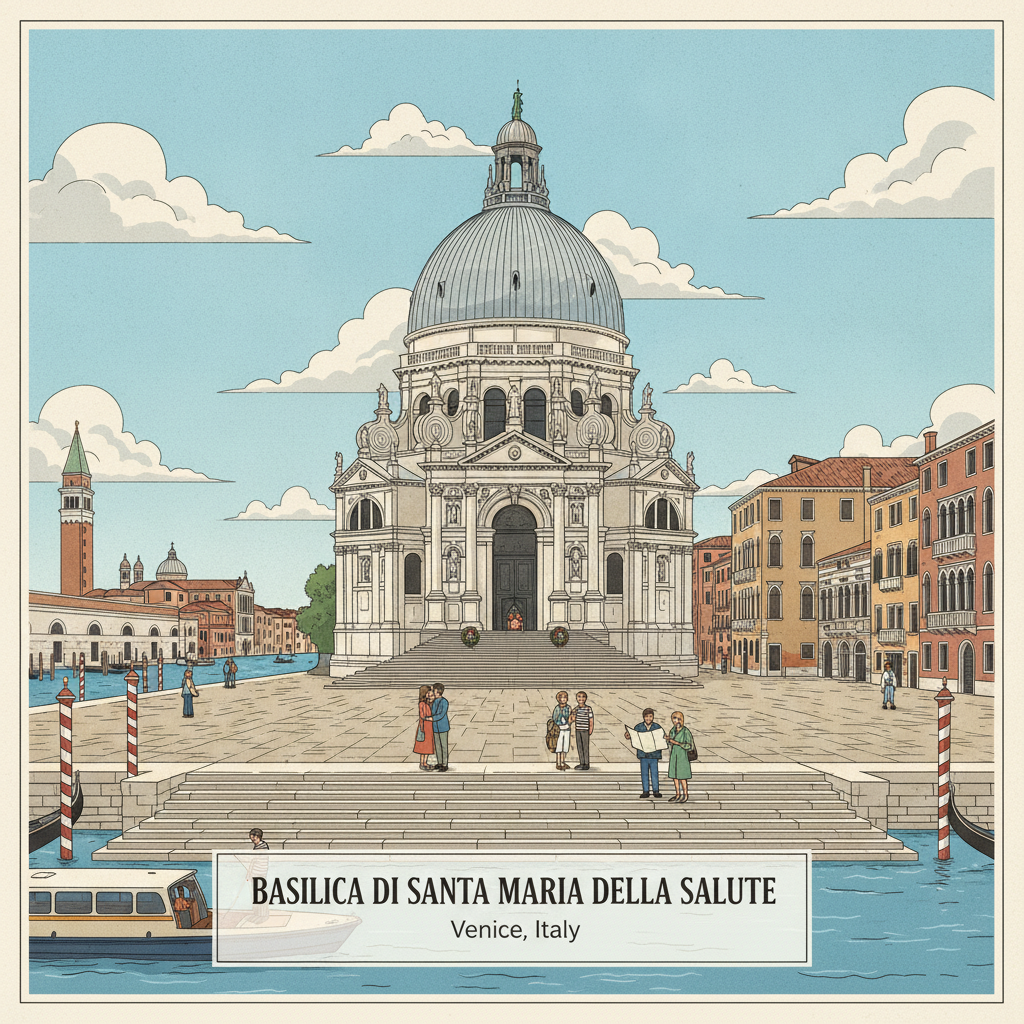
Basilica di Santa Maria della Salute (Campo della Salute, Sestiere Dorsoduro, Venice — the Baroque votive church built between 1631 and 1687 by Baldassare Longhena as a vow to the Virgin Mary by the Venetian Senate following the devastating plague of 1630-1631, which killed approximately one-third of Venice's population (some 46,000 deaths from a pre-plague population of approximately 140,000): the Senate voted in October 1630, while the plague was still raging, to build a new church if the Virgin Mary would intercede to end the epidemic, and the church's construction began in 1631, when the plague finally subsided; the church's location — at the tip of the Dorsoduro peninsula at the junction of the Grand Canal and the Giudecca Canal — was chosen to maximize its visual impact, and Longhena designed the building to be visible from the Piazza San Marco across the Basin of San Marco, positioning it as the perfect visual counterpoint to the Palazzo Ducale and Campanile on the opposite bank; the building's distinctive form — the enormous central octagonal plan topped by a large dome (16 metres in diameter, rising 60 metres above the canal level), surrounded by a ring of pilasters that Longhena called 'the great stone snail', and preceded by a broad flight of ceremonial steps directly from the canal — creates the most dramatically theatrical building in Venice's skyline; the church contains important works by Titian (the three ceiling paintings in the sacristy — 'David and Goliath', 'Abraham and Isaac', and 'Cain and Abel') and Tintoretto ('The Wedding at Cana', painted in 1551 for the refectory of the Crociferi monastery, now installed in the sacristy).
- 4
Punta della Dogana (Customs Point) — Contemporary Art at the Tip of Dorsoduro
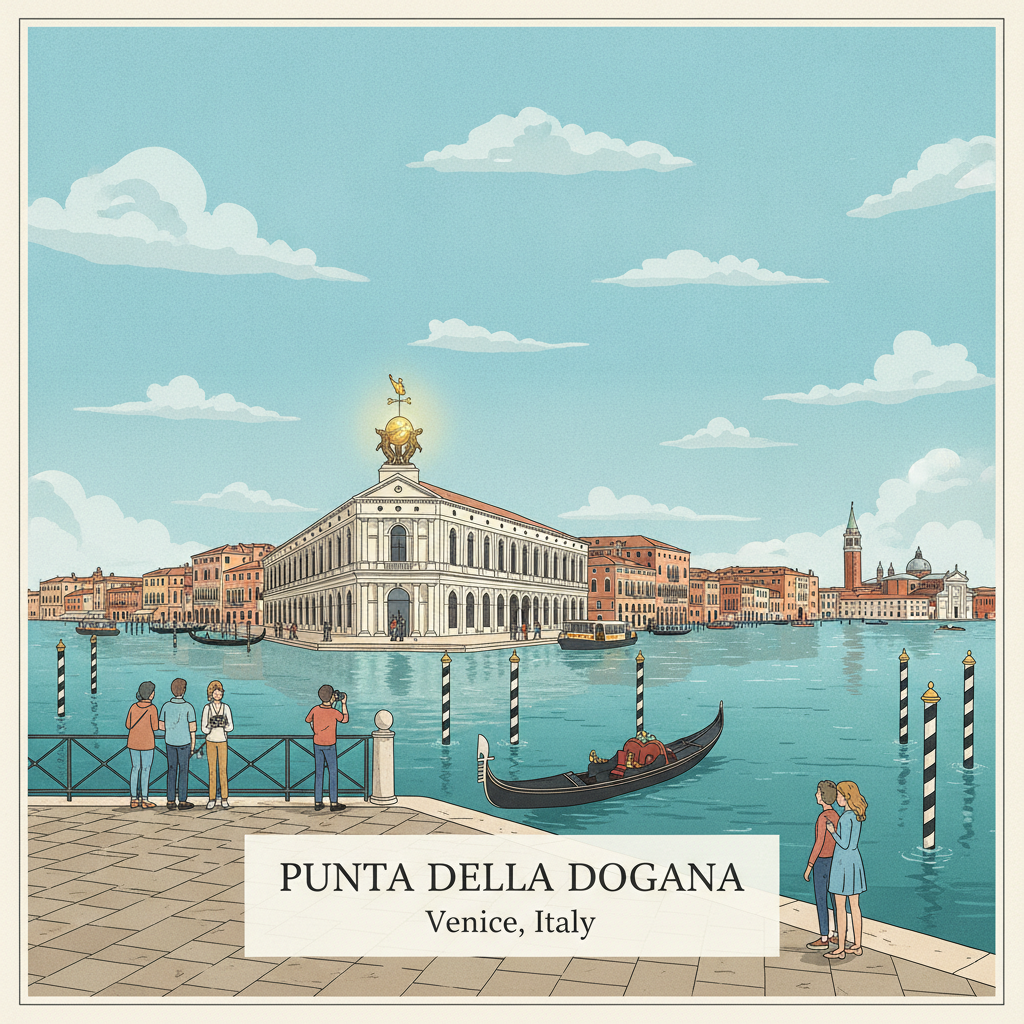
Punta della Dogana (Fondamenta della Dogana, Sestiere Dorsoduro, Venice — the former customs house (dogana da mar, or sea customs house) at the very tip of the Dorsoduro sestiere, at the point where the Grand Canal and the Giudecca Canal converge and the waters open into the Bacino di San Marco: the customs house building was constructed between 1677 and 1682 by Giuseppe Benoni on a triangular site at the canal junction, and served as the point of inspection for all goods arriving in Venice by sea (every ship entering the Venetian lagoon was required to stop at the customs house, declare its cargo, pay duties, and obtain clearance before proceeding into the city); the most distinctive architectural feature of the building is the golden globe topped by a weathervane in the form of the figure of Fortune (Fortuna) rotating on its axis, supported by two bronze Atlas figures, that crowns the triangular pavilion at the tip of the building — the figure has been the visual anchor of the southern view of Venice for over three centuries; the building was converted in 2009 by the Japanese architect Tadao Ando (who also converted the Palazzo Grassi on the Grand Canal) into a contemporary art museum for the collection of François Pinault (the French luxury goods billionaire and art collector), and now presents major temporary exhibitions of contemporary art alongside Pinault's permanent collection.
- 5
Zattere Waterfront — Dorsoduro's Sunny Southern Promenade
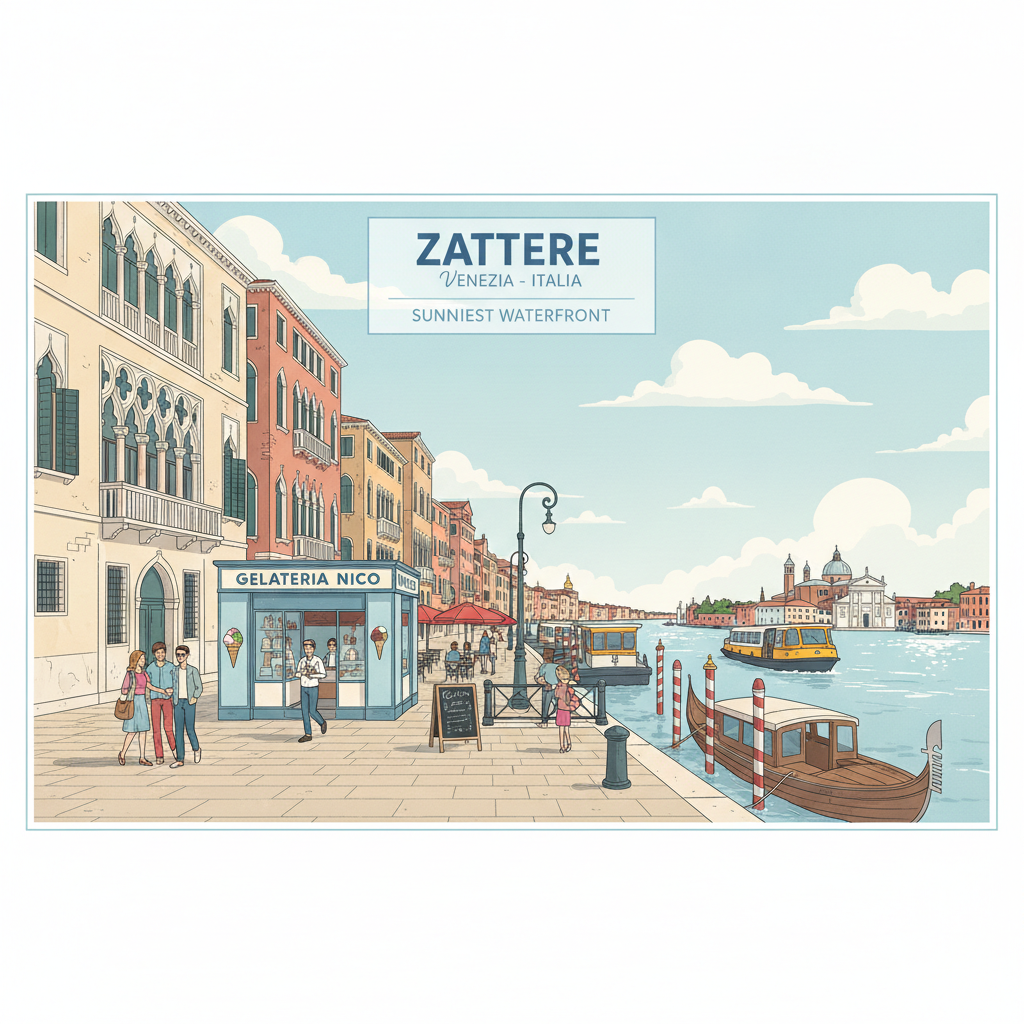
Le Zattere (Fondamenta Zattere, the approximately 1.5-kilometre waterfront promenade running along the southern edge of the Sestiere Dorsoduro from the Stazione Marittima (the cruise ship terminal) in the west to the Punta della Dogana in the east, facing the Giudecca Canal and the island of Giudecca across the water: the Zattere takes its name from the rafts (zattere) of logs that were floated along this section of canal and moored at this waterfront for unloading during the medieval and early modern period — timber was one of the most essential commodities in Venice both as building material and as fuel for the glass furnaces of Murano and the boat-building yards of the Arsenal; the Zattere is the most consistently sunny and least crowded of Venice's major waterfront promenades, benefiting from its south-facing aspect (the Giudecca Canal is approximately 350 metres wide, providing an unobstructed view to the south and excellent solar exposure), and is consequently popular with Venetian residents for evening walks (passeggiata), outdoor dining at the several bar-restaurants along the waterfront, and as a departure point for the Giudecca ferry (vaporetto line 2) that crosses to the Giudecca island; the gelateria Nico (at Zattere 922) is one of the most historic and beloved ice cream shops in Venice, famous since the 1950s for its 'gianduiotto' — a block of frozen hazelnut and chocolate ice cream served on a plate with cream.
- 6
Campo Santa Margherita — Dorsoduro's Village Square
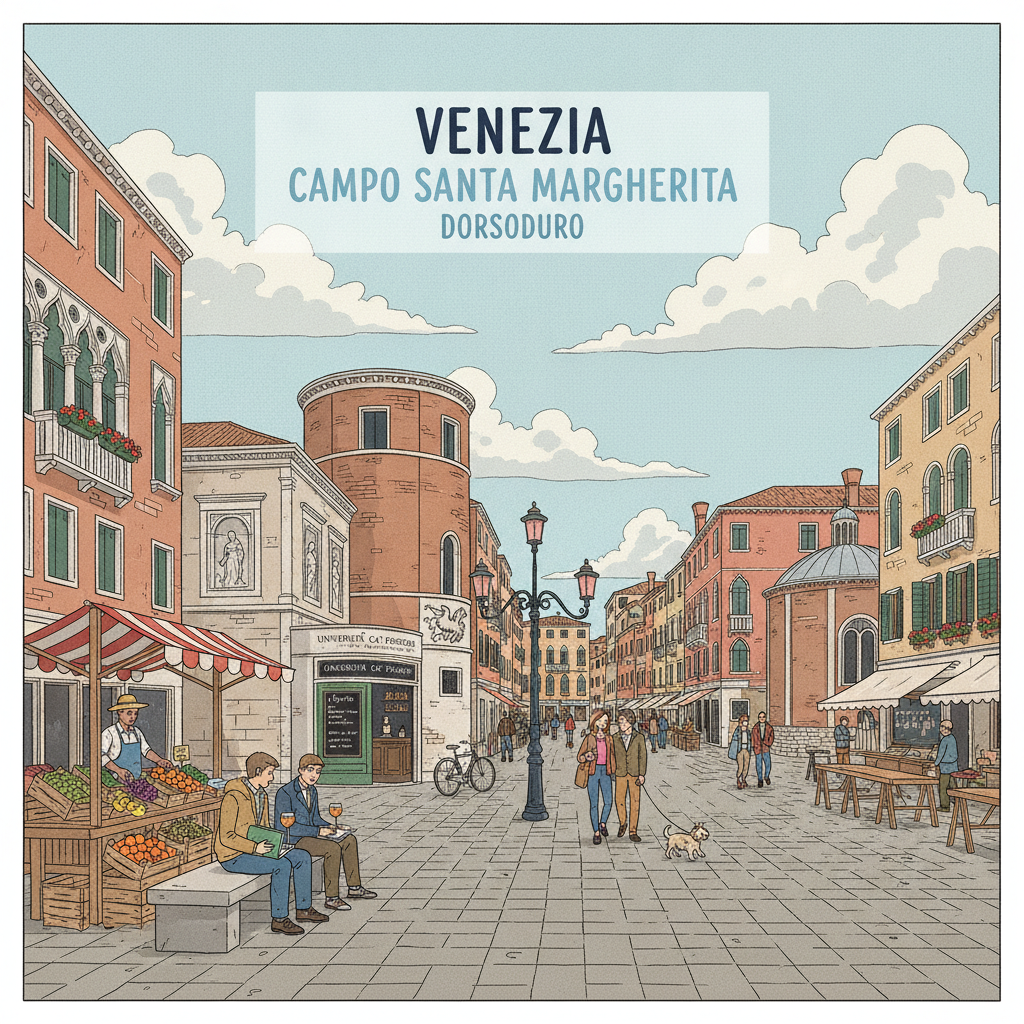
Campo Santa Margherita (Campo Santa Margherita, Sestiere Dorsoduro, Venice — the largest campo in Venice (after Piazza San Marco, which is officially a 'piazza'), and the social heart of the Dorsoduro sestiere and of the local Venetian population of the western part of the city: Campo Santa Margherita has been the market square and community centre of the Dorsoduro district for centuries — the campo still functions as an outdoor market (daily from approximately 08:00-13:00), with stalls selling fruit and vegetables, fish, and household goods; the campo is surrounded by a mix of traditional bakeries, wine bars (bacaro — the quintessentially Venetian wine bar serving cicchetti, the Venetian tapas of small portions of food — crostini with cod bacalà, fried sardines, eggs with anchovies, and polpette (meatballs) — with small glasses of house wine or prosecco), cafes, bookshops, and the University of Ca' Foscari faculty buildings; the campo is particularly lively in the evening, when Venetian university students, young professionals, and local residents gather for the 'aperitivo' hour (approximately 18:00-20:00) — a Venetian social ritual of particular importance in the Dorsoduro/Santa Croce area due to the concentration of university faculties.
Walk this route with audio
Stories play automatically as you reach each stop — no tapping needed.
More in venice
Cannaregio Sestiere, the Jewish Ghetto & Fondamente Nove Waterfront
Piazza San Marco, Basilica di San Marco, Palazzo Ducale & the Campanile
The Gondola: Squero di San Trovaso, the Traghetti & Venice's Working Watercraft
Castello Sestiere: the Arsenale, Venice Biennale Gardens & San Giovanni e Paolo
Murano, Burano & Torcello — The Venetian Lagoon Island Circuit