Grand Canal, Rialto Bridge, Rialto Fish Market & Venetian Palazzo Architecture
The Grand Canal — the S-shaped waterway 3.8 kilometres long and up to 90 metres wide that functions as the main 'street' of Venice, lined by over 170 buildings representing six centuries of Venetian palazzo architecture from Gothic to Baroque — and the Rialto district, which was the commercial heart of Venice from the 12th century until the fall of the Republic in 1797, together form the essential commercial and architectural spine of La Serenissima.
- 1
Canal Grande (Grand Canal) — Venice's Main Street
Canal Grande (the Grand Canal, the primary waterway of Venice, running in an inverted S-shape from the Santa Lucia railway station in the northwest to the Bacino di San Marco in the southeast, a distance of approximately 3.8 kilometres): the canal, which varies in width from 30 to 90 metres and in depth from 5 to 5.5 metres, is the result of the tidal creek that originally ran through the centre of the archipelago of islands that became Venice, which was gradually deepened and widened over the medieval period as it became the primary commercial artery of the city; the canal is lined on both sides by approximately 170 palazzi — the merchant palaces of the Venetian aristocracy and merchant class that line both banks in an almost unbroken sequence of Gothic, Renaissance, Baroque, and Neoclassical facades; the canal is served by the ACTV vaporetto (water bus) service, which runs multiple routes along the canal's length from early morning until midnight (Line 1, the 'slow' route that stops at every station, is the primary sightseeing route along the canal), and by private water taxis (motoscafi) and gondolas; the canal has only four crossings — the Rialto Bridge (the oldest, 16th century), the Ponte dell'Accademia (the southern crossing, rebuilt in wood in 1932 after the collapse of a 19th-century iron bridge), the Ponte degli Scalzi (the crossing near the railway station, 1934), and the Ponte della Costituzione (the Calatrava Bridge, the most recent and most controversial, 2008) — meaning that navigating Venice largely requires crossing by traghetto (the large gondola-style ferry that crosses the canal at several intermediate points) or taking a long detour to the nearest bridge.
- 2
Ponte di Rialto (Rialto Bridge) — Venice's Most Famous Bridge
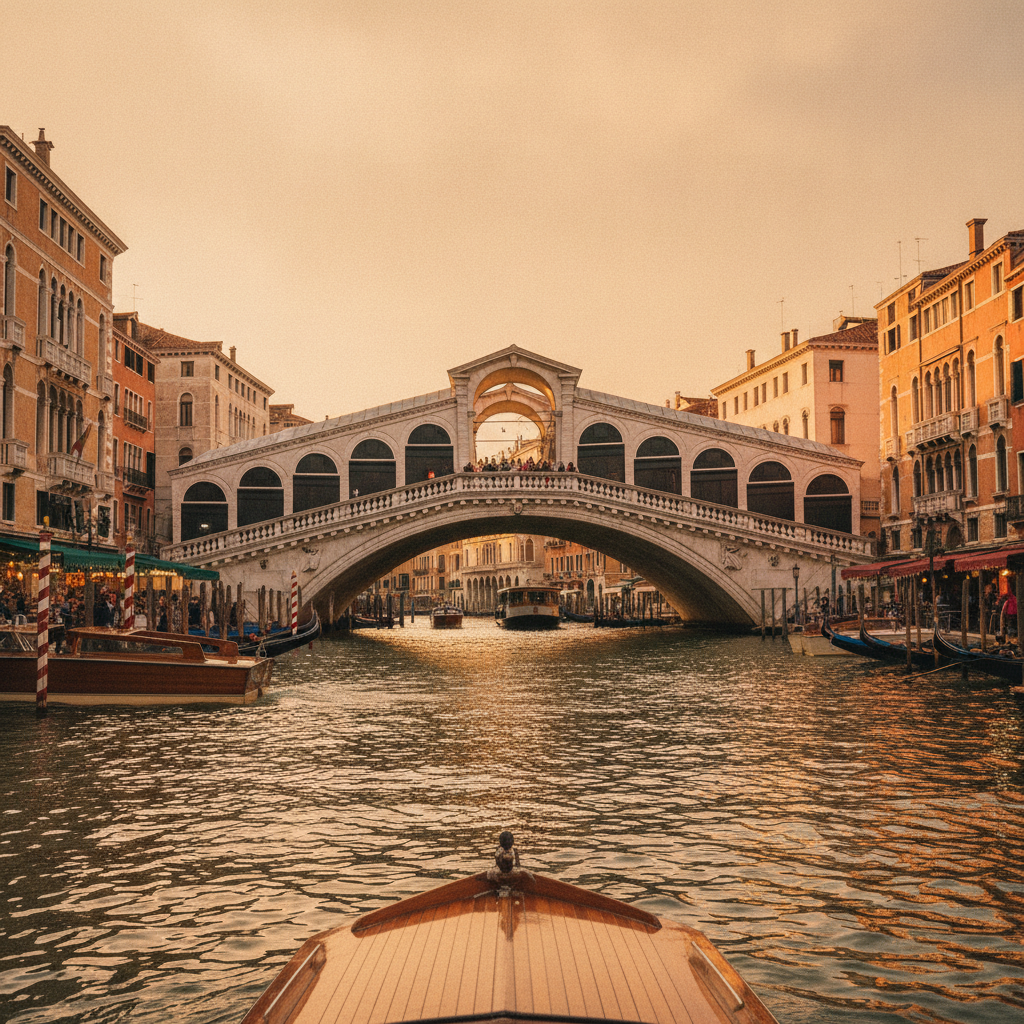
Ponte di Rialto (Rialto Bridge, crossing the Grand Canal at its narrowest point, Sestiere San Marco/San Polo border, Venice — the stone bridge built between 1588 and 1591 by Antonio da Ponte, replacing a series of earlier wooden bridges at this location, the oldest of which dates from circa 1255: the competition to design a permanent stone bridge at the Rialto was one of the most famous architectural competitions of the Renaissance, with proposals submitted by Michelangelo, Palladio, Sansovino, and other major architects all rejected in favour of Antonio da Ponte's more practical design; the bridge's single stone arch spans 28 metres across the canal at its narrowest point (approximately 28 metres wide at this location), with the arch rising 7.5 metres above the canal surface at its highest point; the bridge is 22 metres wide and is lined on both sides with two rows of shops (currently jewellers, leather goods, and souvenir shops, as they have been since the bridge's construction) separated by a central promenade and flanked by two external walkways with balustrades that provide views up and down the canal; the Rialto Bridge has been the commercial and symbolic centre of Venice for over seven centuries — it was the point at which merchants gathered to exchange news and do business, the location of the city's earliest banks (banca rota, or 'broken bench' — the bench of a failed banker was literally broken, giving us the modern word 'bankrupt'), and the centre of the spice and commodity trade that made Venice the richest city in medieval Europe.
- 3
Mercato di Rialto (Rialto Market) — Venice's Legendary Fish & Produce Market
Mercato di Rialto (Rialto Market, Campi de la Pescaria and Campo de la Fruta, Sestiere San Polo, Venice — the wholesale and retail market that has operated on the San Polo bank of the Grand Canal at the Rialto since the 11th century, making it one of the oldest continuously operating markets in Europe: the market occupies two adjacent campos — the Pescheria (fish market) and the Erbaria (produce market) — both covered by late Gothic/neo-Gothic loggia structures (the current Pescheria loggia dates from 1907, designed in neo-Gothic Venetian style by Domenico Rupolo on the site of an earlier medieval loggia); the Pescheria (fish market) is the most spectacular element of the Rialto Market and one of the most visually extraordinary daily markets in Europe — the stone counter displays the extraordinary diversity of seafood fished from the Northern Adriatic and the Venetian Lagoon: scampi (langoustines), seppie (cuttlefish, used in the classic Venetian pasta 'bigoli in salsa'), moleche (soft-shell crabs, available only in spring and autumn when the crabs moult, and a seasonal delicacy of Venetian cuisine), granseola (spider crab), caparossoli (clams, used in the classic 'pasta alle vongole'), and a variety of fish including branzino (sea bass), orate (sea bream), rombo (turbot), and the lagoon's characteristic flat fish; the market operates Tuesday through Saturday approximately 07:00-12:00.
- 4
Ca' d'Oro (House of Gold) — The Most Beautiful Gothic Palace on the Grand Canal
Ca' d'Oro (House of Gold, Calle Ca' d'Oro, Sestiere Cannaregio, Venice, fronting the Grand Canal — the Gothic palazzo built between 1421 and 1440 for the Venetian nobleman Marino Contarini, considered the most beautiful example of Venetian Gothic architecture and the most ornate palazzo facade on the Grand Canal: the palazzo takes its name from the original gilded decoration of its facade (the tracery, columns, and decorative elements were originally covered in gold leaf, vermillion, and ultramarine blue paint, of which all traces have long since disappeared leaving only the white Istrian stone lacework); the facade is characterized by the characteristic elements of Venetian Gothic palazzo design — the superimposed arcaded loggias (three logge, one on each storey, with pointed ogival arches in the Eastern Gothic manner influenced by Venetian trade with the Byzantine and Islamic world), the off-centre location of the entrance portal (the portego d'acqua, or water entrance), and the asymmetrical arrangement of the window openings that contrasts with the symmetrical regularity of Florentine Renaissance architecture; the building now houses the Galleria Giorgio Franchetti (the museum of the art collection donated by Baron Giorgio Franchetti to the Italian state in 1916), which contains significant works including Andrea Mantegna's 'St Sebastian' (1506), Titian's 'Venus at a Mirror', and important examples of Venetian bronze sculpture.
- 5
Fondaco dei Tedeschi — The German Merchants' Warehouse & Venice's Commercial History
Fondaco dei Tedeschi (Ruga dei Oresi, Sestiere San Marco, Venice, adjacent to the Rialto Bridge on the San Marco bank — the former trading post (fondaco, from the Arabic funduq, a combined warehouse, hostel, and trading post) of the German merchants (tedeschi, meaning 'Germans' but broadly including merchants from the Holy Roman Empire including German, Austrian, Flemish, and Hungarian traders) that operated in Venice from the early 13th century: the fondaco system — the mandatory residential and commercial complex in which foreign merchants were required by Venetian law to live, store their goods, and conduct their trade under direct government supervision — was one of the most sophisticated instruments of Venetian commercial regulation and intelligence gathering; the building visible today was constructed between 1505 and 1508 following the destruction of the earlier fondaco by fire in 1505, and was one of the largest buildings in Venice at the time of its construction; the exterior of the building facing the Grand Canal was decorated with frescoes by Giorgione and the young Titian in 1508 (the only exterior fresco commission of Titian's career), of which only fragments survive (now in the Ca' d'Oro); the building has served various functions since the suppression of the German merchant community following Napoleon's conquest of Venice, and now (since 2016) operates as a luxury shopping centre (part of the Benetton Group's DFS retail chain) with a rooftop terrace accessible to the public that provides one of the finest 360-degree views of Venice available without climbing the Campanile.
- 6
Gondola Traghetto & Canal Observation Point — Reading the Grand Canal
Gondola Traghetto service (the public gondola ferry crossings of the Grand Canal operated at several fixed points along the canal's length as an affordable alternative to the four permanent bridges — the principal Rialto-area traghetto operates between the Riva del Carbon on the San Marco bank and the Riva del Vin on the San Polo bank, directly adjacent to the Rialto Bridge): the traghetto is the most economical way to experience a gondola ride in Venice (the crossing costs approximately 2 euros versus the standard gondola ride price of 80-100 euros for 30 minutes), and offers a brief but authentic working experience of the Grand Canal at the level of the waterway rather than from the elevated vantage of a bridge; the traghetti are operated by gondoliers in traditional black gondolier costume (black and white striped shirt, black hat) and the crossing takes approximately 2-3 minutes; the convention for traghetto passengers is to stand upright during the crossing rather than sit, though tourists are generally excused from this local etiquette; the Grand Canal in the Rialto area is among the busiest waterways in Venice — the combination of vaporetto water buses (routes 1, 2, and N/night bus all use this section), private water taxis, delivery barges (the moto topo flat-bottomed cargo boats that supply all goods to Venice since no wheeled vehicles can operate in the city), gondolas, and private boats creates the characteristic Venetian waterway experience; the canal's tidal nature (Venice experiences a semi-diurnal tidal cycle of approximately 0.5-1 metre) means that its level and current vary throughout the day.
Walk this route with audio
Stories play automatically as you reach each stop — no tapping needed.
More in venice
Cannaregio Sestiere, the Jewish Ghetto & Fondamente Nove Waterfront
Piazza San Marco, Basilica di San Marco, Palazzo Ducale & the Campanile
The Gondola: Squero di San Trovaso, the Traghetti & Venice's Working Watercraft
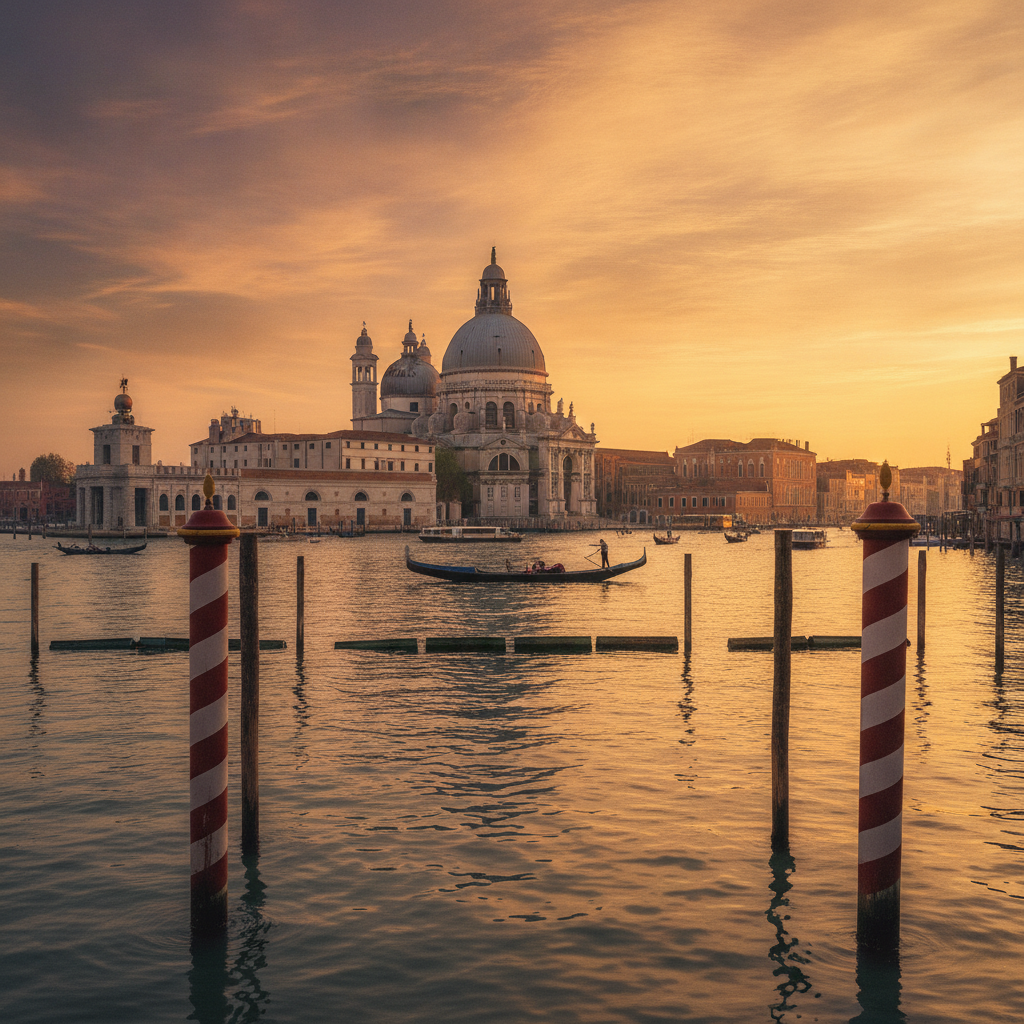
Dorsoduro: Gallerie dell'Accademia, Peggy Guggenheim Collection & Santa Maria della Salute
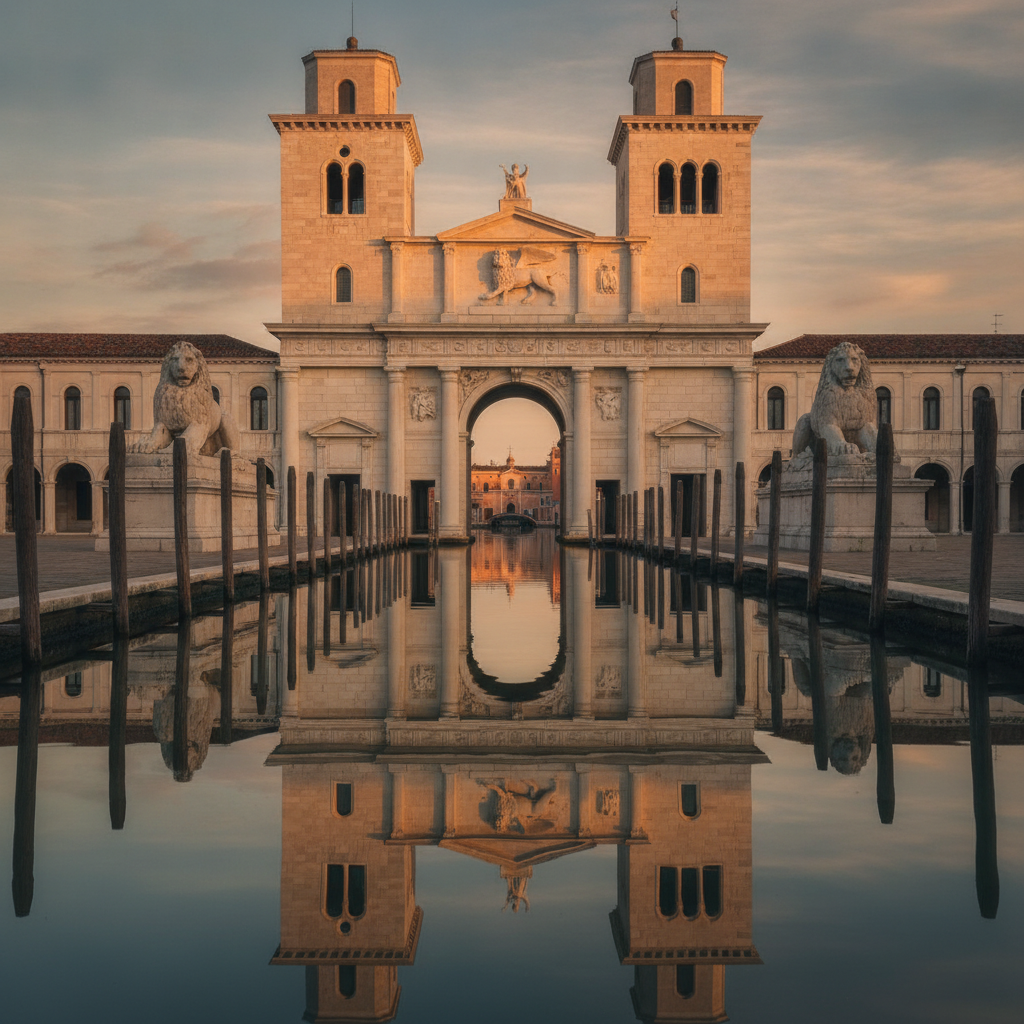
Castello Sestiere: the Arsenale, Venice Biennale Gardens & San Giovanni e Paolo