Victoria BC: The Colonial Governor of Mixed African and Creole Heritage Who Built British Columbia, the Nanaimo Bar That Is Considered a Definitive Canadian Dessert and a Castle Built by a Coal Baron Who Was Famously Anti-Labour
Read the story of James Douglas who founded Victoria as a man of mixed Black Creole and Scottish ancestry married to the daughter of a Cree woman and built the most explicitly British colonial society in Canada, drive north 110 kilometres to Nanaimo to find the three-layer chocolate custard bar named for the city and regarded across Canada as the quintessential Canadian dessert in dozens of bakery variations on the original recipe, visit Hatley Castle in Colwood where James Dunsmuirs son of the coal baron who built Craigdarroch built a 40-room baronial estate with formal Italian and Japanese gardens and then the government bought it for a navy training base in 1940, cycle the Lochside Trail from the Inner Harbour to Butchart Gardens through Saanich Peninsula farmland to arrive at the quarry garden that 1 million visitors see annually, attend the Moss Street Paint-In where 250 artists set up on the sidewalk for the largest outdoor art event in British Columbia, and understand that Cook Street Village in Fairfield is the neighborhood commercial street that most Victoria residents would name as the place that best represents what they want their city to be.
- 1
Victoria Oak Bay Marina and Waterfront
The Oak Bay Marina on the southeastern waterfront of Greater Victoria, on the protected waters of Oak Bay between the Oak Bay headland and the Trial Islands, provides moorage for approximately 600 recreational and commercial vessels and is the primary point of departure for recreational salmon and halibut fishing in the offshore waters of the Strait of Juan de Fuca. The chinook salmon fishing around the southern tip of Vancouver Island, with a charter boat industry operating from Oak Bay Marina and the Saanich Inlet from May through September, is the most productive marine recreational fishery in British Columbia south of the central coast. The Trial Islands adjacent to Oak Bay Marina are a small provincial ecological reserve protecting rare arbutus and Garry oak coastal bluff habitat. The Cattle Point area at the southern end of Oak Bay, where a boat launch and shore-fishing access point overlooks the Race Rocks tidal channel, provides some of the most accessible whale and marine mammal watching from shore in Greater Victoria, with sea lions haul out on the rocks below the seawall and orca passing through the tidal race at speed during their salmon hunting. The Dallas Road seawall walk from Ogden Point to Clover Point and then to the Oak Bay shoreline is a continuous 8-kilometre pedestrian route along the southern shore of Victoria combining urban waterfront, Beacon Hill Park, and the beginning of the Oak Bay beach promenade.
- 2
Victoria Nanaimo and North Island
Nanaimo, the second largest city on Vancouver Island 110 kilometres north of Victoria via the Trans-Canada Highway or 1 hour by BC Ferries from Horseshoe Bay in West Vancouver, was the primary coal mining center on the west coast of Canada from the 1850s through the 1950s, with the coal mines of Nanaimo and Extension providing fuel for the Royal Navy, the CPR steamships, and Pacific coast industry. The Nanaimo Bar, the three-layer no-bake dessert square of chocolate and custard credited to Nanaimo and celebrated annually with a Nanaimo Bar Trail of bakeries and cafes offering variations on the recipe, is the most famous culinary export of British Columbia and is regarded across Canada as a definitive Canadian dessert. The Nanaimo Bastion, a wooden HBC fortification built in 1853 and the oldest standing wooden structure in western Canada, is preserved downtown. The drive north from Nanaimo on the Island Highway through the Comox Valley, Campbell River, and Strathcona Provincial Park, ending at the Telegraph Cove area and Port Hardy, covers the full length of Vancouver Island through communities dependent on forestry, fishing, and increasingly tourism, with the Great Bear Rainforest beginning at the northern tip of the Island and extending up the BC coast. The Strathcona Provincial Park, BC oldest provincial park established in 1911, protects the interior wilderness of central Vancouver Island.
- 3
Victoria Hudson Bay Company Origins
James Douglas, who founded Fort Victoria in 1843, served simultaneously as Chief Factor of the HBC and Governor of the Colony of Vancouver Island from 1851 and then Governor of the Colony of British Columbia from 1858, making him the most powerful individual in Pacific Northwest history for over 20 years and the figure whose decisions about settlement, Indigenous relations, and colonial development most shaped the society that became British Columbia. Douglas was born in British Guiana of a Scottish father and a free Creole woman of mixed Black and European ancestry, making him one of the few colonial governors of non-European heritage in British colonial history. Douglas wife Amelia was the daughter of a Cree woman and a HBC officer, making their children of mixed European and Indigenous ancestry in the colonial capital they governed. The complexity of Douglas heritage and the racial ideologies of colonial Victoria, which celebrated him as the founder of British Columbia while he worked within a system of racial hierarchy, has been addressed by BC historians in recent decades. The Douglas relationship with the Lekwungen people, which involved genuine respect for Indigenous knowledge alongside colonial dispossession, represents the ambiguity at the foundation of Victoria identity. His career embodies the paradox of a man of mixed ancestry building an explicitly British colonial society.
- 4
Victoria Moss Street Art Market
The Moss Street Paint-In, held annually since 1991 on a Saturday in July on the residential stretch of Moss Street through the Rockland and Fairfield neighborhoods, is the largest outdoor art event in British Columbia, with approximately 250 artists setting up easels, tables, and displays along several blocks of the street for a daylong open-air market and performance event attracting over 20,000 visitors. The event has helped establish Moss Street as the primary arts-identified residential street in Victoria, with gallery spaces, working artist studios, and arts organizations concentrated in its Rockland and Fairfield sections. The Fairfield neighborhood south of Beacon Hill Park, immediately east of James Bay, is the most desirable residential neighborhood in Victoria for young families and professionals, combining proximity to the park, the Dallas Road waterfront, and the residential streetscape of Craftsman and arts-and-crafts houses from the 1910s and 1920s. The Cook Street Village commercial node in Fairfield, a two-block strip of independent coffee shops, restaurants, bakeries, and specialty food shops, serves as the neighborhood heart and is considered the most successful neighborhood commercial district in Victoria. The combination of Beacon Hill Park, the Dallas Road waterfront, the Cook Street Village amenities, and the housing stock makes Fairfield the neighborhood most consistently cited as the most livable in the city.
- 5
Victoria Hatley Castle and Royal Roads
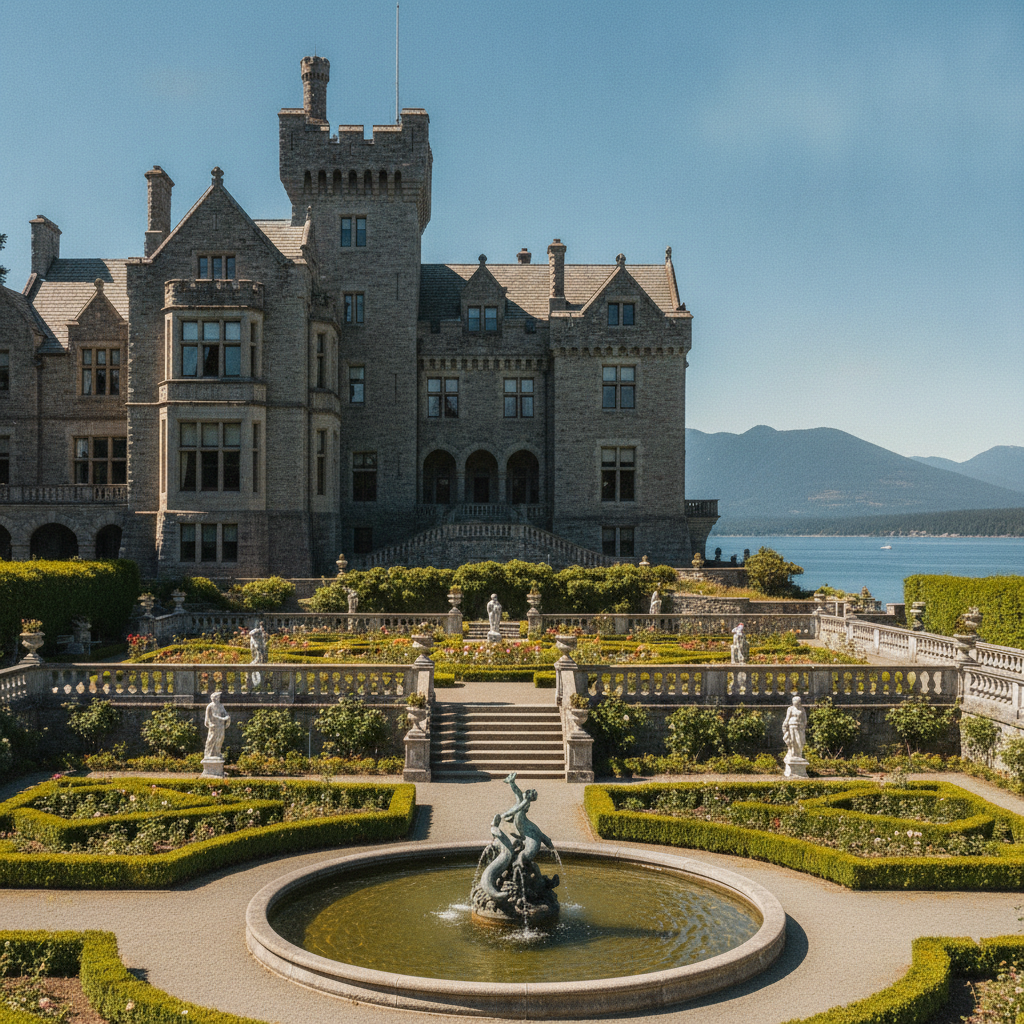
Hatley Castle, a 40-room Edwardian baronial castle built by James Dunsmuir, son of coal baron Robert Dunsmuir and Premier and Lieutenant Governor of British Columbia, between 1908 and 1910 on a 700-acre estate in Colwood west of Victoria, was sold to the federal government in 1940 and served as a Royal Canadian Navy training establishment during World War II before becoming the campus of Royal Roads Military College and subsequently Royal Roads University. The castle, with its Italian gardens, Japanese garden, rose garden, and wilderness forest estate, is open to public visits and has been used as a filming location for dozens of television productions including portions of X-Files and various American science fiction series that use the castle exterior as a stand-in for European or American period settings. The gardens of Hatley Castle, designed in 1909 by the Boston firm Brett and Hall who also designed the Butchart Gardens, are considered among the finest Edwardian formal gardens in western Canada. The Dunsmuir family history, from Robert Dunsmuir who built Craigdarroch Castle and died before occupying it, through his son James who built Hatley Castle and who was notoriously anti-labor in his management of the Vancouver Island coal mines, represents the complete arc of Vancouver Island resource extraction wealth and its social consequences.
- 6
Victoria Accommodation and Experience Summary
Victoria Greater offers accommodation ranging from the historic Fairmont Empress Hotel on the Inner Harbour to dozens of bed and breakfast properties in the heritage houses of James Bay, Rockland, and Fairfield, to boutique hotels in the Exchange District and Johnson Street. The most atmospheric accommodation is in the heritage houses of the inner neighborhoods, where gardens maintained by retired owners are visible from guest rooms and afternoon tea is sometimes served by hosts who take the tradition seriously. The summer tourism season from May through September fills accommodation at premium rates, with the Inner Harbour area commanding the highest prices. Visitors who come in February for the garden season should book early as the winter visitation is growing. The compact downtown and the Galloping Goose cycling infrastructure make a car unnecessary for visitors focused on the urban experience, with the cycling network connecting the Inner Harbour to Butchart Gardens via the Lochside Trail. The combination of afternoon tea at the Empress, a whale watching excursion, a Butchart Gardens evening with fireworks, and a day trip to Salt Spring Island represents the conventional Victoria visitor experience. The unconventional experience includes the Juan de Fuca Marine Trail, the Fernwood arts community, the Fort Street antique district, and the Sooke Potholes freshwater swimming that serve a resident audience rather than a tourist one but reward the visitor who finds them.
Walk this route with audio
Stories play automatically as you reach each stop — no tapping needed.
More in Victoria
Victoria BC: The Six-Gill Sharks in the Anoxic Fjord Nobody Talks About, the Language With Fewer Than 20 Fluent Speakers That Is Now Being Taught in Schools and the Blue Flower Fields That Fed a People for Thousands of Years
Praslin Island: Vallée de Mai UNESCO Forest & Anse Lazio
Victoria BC: The Most English City in Canada Where 85 Percent of Residents Were Born in Canada, the Afternoon Tea Capital of North America and the Capital of a Province 14 Times the Size of Switzerland
Victoria BC: The First Brew Pub in Canada That Has Been Serving Pints Since 1984, the Oldest Building in Western Canada Outside Quebec and the Intertidal Zone That Has No Equal in British Columbia
Victoria BC: The Architect Who Designed Both the Legislature and the Empress Hotel Was Murdered by His Young Wife Lover in England, Craigdarroch Castle Built by a Coal Baron Who Died Before Moving In and Canada Coldest Water Surfers