Klimt & Baroque Splendor: Belvedere to Karlskirche
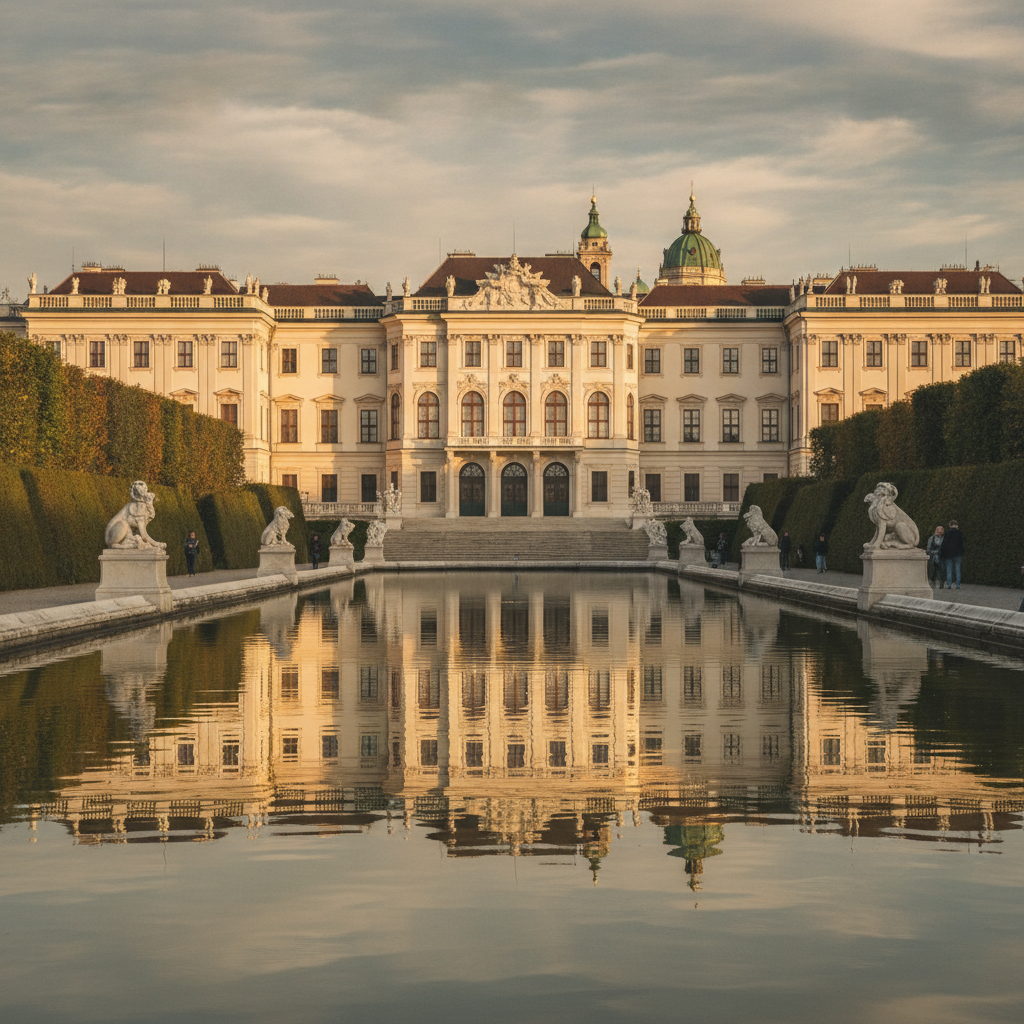
Prince Eugene of Savoy built the Belvedere complex as the most lavish private palace in 18th-century Vienna; today the Upper Belvedere houses Gustav Klimt's The Kiss in its original gilded glory, flanked by Schiele, Kokoschka, and the greatest concentration of Viennese Modernism anywhere. The route then continues north to Karlskirche, the masterpiece of Johann Bernhard Fischer von Erlach and the finest Baroque church in Vienna.
- 1
Upper Belvedere
The Upper Belvedere (Oberes Belvedere), built between 1717 and 1723 by Johann Lukas von Hildebrandt for Prince Eugene of Savoy, was conceived as the greatest private garden palace in Europe — a building designed purely for pleasure and display, not for residence. Today it houses the Österreichische Galerie Belvedere, the finest collection of Austrian art from the Middle Ages to the 20th century. The museum's centerpiece and Vienna's single most famous artwork is Gustav Klimt's The Kiss (1907–08), a 180×180cm canvas of two figures entwined in gold-leaf mosaic, emblem of the Gesamtkunstwerk ideal that drove the Viennese Secession. The museum also holds major works by Egon Schiele — including Death and the Maiden — and Oskar Kokoschka.
- 2
Lower Belvedere & Baroque Museum
The Lower Belvedere (Unteres Belvedere), the earlier and more intimate of the two palaces, was Prince Eugene's actual summer residence, completed in 1716. Its Marble Hall and Golden Cabinet are among Vienna's finest Baroque interiors; the Orangery, converted into a museum, holds a collection of medieval Austrian art and the original lead statues from the Sphinx Alley in the garden (now replaced with reproductions). The Belvedere stables, also now a museum space, were designed with the same architectural care as the palace itself — an indication of the prince's extraordinary expenditure on this pleasure estate.
- 3
Orangery
The Orangery of the Lower Belvedere, a 120-meter-long winter garden built in 1712 to shelter Prince Eugene's exotic plant collection, is today a museum gallery space primarily dedicated to medieval Austrian art. In a less famous but historically pivotal moment, the Orangery was the site of the first public performance of Beethoven's Seventh Symphony in December 1813, conducted by Beethoven himself, at a concert benefiting soldiers wounded at the Battle of Hanau. The performance was a triumph — the second movement Allegretto was immediately encored — and re-established Beethoven's reputation in Vienna after a difficult decade.
- 4
Belvedere Gardens
The Belvedere gardens, laid out between 1700 and 1725, are the finest surviving example of a Baroque garden in Vienna and one of the best in Central Europe. The garden's geometry — three descending terraces linked by cascades, with the Upper Belvedere at the top and the Lower Belvedere at the bottom — creates a single theatrical composition visible from both ends. The central water feature, the Great Cascade, is flanked by two Sphinx Alleys; the sphinxes and allegorical figures are 18th-century originals (the sphinxes in situ are reproductions; originals are in the Orangery). The garden is freely accessible and extensively used by Viennese for daily exercise.
- 5
Karlskirche
The Karlskirche (St. Charles's Church), built between 1716 and 1737 by Johann Bernhard Fischer von Erlach and completed by his son Joseph Emanuel, is the supreme example of Austrian Baroque architecture and the most complex sacred building in Vienna. Emperor Charles VI commissioned it as a votive offering after a devastating plague of 1713, which killed over 8,000 Viennese. Its facade is without precedent: a Roman temple portico flanked by two freestanding columns modeled on Trajan's Column in Rome — each 33 meters high, their spiral reliefs depicting scenes from the life of St. Charles Borromeo. Inside, the panoramic fresco cycles on the dome can now be seen close-up from a modern elevator-equipped panorama platform installed inside the dome itself.
- 6
Schwarzenbergplatz
Schwarzenbergplatz is one of Vienna's grandest squares, marking the boundary between the Ringstrasse and the residential districts behind it. At its center stands the equestrian statue of Prince Karl Philipp zu Schwarzenberg, commander of the allied forces at the Battle of Leipzig in 1813 that broke Napoleon's grip on Europe. Behind the Schwarzenberg monument stands the Soviet War Memorial (Heldendenkmal der Roten Armee), erected in 1945 to commemorate Soviet soldiers killed in the battle for Vienna — the only Soviet war monument in Western Europe still standing in its original location, maintained by Austria under the 1955 State Treaty that ended the occupation.
Walk this route with audio
Stories play automatically as you reach each stop — no tapping needed.
More in vienna
Old Vienna: Prater, Riesenrad & Leopoldstadt
Color & Harmony: Hundertwasser, Stadtpark & the Danube Canal
Imperial Summer: Schönbrunn Palace & Gardens
Empire's Heart: Stephansdom & the Innere Stadt
Markets & Modernism: Naschmarkt to MuseumsQuartier