Coffeehouse Vienna: From Café Central to Josefstadt
The Viennese coffeehouse is a UNESCO Intangible Cultural Heritage — a specific institution, not just a café, with its newspapers-on-holders, marble tables, unhurried waiters, and the unspoken agreement that ordering one coffee entitles you to stay all day. This route connects Vienna's most famous coffeehouses with the 8th district Josefstadt, the city's most concentrated neighborhood of late Baroque architecture and bourgeois cultural life.
- 1
Café Central
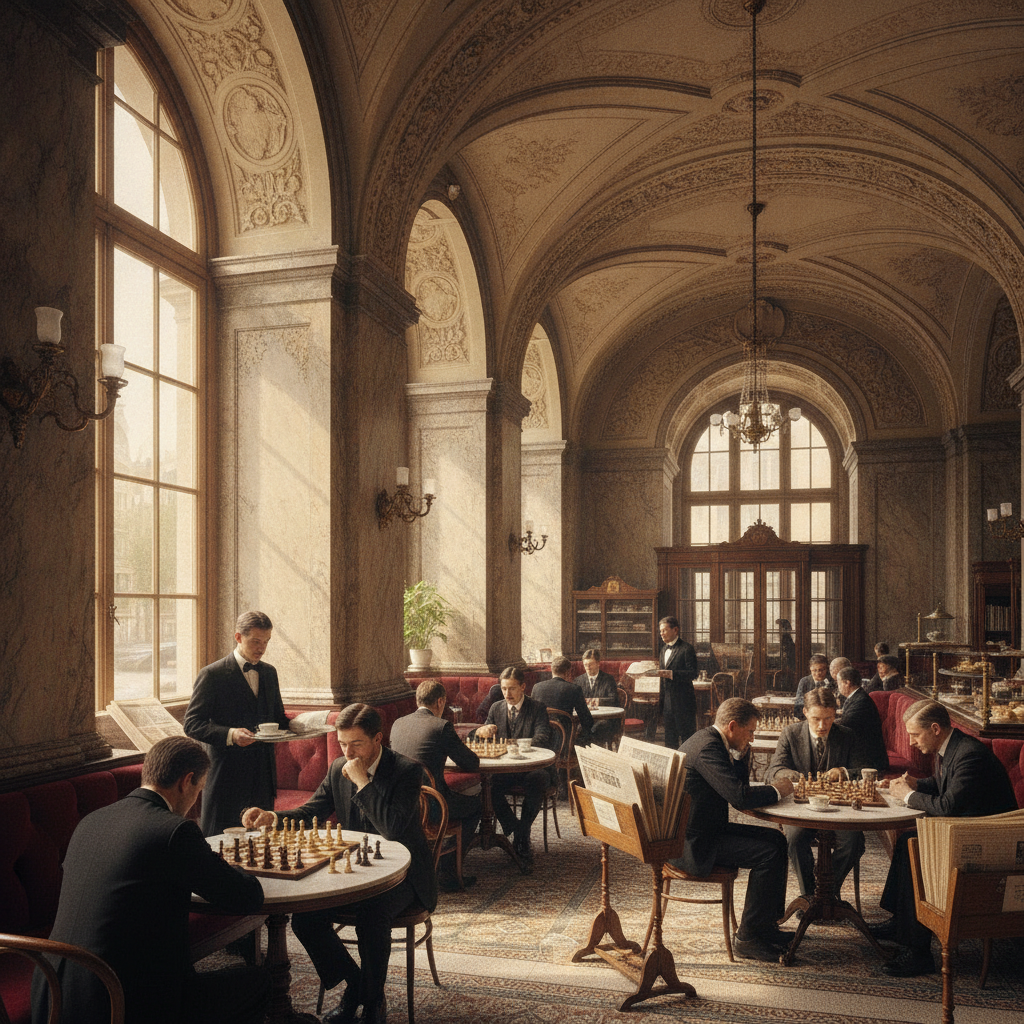
Café Central, opened in 1876 in the ground floor of the Palais Ferstel (1860), is the most architecturally spectacular coffeehouse in Vienna and perhaps in the world. Its interior — soaring vaulted ceilings, marble arches, painted lunettes, and marble-topped tables — was designed by the Ringstrasse architects Ferstel and Gottfried Semper for maximum theatrical effect. The café was the intellectual center of fin-de-siècle Vienna: Leon Trotsky played chess here in 1907-1913 (a cardboard figure of him still sits at the entrance), Sigmund Freud, Arthur Schnitzler, Hugo von Hofmannsthal, Alfred Adler, and Peter Altenberg were regular patrons. The café closed in 1944, was used as a warehouse, and was painstakingly restored to its original grandeur and reopened in 1986.
- 2
Café Landtmann
Café Landtmann, founded in 1873 and located directly across from the Rathaus on the Ringstrasse, has been Vienna's most politically connected coffeehouse for 150 years. Sigmund Freud was a regular, as were Gustav Mahler, Adolf Loos, Paul Anka, and every Austrian federal chancellor from Karl Renner to the present day. The café's privileged location — between the University, the Burgtheater, and the Parliament — made it the informal salon where journalists, politicians, academics, and artists intersected. Unlike Café Central's restored grandeur, Landtmann's interior is more understated, but its garden terrace facing the Rathaus park is one of the finest outdoor café settings in the city.
- 3
Josefstadt Theater
The Josefstadt Theater, founded in 1788 and Vienna's oldest continuously operating theater still in its original building, gave its 200th anniversary production in 1988 under the direction of Max Reinhardt, who had transformed it from a minor variety theater into a distinguished repertory house in 1924. The theater's bicentennial production was the Austrian premiere of Raimund's Verschwender, attended by Beethoven. Today the Josefstadt operates as a publicly-funded repertory theater with a permanent ensemble, staging classic and contemporary drama — one of three such companies in Vienna along with the Burgtheater and the Volkstheater.
- 4
Piaristenkirche (Maria Treu)
The Piaristenkirche — formally the Church of Maria Treu (Mary of the Faithful) — stands at the heart of the Josefstadt on its own elegant square and is one of Vienna's finest surviving High Baroque churches. Built between 1698 and 1753 by the Piarist order (a teaching order whose members ran schools throughout Catholic Europe), its twin-towered facade and compact interior are considered among Lucas von Hildebrandt's finest sacred work. The church's most celebrated feature is the ceiling fresco cycle by Franz Anton Maulbertsch (1752), the greatest Austrian Baroque painter — the largest Maulbertsch commission still in its original setting.
- 5
Altes AKH (Old General Hospital)
The Altes Allgemeines Krankenhaus (Old General Hospital) campus, built by Emperor Joseph II between 1783 and 1796 as Europe's largest hospital, today forms the main campus of the University of Vienna after being repurposed in the 1990s. Its extraordinary courtyard complex — ten interconnected courtyards of different sizes, linked by arcaded walkways — is one of the hidden gems of Vienna's urban fabric, a miniature city within the city largely unknown to tourists. The hospital was the birthplace of the Vienna Medical School in the 19th century: Semmelweis discovered handwashing here in 1847, and Sigmund Freud completed his residency here in the early 1880s.
- 6
Volksoper
The Volksoper (People's Opera), built in 1898 as a municipal theater for the 50th anniversary of Emperor Franz Joseph's reign, is Vienna's second opera house after the State Opera and performs operetta, musical theater, and opera for lower ticket prices in a more informal atmosphere. Its repertoire — dominated by Viennese operetta (Lehár, Kálmán, Strauss) and German-language opera — preserves the central European musical tradition that the Vienna State Opera increasingly leaves aside in its pursuit of international prestige. For visitors interested in authentic Viennese musical culture rather than global opera celebrity, the Volksoper often provides a more genuinely local experience.
Walk this route with audio
Stories play automatically as you reach each stop — no tapping needed.
More in vienna
Old Vienna: Prater, Riesenrad & Leopoldstadt
Color & Harmony: Hundertwasser, Stadtpark & the Danube Canal
Imperial Summer: Schönbrunn Palace & Gardens
Empire's Heart: Stephansdom & the Innere Stadt
Markets & Modernism: Naschmarkt to MuseumsQuartier