Imperial Vienna: The Hofburg & Habsburg Legacy
For six centuries the Hofburg was the winter residence of the Habsburg dynasty — the family that ruled Austria, and at times much of Europe, from 1273 to 1918. Today the complex occupies 240,000 square meters in the heart of Vienna, containing multiple museums, the Spanish Riding School, the Imperial Chapel, and the offices of the Austrian President. This walk explores the apartments of Emperor Franz Joseph and Empress Sisi, the subterranean crypt where Habsburg hearts are stored, and the palace gardens where Mozart gave his first Vienna concert.
- 1
Michaelerplatz & Hofburg Entrance
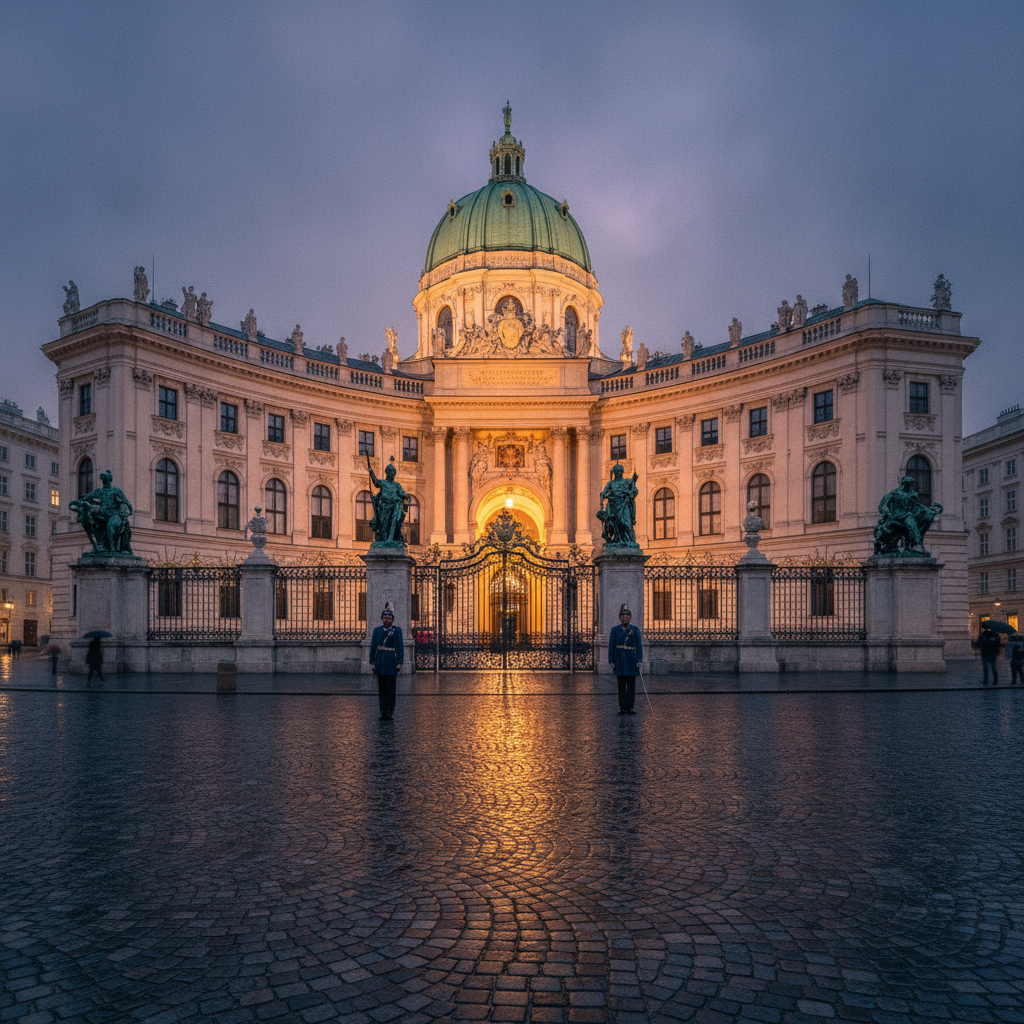
The Michaelerplatz — the square in front of the Hofburg's main gate — is one of Vienna's great urban compositions, framed on three sides by centuries of architectural ambition: the curvaceous Neo-Baroque Michaelertrakt (completed 1893), the Loos Haus (1912) opposite, the Michaelerkirche alongside, and the gate itself with its flanking fountains depicting Austria's mastery of the sea and land. Beneath the square, excavations in 1990 revealed the remains of a Roman military encampment from the 1st century AD, now visible through glass panels. The Michaelertor gateway, framed by the great dome above, is one of the most theatrical entrances in European architecture.
- 2
Imperial Apartments (Kaiserappartements)
The Imperial Apartments of Emperor Franz Joseph I and Empress Elisabeth (known as Sisi) occupy the first floor of the Reichskanzleitrakt wing. Franz Joseph's apartments are a study in spartan imperial duty: an iron military camp bed, a simple writing desk, and an unheated bathroom convey the Emperor's deliberate austerity in contrast to the gilded public rooms. Sisi's apartments tell a different story — the empress's obsessive gymnastics equipment, her portrait as a young woman by Franz Xaver Winterhalter, and her carefully preserved dressing room with its pharmacy scales (she weighed herself daily and maintained a 50cm waist throughout her adult life) reveal a woman at odds with the constraints of her role. The adjacent Sisi Museum is the most visited in Austria.
- 3
Spanish Riding School (Spanische Hofreitschule)
Founded in 1572 and housed since 1735 in a purpose-built Baroque riding hall designed by Josef Emanuel Fischer von Erlach, the Spanish Riding School is the oldest classical equestrian academy in the world still in operation. The Lipizzan stallions trained here perform the haute école movements — the levade, courbette, and capriole — that have been practiced continuously for 450 years. The hall itself is an architectural masterpiece: a white and gold Baroque space with crystal chandeliers, two tiers of royal boxes, and enough natural light through tall windows to illuminate the performances without artificial lighting. Attending a full performance is one of Vienna's most exclusive and expensive cultural experiences; morning training sessions are open to visitors.
- 4
Imperial Crypt (Kaisergruft)
Beneath the Kapuzinerkirche — the Capuchin Church on Neuer Markt — the Imperial Crypt holds the coffins of 149 members of the Habsburg dynasty across ten vault rooms spanning 400 years of history. The most visited grave is Empress Sisi's, covered in flowers left by visitors; nearby is Franz Joseph's, and beyond them the ornate double sarcophagus of Maria Theresa and her husband Franz I of Lorraine, designed by sculptor Balthasar Ferdinand Moll in 1753. Under Habsburg tradition, the bodies were divided after death: hearts went to the Augustinerkirche, intestines to the catacombs of the Stephansdom, and only the bodies came here — a peculiar legacy of medieval Catholic devotional practice.
- 5
Augustinerkirche (Court Parish Church)
The Augustinerkirche — the Augustinian Church — was the Habsburg parish church for five centuries, where royal christenings, weddings, and funerals were held, and where Haydn's Nelson Mass was premiered. Its most remarkable feature is the Herzgruft — the Heart Crypt — containing 54 silver urns holding the hearts of Habsburg rulers from the 17th to 20th centuries. The Neoclassical Canova memorial to Archduchess Maria Christina (1805) in the nave is considered one of the finest monuments of its era. The church is unusually plain by Vienna standards — deliberately so, as a reminder of Augustinian austerity.
- 6
Burggarten
The former private garden of the Habsburg emperors, the Burggarten was opened to the public in 1919 after the fall of the monarchy. It is best known for the marble statue of Mozart (1896) that stands at its center — probably the most photographed object in Vienna, its white marble always surrounded by visitors. The garden also holds a greenhouse with a butterfly house, a bronze equestrian statue of Emperor Franz Joseph, and the art nouveau Palmenhaus café in a magnificent iron-and-glass conservatory. On warm afternoons the Burggarten is one of the most pleasant open spaces in the city center.
Walk this route with audio
Stories play automatically as you reach each stop — no tapping needed.
More in vienna
Old Vienna: Prater, Riesenrad & Leopoldstadt
Color & Harmony: Hundertwasser, Stadtpark & the Danube Canal
Imperial Summer: Schönbrunn Palace & Gardens
Empire's Heart: Stephansdom & the Innere Stadt
Markets & Modernism: Naschmarkt to MuseumsQuartier