Color & Harmony: Hundertwasser, Stadtpark & the Danube Canal
Vienna's most colorful quarter connects the organic architecture of Friedensreich Hundertwasser — whose social housing project and converted factory-museum brought outsider Expressionism into the municipal mainstream — with the Stadtpark, Vienna's most beloved public park and the green lung of the inner city, and the Danube Canal waterfront that has become the city's most dynamic urban leisure strip.
- 1
Hundertwasserhaus
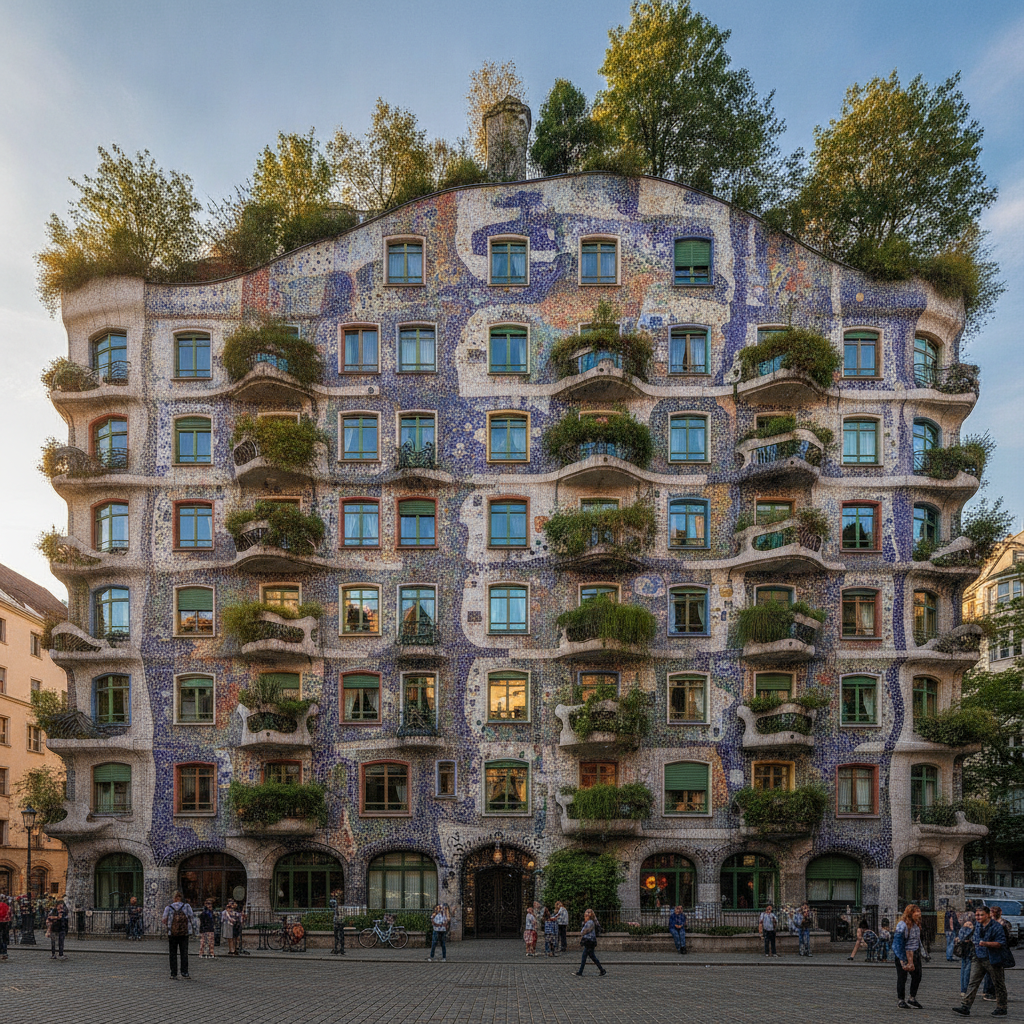
The Hundertwasserhaus (1983-86), a 52-apartment social housing block designed by the painter and architect Friedensreich Hundertwasser for the City of Vienna, is the most visited residential building in Europe — a structure so emphatically at odds with the rectilinear logic of 20th-century housing architecture that it stops pedestrians cold. Hundertwasser's fundamental principle was that straight lines are godless: the Hundertwasserhaus has no two windows the same, floors that undulate like hills, columns of different heights, and 250 trees growing on the roof terraces and inside the apartments, their roots visible through the facade. The building was built in collaboration with architect Joseph Krawina and remains occupied social housing; the residents' privacy is protected by a buffer of souvenir shops and a viewing area across the street.
- 2
KunstHaus Wien
The KunstHaus Wien, converted from a former Thonet bentwood furniture factory in 1991 by Hundertwasser himself, serves as the permanent museum of Hundertwasser's work and hosts temporary exhibitions of international art. The building's exterior — tiled in irregular multicolored ceramic mosaic, with undulating floors and tree-lined terraces — is itself a total work of Hundertwasser's art. The permanent collection on the upper floors presents the full trajectory of Hundertwasser's career, from his early gestural painting influenced by Paul Klee and Egon Schiele, through his mature architectural philosophy, to his environmental activism and ship and flag design. Hundertwasser died in 2000 aboard the Queen Elizabeth II.
- 3
Stadtpark (City Park)
The Stadtpark, opened in 1862 as Vienna's first public municipal park, occupies both banks of the Wien river where it enters the Ringstrasse district. Its English landscape style — informal plantings, winding paths, and romantic ponds — was a deliberate contrast to the formal Baroque geometry of Schönbrunn and the Augarten. The park's most famous element is the gilded statue of Johann Strauss II (1899) by Edmund Hellmer, depicting the Waltz King mid-bow with violin, the most photographed statue in Vienna. The park also contains memorials to Franz Schubert, Franz Lehár, Robert Stolz, and the painter Hans Makart — a monument to Vienna's extraordinary 19th-century cultural output.
- 4
Kursalon
The Kursalon Hübner, a grand Italianate pavilion built in 1867 within the Stadtpark, was originally a resort house for visitors taking medicinal treatments at the Wien river baths. Today it is a concert venue specializing in Johann Strauss and Mozart concerts — an explicitly tourist-facing operation offering what the Vienna Philharmonic does not: accessible, informal classical music in a beautiful setting. Strauss himself conducted here regularly in the 1860s; the Kursalon's terrace garden, facing the Stadtpark lawns, is one of the most pleasant outdoor dining spots in the central city.
- 5
Urania
The Urania (1910), a Jugendstil public education building designed by Max Fabiani on the bank of the Wien river at its junction with the Danube Canal, was built as a public observatory and science education center by the Vienna municipality — part of the late Habsburg city's ambitious program of popular enlightenment. Its rooftop observatory dome is still operational and open to the public on clear evenings. The Urania also contains a cinema (one of Vienna's oldest, continuously in operation), a theater, and the Urania Puppet Theater. The building's terrace bar overlooking the Danube Canal is a popular evening gathering point.
- 6
Schwedenplatz
Schwedenplatz (Sweden Square), the major transport hub on the Danube Canal where the U1 and U4 metro lines intersect, marks the northern boundary of the old city and the beginning of the canal waterfront promenade. The square's name dates from 1648, when Swedish envoys received payment here from the Austrian crown at the end of the Thirty Years' War. Today the canal embankment either side of Schwedenplatz hosts the Donaukanal bar and restaurant strip — a 3-kilometer open-air leisure zone of bars, clubs, art projects, and urban beaches that has transformed a previously industrial waterway into Vienna's most dynamic public space, particularly animated from April to October.
Walk this route with audio
Stories play automatically as you reach each stop — no tapping needed.
More in vienna
Old Vienna: Prater, Riesenrad & Leopoldstadt
Imperial Summer: Schönbrunn Palace & Gardens
Empire's Heart: Stephansdom & the Innere Stadt
Markets & Modernism: Naschmarkt to MuseumsQuartier
Klimt & Baroque Splendor: Belvedere to Karlskirche