Markets & Modernism: Naschmarkt to MuseumsQuartier
Vienna's most vibrant quarter west of the Ringstrasse combines the Naschmarkt — Central Europe's largest open-air market, a 500-stall institution that has fed the city since the 16th century — with the MuseumsQuartier, a former imperial stables complex transformed into one of Europe's largest contemporary art centers, and the Secession building, the manifesto-in-stone of the Wiener Secession movement that launched Klimt.
- 1
Naschmarkt
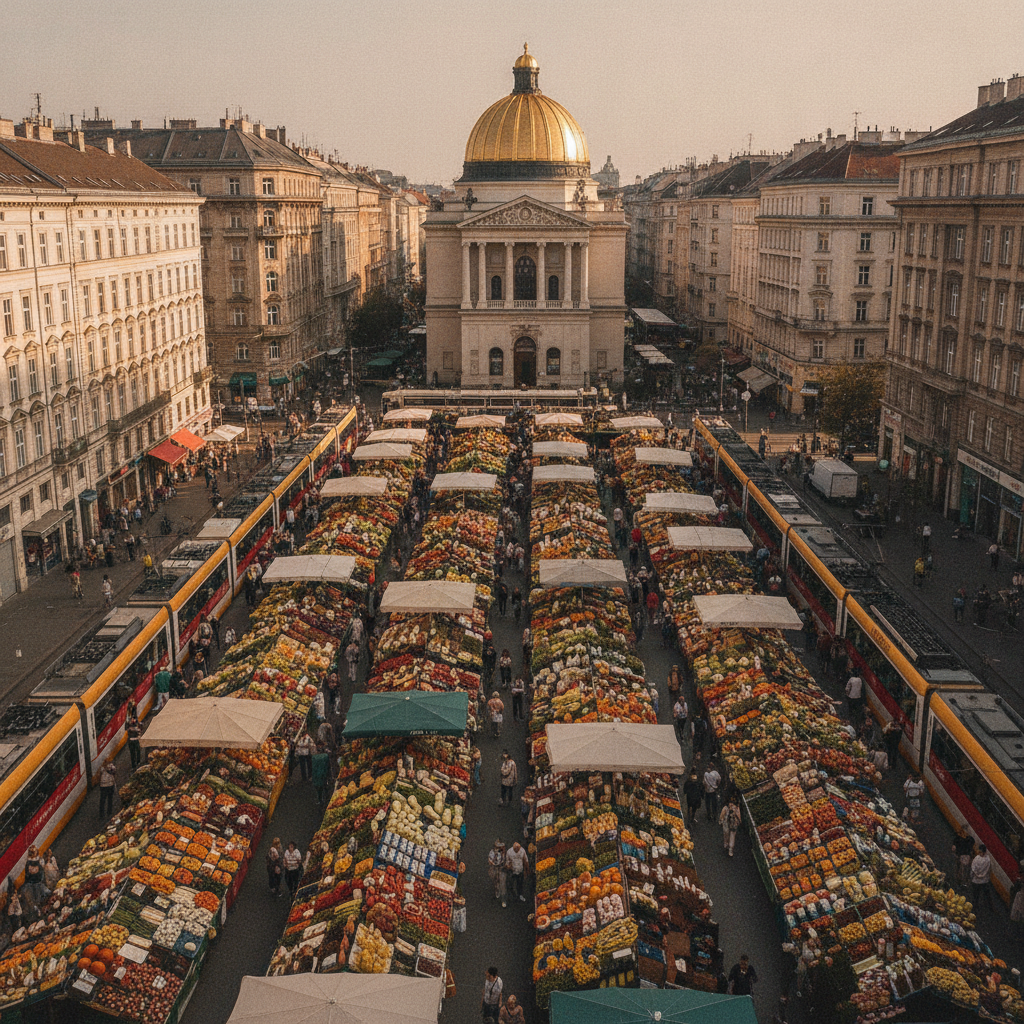
The Naschmarkt, stretching 1.5 kilometers along the Wienzeile between Karlsplatz and Kettenbrückengasse, is the largest outdoor market in Central Europe and one of Vienna's most democratic and sensory spaces. Its 500-plus permanent stalls have occupied this stretch since the 16th century — the market began as a milk market and expanded over centuries to become the provisioning center of the Habsburg capital. Today the stalls sell an extraordinary diversity of produce, cheeses, meats, fish, olives, spices, Turkish delicacies, Middle Eastern foods, and flowers, reflecting the waves of immigration that have shaped modern Vienna. Saturday mornings extend the market into a vast flea market stretching back from the permanent stalls.
- 2
Kettenbrückengasse
Kettenbrückengasse, the street station at the lower end of the Naschmarkt, marks the bohemian heart of the 5th and 6th districts — the Margareten and Mariahilf neighborhoods that have been Vienna's most creatively vital quarter for a generation. The streets around the station are lined with independent restaurants, wine bars, vintage shops, and studios that have made this area a genuine alternative to the tourist-facing First District. Schubert was born at Nussdorfer Straße 54 in the 9th district, but he died at a house near Kettenbrückengasse in November 1828, aged 31; the house is now a small museum.
- 3
MuseumsQuartier (MQ)
The MuseumsQuartier (MQ), opened in 2001 within the former imperial court stables built by Fischer von Erlach in 1725, is one of the ten largest cultural centers in the world by area. Its Fischer von Erlach Baroque wings frame a courtyard that is today one of Vienna's most animated public spaces — filled in summer with the famous MQ deck chairs (Enzis) that have become synonymous with Viennese outdoor leisure culture. The complex houses the Leopold Museum (the world's largest collection of Egon Schiele), MUMOK (Museum moderner Kunst), the Kunsthalle Wien contemporary art hall, the Architekturzentrum Wien, and dozens of smaller cultural organizations.
- 4
Secession Building
The Secession building (1897-98), designed by Joseph Maria Olbrich for the association of artists who broke away from the conservative Vienna Künstlerhaus in 1897, is the founding monument of Viennese Modernism. Its stark white cubic volumes, ornamental leaf-and-berry frieze, and the famous gilded dome of wrought-iron laurel leaves — nicknamed the Goldener Krauthappel (Golden Cabbage) by irreverent Viennese — announced a total break with historical ornament. Above its entrance the Secession's motto reads: DER ZEIT IHRE KUNST / DER KUNST IHRE FREIHEIT (To Every Age Its Art / To Art Its Freedom). In the basement, Klimt's Beethoven Frieze (1902) — 34 meters of painted casein and gold on plaster — has been permanently displayed since its rediscovery in the 1970s.
- 5
Theater an der Wien
The Theater an der Wien, founded in 1801 by Emanuel Schikaneder — the librettist of Mozart's The Magic Flute — is one of the oldest continuously operating theaters in Europe and arguably the most historically significant venue for opera in the world. Beethoven's Fidelio had its world premiere here in 1805; Beethoven himself lived in the theater's rooms during its composition. Mozart's Die Zauberflöte, which Schikaneder also starred in, was premiered at the earlier Freihaus-Theater auf der Wieden. After decades as a musical venue, the Theater an der Wien was restored as a full opera house in 2006 and operates as one of Vienna's three state-funded opera stages.
- 6
Mariahilfer Straße
Mariahilfer Straße, the 2-kilometer shopping street running west from the MuseumsQuartier, is Vienna's main shopping axis and the longest shopping street in Austria — though it is less famous globally than the Graben or Kohlmarkt, which are exclusively luxury retail, Mariahilfer Straße is where ordinary Viennese actually shop, with major chain stores alongside independent retailers. Its 2015 conversion to a pedestrian and bicycle zone was the most controversial urban planning decision in Vienna in a generation, generating years of public debate but ultimately proving widely popular. The Mariahilfer Kirche (Church of Mary Help), near the street's center at No. 55, contains a remarkable Baroque interior and holds a relic of St. Valentine.
Walk this route with audio
Stories play automatically as you reach each stop — no tapping needed.
More in vienna
Old Vienna: Prater, Riesenrad & Leopoldstadt
Color & Harmony: Hundertwasser, Stadtpark & the Danube Canal
Imperial Summer: Schönbrunn Palace & Gardens
Empire's Heart: Stephansdom & the Innere Stadt
Klimt & Baroque Splendor: Belvedere to Karlskirche