Old Vienna: Prater, Riesenrad & Leopoldstadt
The Prater park and its famous Riesenrad Ferris wheel occupy the island between the Danube and the Danube Canal in Vienna's 2nd district, Leopoldstadt — the historic Jewish quarter of Vienna that was the cultural hub of the city's Ashkenazi community before the Holocaust. The route connects the Prater's fairground nostalgia with Leopoldstadt's layered history and the Augarten park, Vienna's oldest public garden.
- 1
Riesenrad (Giant Ferris Wheel)
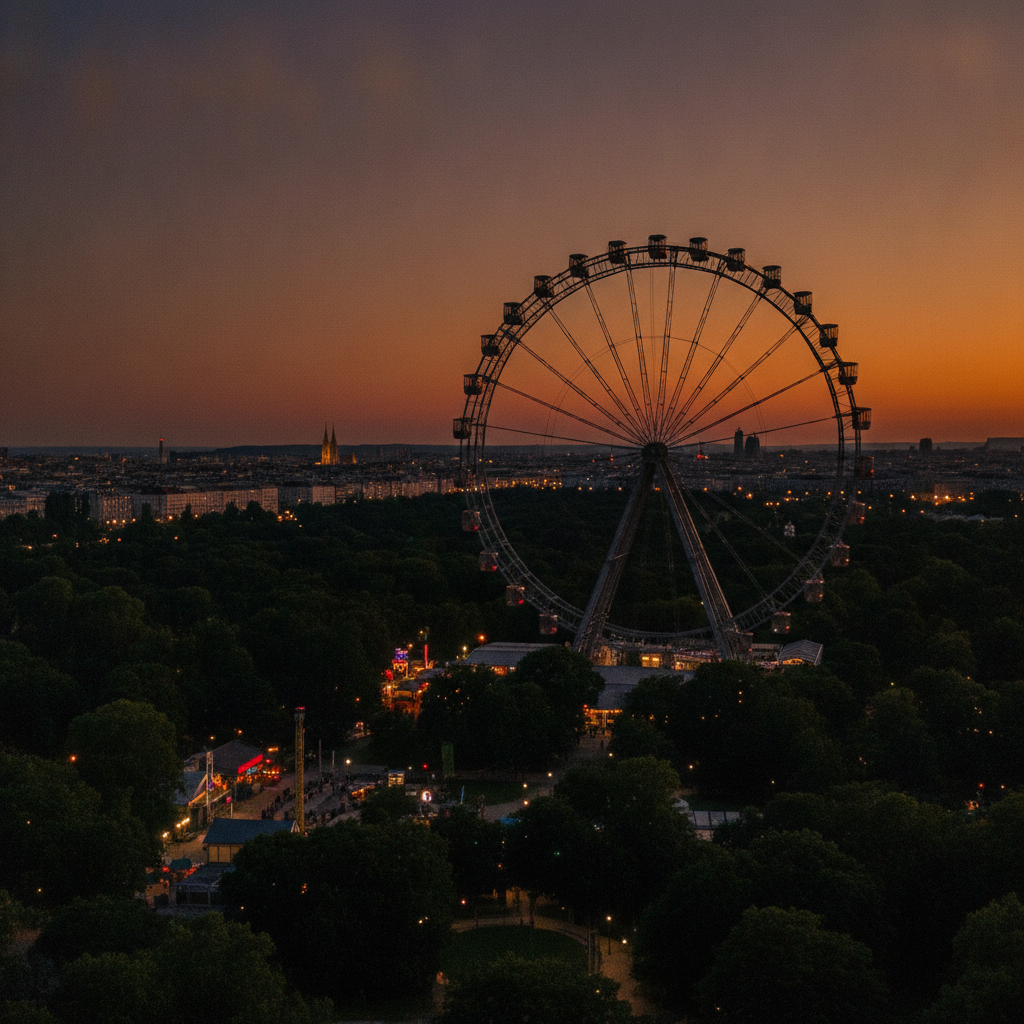
The Riesenrad (Giant Ferris Wheel), built in 1897 by the English engineer Walter Bassett Basset to mark the Golden Jubilee of Emperor Franz Joseph's reign, is Vienna's most enduring icon after St. Stephen's Cathedral and one of the oldest surviving Ferris wheels in the world. Its 15 red wooden gondolas carry passengers 65 meters above the Prater on a 9-minute rotation; the view from the top encompasses the entire Vienna basin, the Danube, the Wienerwald, and the alpine foothills. The Riesenrad became world-famous as the setting for the meeting between Harry Lime and Holly Martins in Carol Reed's The Third Man (1949) — the film's most famous scene, in which Lime delivers his cuckoo clock speech about the Swiss.
- 2
Wurstelprater Amusement Park
The Wurstelprater — the amusement park section of the larger Prater — is Central Europe's oldest permanent funfair, a continuous institution since Emperor Joseph II opened the Prater forests to the public in 1766. For the next century, the Wurstelprater was the entertainment capital of Vienna, where the bourgeoisie, aristocracy, and working class mixed in a rare democratic space: puppet theaters (Wurstel = Punch-and-Judy character), merry-go-rounds, beer gardens, and shooting galleries. Today it retains a nostalgic, slightly melancholy quality that no modern theme park can replicate — its vintage rides (many dating from the early 20th century) operate alongside new attractions in an atmosphere that feels genuinely historic.
- 3
Prater Hauptallee
The Hauptallee (Main Avenue) of the Prater is a dead-straight 4.5-kilometer avenue of ancient chestnut trees running from the Praterstern hub to the Lusthaus hunting lodge at the far end of the park. Emperor Joseph II's 1766 decree opening the Prater to the public turned this former imperial hunting reserve into the first royal park in Europe to be freely accessible to all citizens regardless of rank. The Hauptallee was the setting for the most fashionable Vienna promenading in the 19th century — Beethoven walked here daily, and Johann Strauss II premiered several of his waltzes at the Lusthaus pavilion at its far end.
- 4
Leopoldstadt
Leopoldstadt, the 2nd district of Vienna, has been the center of Jewish life in Vienna since the 17th century — it was the site of the formal Jewish ghetto established in 1625, destroyed in the 1670 pogrom ordered by Leopold I (who then named the district after himself), and reestablished as the center of Viennese Jewish culture in the 19th century. Before 1938, approximately 65,000 Jews lived in Leopoldstadt — more than a third of Austria's entire Jewish population. The district was devastated by the Nazi deportations; today it has been transformed by new immigration, primarily from Turkey and former Yugoslavia, but memorials, synagogues, and community institutions maintain the connection to its Jewish history.
- 5
Augarten
The Augarten, occupying the northern end of Leopoldstadt between two branches of the Danube Canal, is Vienna's oldest baroque garden open to the public — laid out in 1650 and opened to citizens by Emperor Joseph II in 1775 (six years before the Prater). Its long allées of chestnuts and lime trees are among the most atmospheric walking spaces in Vienna. The park is dominated by two enormous World War II flak towers — 57-meter-high reinforced concrete anti-aircraft gun platforms built in 1944, too massive to demolish, now incorporated into the park landscape as a permanent memento mori of the war's presence in the city.
- 6
Augarten Porcelain Factory
The Augarten Porcelain Manufactory, founded in 1718 by Emperor Charles VI — just four years after the invention of European hard-paste porcelain at Meissen, making it one of the oldest porcelain factories in the world — occupies the Baroque palace at the center of the Augarten park. The Augarten factory is still producing fine Vienna porcelain by hand using 18th-century techniques, and the manufactory's shop and museum within the palace complex show both historic pieces and current production. The factory's Wiener Rose pattern, created in 1894, remains its most iconic design.
Walk this route with audio
Stories play automatically as you reach each stop — no tapping needed.
More in vienna
Color & Harmony: Hundertwasser, Stadtpark & the Danube Canal
Imperial Summer: Schönbrunn Palace & Gardens
Empire's Heart: Stephansdom & the Innere Stadt
Markets & Modernism: Naschmarkt to MuseumsQuartier
Klimt & Baroque Splendor: Belvedere to Karlskirche