Warsaw Under Communism — the Palace of Culture, Solidarity & the Cold War City
Warsaw's communist period (1944/45-1989, the longest communist occupation of any Western Bloc capital) produced the most architecturally and politically significant communist-era urban environment in the Eastern Bloc — the Palace of Culture and Science, the Marszałkowska Dzielnica Mieszkaniowa housing estates, the Solidarity trade union movement centred in Warsaw and the Lenin Shipyard in Gdańsk that ended communism in Poland.
- 1
The Stalinist Palace — Gift or Imposition?
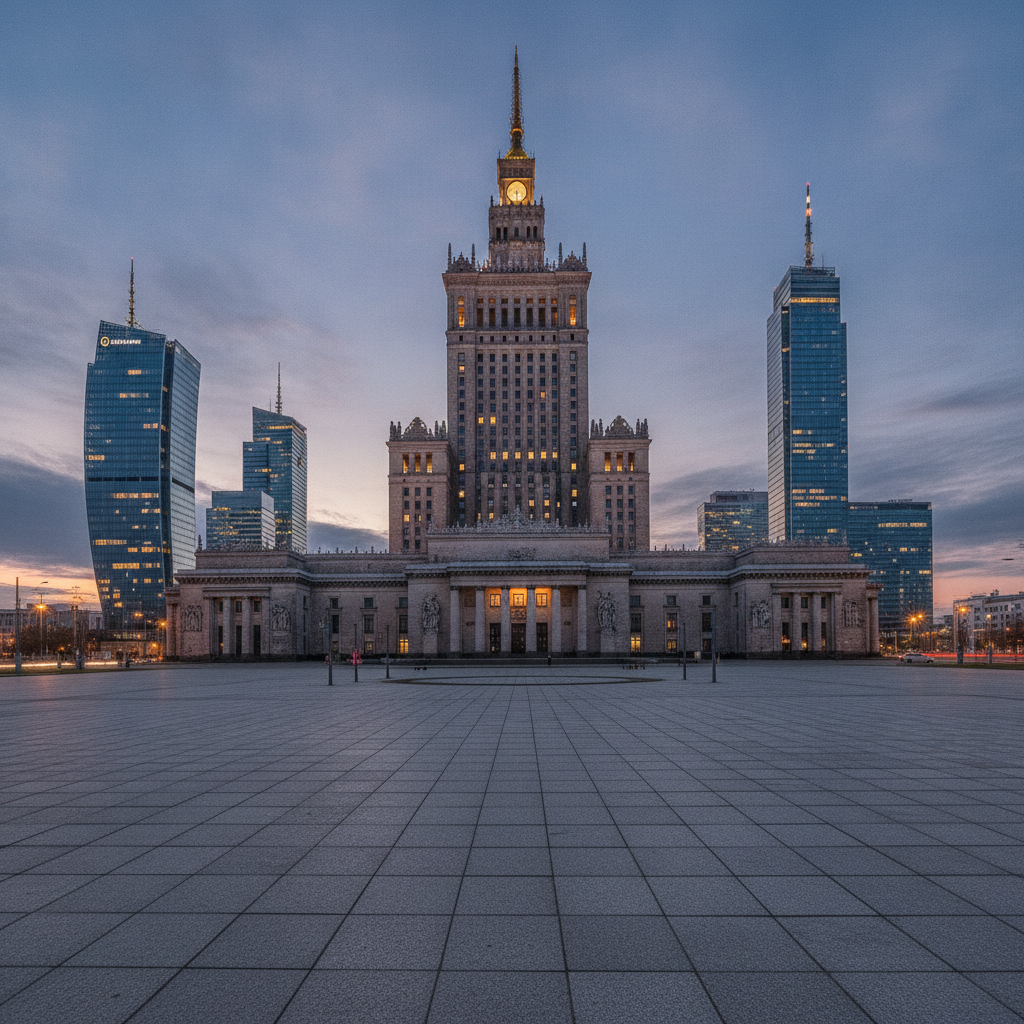
The Palace of Culture and Science (Pałac Kultury i Nauki, Defilad Square, the 231m tower completed 1955, the 'gift from the Soviet people to the Polish people' inscribed on the facade in Polish, the building designed by the Soviet architect Lev Rudnev in the Stalinist neoclassical style with Polish historical decorative elements — the towers of Polish Gothic and Renaissance architecture quoted in the upper stories, the socialist realist reliefs on the lower facade depicting workers, scientists, and artists in the manner of Soviet monumental art) is the most contested building in Poland. The Polish ambivalence (the building acknowledged as the largest and most prominent building in Warsaw, simultaneously despised as the symbol of Soviet domination and celebrated as a functional institution containing theatres, cinemas, a science museum, and the university — the building too large and too useful to demolish, though the question of demolition was seriously discussed in 1989 and periodically arises in Polish politics) is itself the best expression of Poland's relationship to the communist period. The observation deck (the view from the 30th floor at 114m altitude, the 360-degree panorama, the Old Town reconstruction visible to the north, the glass office towers visible in all directions, the Vistula visible to the east, the view the best available in Warsaw, €20 adults, daily 10am-8pm).
- 2
The Marszałkowska Housing Estates — Socialist Housing
The MDM (Marszałkowska Dzielnica Mieszkaniowa — the Marshall Street Residential District, the planned Stalinist housing development built 1950-1952 along Marszałkowska Street, the symmetrical residential blocks in the Stalinist neoclassical style flanking the Konstytucji Square — the most complete surviving example of Stalinist urban planning in Warsaw, the bas-relief friezes of workers, peasants, and soldiers on the facades, the central Konstytucji Square with the twin fountains and the uniformly proportioned apartment blocks on all four sides, the residential buildings inhabited since 1952 by Warsaw residents, the ground floors now occupied by restaurants, cafes, and shops in the post-1989 commercial conversion of the street-level spaces) and the Muranów district (the neighbourhood built on the rubble of the destroyed Warsaw Ghetto, the communist planners choosing to construct new housing directly on the rubble of the Ghetto rather than excavate it, the current apartment blocks literally standing on the compressed ruins of the pre-war Jewish neighbourhood, the ground level elevated 2-3 metres above the pre-war level by the rubble fill — this raising of the ground level visible wherever the original pre-war buildings survive adjacent to the Muranów housing) represent the two defining communist housing typologies in Warsaw.
- 3
Solidarity — the Trade Union That Ended Communism
The Solidarity movement (Niezależny Samorządny Związek Zawodowy Solidarność — Independent Self-governing Trade Union Solidarity, founded 31 August 1980 at the Lenin Shipyard in Gdańsk when the shipyard workers' strike resulted in the government signing the August Agreements granting the right to form independent trade unions, the union growing to 10 million members — one-quarter of the Polish population — within 18 months, suppressed by the martial law declared by General Jaruzelski on 13 December 1981, the union operating underground until 1989 when the Round Table Agreement gave it legal status and the right to participate in elections, the Solidarity candidates winning 99 of 100 Senate seats in June 1989, the election the first step in the democratic transition that spread across the Eastern Bloc in 1989): the Solidarity Electoral Office on Mazowiecka Street (the office where the Solidarity electoral committee operated, now marked by a small plaque), the Solidarity monument on Rondo Solidarności (the bronze cross monument on the roundabout that was the site of the 1981 martial law declaration, the monument marking the space where the communist-era demonstration took place) and the Lech Wałęsa Foundation (the Wałęsa archive and educational foundation, open to visitors by appointment, the collection of the Nobel Peace Prize documents, the correspondence with Reagan and Thatcher, the handwritten notes from the 1980 strike negotiations).
- 4
Praga — the Unreconstructed Right Bank
Praga (the right-bank district of Warsaw, the part of the city that the Soviet army chose not to cross the Vistula to defend during the Warsaw Uprising of 1944, allowing the German army to suppress the uprising and demolish the left bank while Praga was held — the consequence being that Praga retains the pre-war Warsaw urban fabric completely while the left bank is entirely reconstructed): the Różycki Bazaar (Targowa 54, the traditional flea market and food market operating continuously since 1882, the oldest market in Warsaw, the pre-war Jewish and Polish trading tradition surviving in the covered stalls, the market open Tuesday-Saturday 6am-4pm, Sunday 6am-2pm, the vendors a mix of the elderly Polish community and the Ukrainian and Vietnamese immigrant communities that have settled in Praga since 1989, the market the most demographically honest expression of contemporary Warsaw) and the Praga Museum (Targowa 50, €5 adults, Tuesday-Sunday 10am-6pm, the local history museum in the pre-war tenement building, the exhibit of the Praga tram factory — the Praga streetcars produced here from 1901 to 1949 — and the photographic history of the right-bank working-class community).
- 5
The Round Table and the End of Communism in Poland
The Round Table Agreement (Okrągły Stół, the negotiation between the communist government and the Solidarity opposition held in the Council of Ministers building at Ujazdów Avenue 1/3 in Warsaw from 6 February to 5 April 1989, the agreement establishing the conditions for the first partially free elections in the Soviet Bloc, the election of 4 June 1989 — the same day as the Tiananmen Square massacre in China — resulting in the defeat of all communist candidates in the competitive seats, the Solidarity landslide the first domino in the collapse of communist governments across Eastern Europe): the Council of Ministers building (the building where the Round Table took place, the actual round table used for the negotiations preserved inside and visible on guided tours of the government quarter, the building not regularly open to the public but tours organized through the Chancellery of the Prime Minister in advance), the Solidarity graffiti trail (the surviving pre-1989 Solidarity stencil graffiti and opposition artwork on the walls of the Praga district — the right bank was the principal territory of underground Solidarity activity in Warsaw because of its working-class character and its geographic separation from the state security apparatus concentrated on the left bank) and the September 1989 exhibition at the Historical Museum (the permanent exhibition on the political transition, the Round Table documents, the Solidarity posters and publications — the most important primary sources for understanding the Polish road out of communism).
- 6
The Warsaw Rising Museum — Poland's Most Visited Museum
The Warsaw Rising Museum (Grzybowska 79, the museum of the 1944 Warsaw Uprising, Poland's most visited museum, €10 adults, the admission including the full 2-3 hour circuit of the exhibition, Monday Wednesday Friday-Saturday 8am-8pm, Thursday 8am-10pm, Sunday 10am-8pm) is the essential Warsaw museum for understanding the Polish historical consciousness. The exhibition arc (the first floor: the buildup to the Uprising, the German occupation, the AK underground, the decision to rise on 1 August 1944; the second floor: the 63 days of fighting, street by street, the civilian life in the fighting city, the sewers — the underground passage system used by the AK fighters to move between districts, the reconstructed sewer section visitors can walk through; the third floor: the capitulation, the German demolition, the death toll, the legacy) and the specific exhibits (the aerial photograph of Warsaw taken by the Germans in January 1945 after the systematic demolition was complete — the photograph showing block after block of rubble, the most comprehensive urban destruction in the history of warfare — the photograph printed at 4m × 4m on the museum's floor, the visitors walking across the aerial image of the destroyed city) make the museum the most emotionally complete history museum in Poland.
Walk this route with audio
Stories play automatically as you reach each stop — no tapping needed.
More in warsaw
Warsaw Jewish Heritage — POLIN Museum, the Ghetto & the Uprising of 1943
Warsaw Music & Culture — Chopin, Łazienki Park, the Palace of Culture & the Museum Circuit
Warsaw Old Town — the Royal Castle, Sigismund Column & the Rebuilt Medieval City
Warsaw Practical Guide — Transport, Seasons, the Vistula & Day Trips