Warsaw Old Town — the Royal Castle, Sigismund Column & the Rebuilt Medieval City
Warsaw (the capital of Poland, population 1.8 million, the largest city in the country and the political, economic, and cultural centre of Poland) was 85 percent destroyed by the Nazi German army in 1944-45 — the most thoroughly destroyed capital city in World War II. The Old Town (Stare Miasto) was rebuilt brick-by-brick from 1945 to 1963 using historical records, photographs, and the 18th-century paintings of Bernardo Bellotto, and was inscribed on the UNESCO World Heritage List in 1980 as the outstanding example of near-total historical reconstruction.
- 1
Castle Square and the Sigismund Column
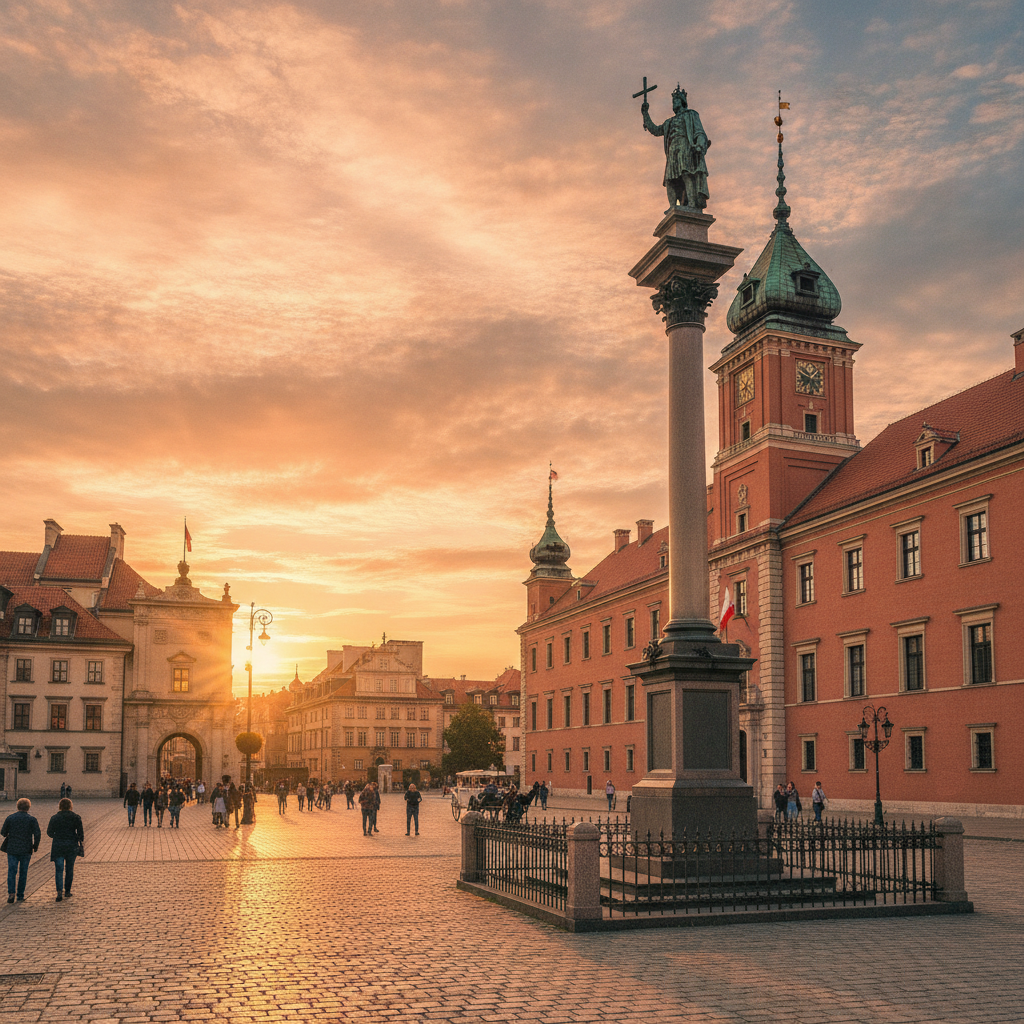
Plac Zamkowy (Castle Square, the square at the entry to the Old Town between the Royal Castle and the Barbican, the main orientation point in the Warsaw Old Town, the square destroyed by German bombardment in September 1939 and then completely levelled during the Warsaw Uprising of 1944 and the subsequent Nazi demolition programme) is defined by the Sigismund Column (the 22m column of pink Swedish granite with the bronze statue of King Sigismund III Vasa, erected in 1644 by his son Władysław IV — the oldest secular monument in Warsaw, the column knocked down by German artillery in 1944, the broken column shaft and the statue preserved in the National Museum during the occupation and re-erected on a new column shaft in 1949, the original broken shaft visible in the courtyard of the Royal Castle). The square is the most photographed location in Warsaw and the natural starting point for the Old Town visit.
- 2
The Royal Castle — Reconstructed from Photographs
The Royal Castle (Zamek Królewski, Plac Zamkowy 4, the pink and white Baroque-Renaissance palace at the edge of the Old Town, the primary residence of Polish kings from the 16th century, blown up by the German army on 17 September 1944 as a deliberate act of cultural annihilation — the castle reduced to rubble, the contents (paintings, furniture, decorative arts) removed by the Germans before the demolition — rebuilt 1971-1984 using the 18th-century paintings of Bernardo Bellotto and the records and photographs of the Polish historical commission, the rooms and interiors reconstructed to the exact specifications of the originals, €16 adults, Tuesday-Sunday 10am-6pm, the Marble Room, the Senate Chamber, the Throne Room, the Ballroom, and the Canaletto Room — the room containing the original Bellotto paintings of 18th-century Warsaw that guided the reconstruction — the essential tour circuit) is the world's most important example of the deliberate post-war reconstruction of a royal palace. The recovered originals (some of the castle's original paintings and decorative objects were hidden by Polish museum workers in the basement during the German demolition, the hidden items incorporated into the reconstruction alongside the reproductions) make the castle a genuine combination of original and reconstructed.
- 3
The Old Town Market Square — Painted Facades and Summer Terraces
Rynek Starego Miasta (the Old Town Market Square of Warsaw, 90m × 73m, the central square of the medieval city founded in the 13th century, completely destroyed in 1944 and rebuilt to the exact specifications of the 17th-19th century facades using Bellotto's paintings and historical photographs, the coloured facades of the townhouses — the pink Baryczka house, the blue Wilczek house, the yellow Fukier house — now housing restaurants, galleries, and the Historical Museum of Warsaw, the cobbled square animated with outdoor cafe terraces from May to October) is the best-preserved example of the post-war Old Town reconstruction — the facades exactly matching the pre-war originals including the painted decorative details and the 18th-century colour scheme. The Historical Museum of Warsaw (Rynek Starego Miasta 28-42, €10 adults, Tuesday-Sunday 10am-6pm, the 60-room collection on the history of Warsaw from the 13th century to the present, the 20-minute film 'Warsaw Will Always Rise' — the documentary record of the city's destruction and reconstruction, the most immediately emotional exhibit in the museum — shown every hour in Polish with English subtitles).
- 4
The Barbican and the City Walls
The Barbican (Barbakan, the semi-circular Gothic defensive outwork built 1548 at the northern entrance to the Old Town, the most completely preserved element of the medieval Warsaw fortifications, originally surrounded by a moat, the wall walk accessible, €4 adults, the Barbican forming the photogenic northern entrance to the Old Town as seen from Nowomiejska Street) and the surviving sections of the city walls (the red brick Gothic walls visible for approximately 800m on the western and northern sides of the Old Town, the walls including the Gunpowder Tower and several bastions, the Wall Walk along the interior face of the walls from the Barbican to the south gate, free, the most peaceful walking route in the Old Town at the early morning) connect the reconstructed townhouses to the surviving medieval fortification. The New Town (Nowe Miasto, the district immediately north of the Barbican, the settlement established in 1408 just outside the Old Town walls, the most atmospheric section of the New Town being Freta Street with the Church of the Holy Spirit and the birthplace of Marie Curie — the house where Maria Skłodowska was born in 1867 now housing a small museum, €5 adults, daily 10am-6pm).
- 5
The Royal Route — from Castle Square to Łazienki
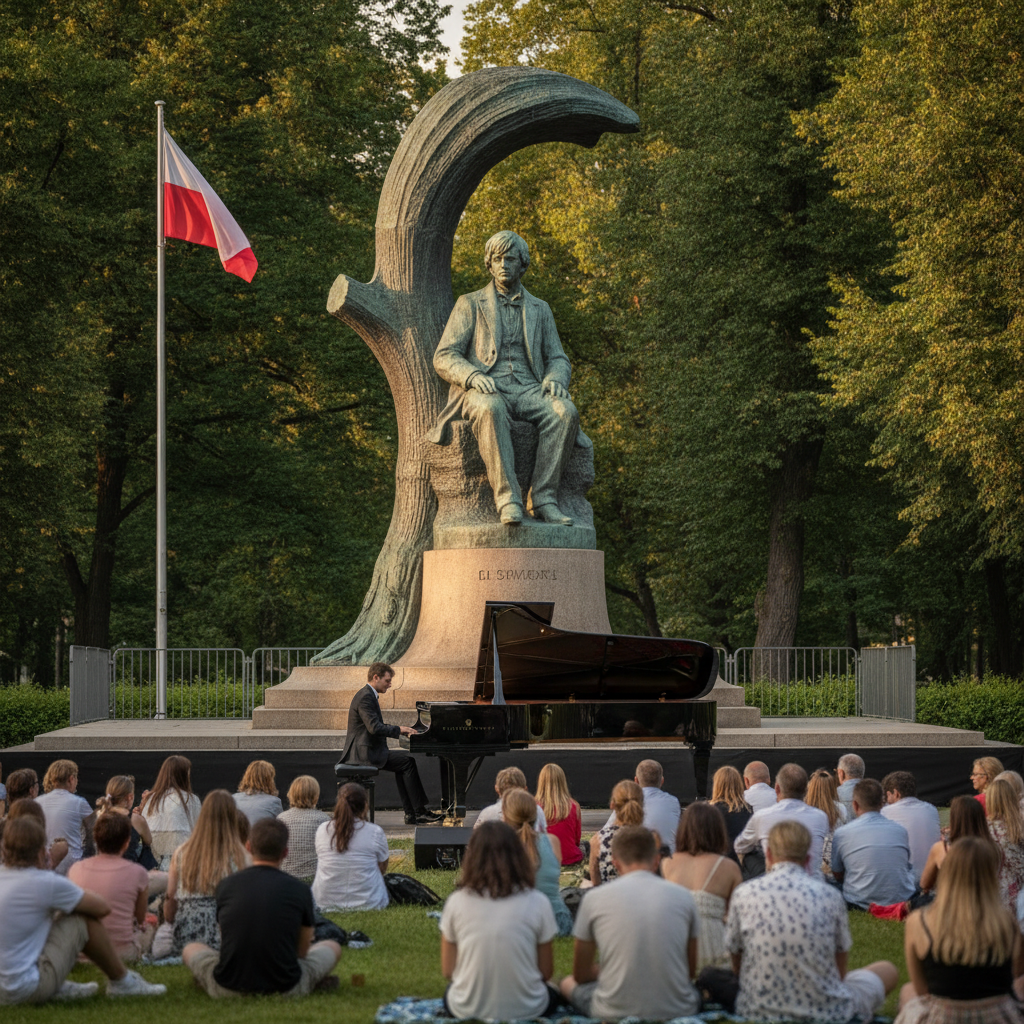
The Royal Route (the historic ceremonial route of Polish kings running south from Castle Square along Krakowskie Przedmieście and Nowy Świat to Łazienki Park, 3.5km in total, the most elegant boulevard in Warsaw, lined with Baroque and neoclassical churches and palaces, the outdoor cafe terraces of the Nowy Świat section from May to October): the Church of the Holy Cross (Krakowskie Przedmieście 3, the Baroque church of 1757, the urn in the left nave pillar containing Frédéric Chopin's heart — the heart removed from Chopin's body at his death in Paris in 1849 per his request to have his heart buried in Poland, the church the most important Chopin pilgrimage site in Warsaw), the Chopin Monument in Łazienki (the bronze statue by Wacław Szymanowski in Łazienki Park, the most reproduced image of Chopin, the statue showing the composer under a stylized weeping willow, the free open-air Chopin piano concerts performed at the statue every Sunday at noon and 4pm from May to September, the most accessible free cultural event in Warsaw) and the Łazienki Palace (the neoclassical Palace on the Island, the summer residence of King Stanisław Augustus Poniatowski, built 1772-1793 on an artificial lake, €15 adults, Tuesday-Sunday 9am-6pm).
- 6
Praga — the East Bank Neighbourhood
Praga (the right-bank district of Warsaw east of the Vistula, the part of the city that was not destroyed in 1944 because the Soviet army stopped at the river and did not cross to assist the Warsaw Uprising — the result being that Praga retains the pre-war Warsaw urban fabric of the 1920s-30s that the left bank entirely lost: the Art Deco apartment buildings, the 19th-century factory buildings converted to art spaces, the pre-war corner shops and cafes operating in their original premises, the most authentic Warsaw street-level experience) is accessible by the Metro Line 2 from the city centre (the Nowy Świat-Uniwersytet or Centrum Nauki Kopernik stations) or by crossing the Śląsko-Dąbrowski Bridge on foot (20 minutes from the Old Town). The Praga attractions: Stalowa Street (the most characteristic pre-war Warsaw street, the Art Deco facades intact, the corner bar Pod Gwiazdą operating since the 1930s), the Warsaw Zoo (Ratuszowa 1/3, one of the largest zoos in Central Europe, the zoo from which the zookeepers Jan and Antonina Żabińska hid approximately 300 Jews from the Warsaw Ghetto during the occupation — the Żabińskis' story the subject of Diane Ackermann's The Zookeeper's Wife, €10 adults), and the Neon Museum (Soho Factory, Mińska 25, the collection of communist-era neon signs, €6 adults).
Walk this route with audio
Stories play automatically as you reach each stop — no tapping needed.
More in warsaw
Warsaw Jewish Heritage — POLIN Museum, the Ghetto & the Uprising of 1943
Warsaw Music & Culture — Chopin, Łazienki Park, the Palace of Culture & the Museum Circuit
Warsaw Under Communism — the Palace of Culture, Solidarity & the Cold War City
Warsaw Practical Guide — Transport, Seasons, the Vistula & Day Trips