The National Mall — America's Front Yard and Hall of Democracy
Washington DC (the District of Columbia — the federal capital of the United States, population approximately 700,000 (the city proper), 6.4 million (the DC-Maryland-Virginia metro area) — the purpose-built national capital planned by Pierre Charles L'Enfant in 1791 on land ceded by Maryland and Virginia, the seat of the three branches of the US federal government, and the city with the highest concentration of free world-class museums and monuments of any city in the United States): the National Mall (the 3.2 km (2 mile) long open park between the Lincoln Memorial and the US Capitol Building) is the symbolic heart of American democracy.
- 1
Lincoln Memorial — The Temple of American Democracy
Lincoln Memorial (the neoclassical memorial to Abraham Lincoln (1809-1865, 16th President of the United States) at the west end of the National Mall, designed by Henry Bacon and completed in 1922 — the most symbolically powerful monument in Washington DC and the most important memorial to any individual in the United States): the Lincoln Memorial (the Greek Doric temple containing the 5.8-metre (19-foot) seated marble statue of Lincoln (the most famous sculpture by Daniel Chester French (1850-1931), completed 1920, the white Georgia marble statue of Lincoln seated in a massive armchair with his hands resting on the arms, his face a portrait of wartime exhaustion and moral determination)) is the backdrop for the most significant public gatherings in American history: the March on Washington for Jobs and Freedom (August 28, 1963 — the civil rights demonstration attended by 250,000 people, the largest political rally in US history to that date, at which Martin Luther King Jr. delivered the 'I Have a Dream' speech from the memorial's steps); the Vietnam Veterans Against the War protests (1967, 1969, 1971); the Million Man March (1995); and the Inauguration Day prayer services of multiple presidents; the inscribed text of the Gettysburg Address (Lincoln's 272-word address at the dedication of the Soldiers' National Cemetery at Gettysburg, Pennsylvania on November 19, 1863 — widely considered the greatest speech in American political history) on the south interior wall and the Second Inaugural Address ('With malice toward none, with charity for all...') on the north interior wall are the most powerful political texts displayed in any American monument.
- 2
Washington Monument & the Reflecting Pool
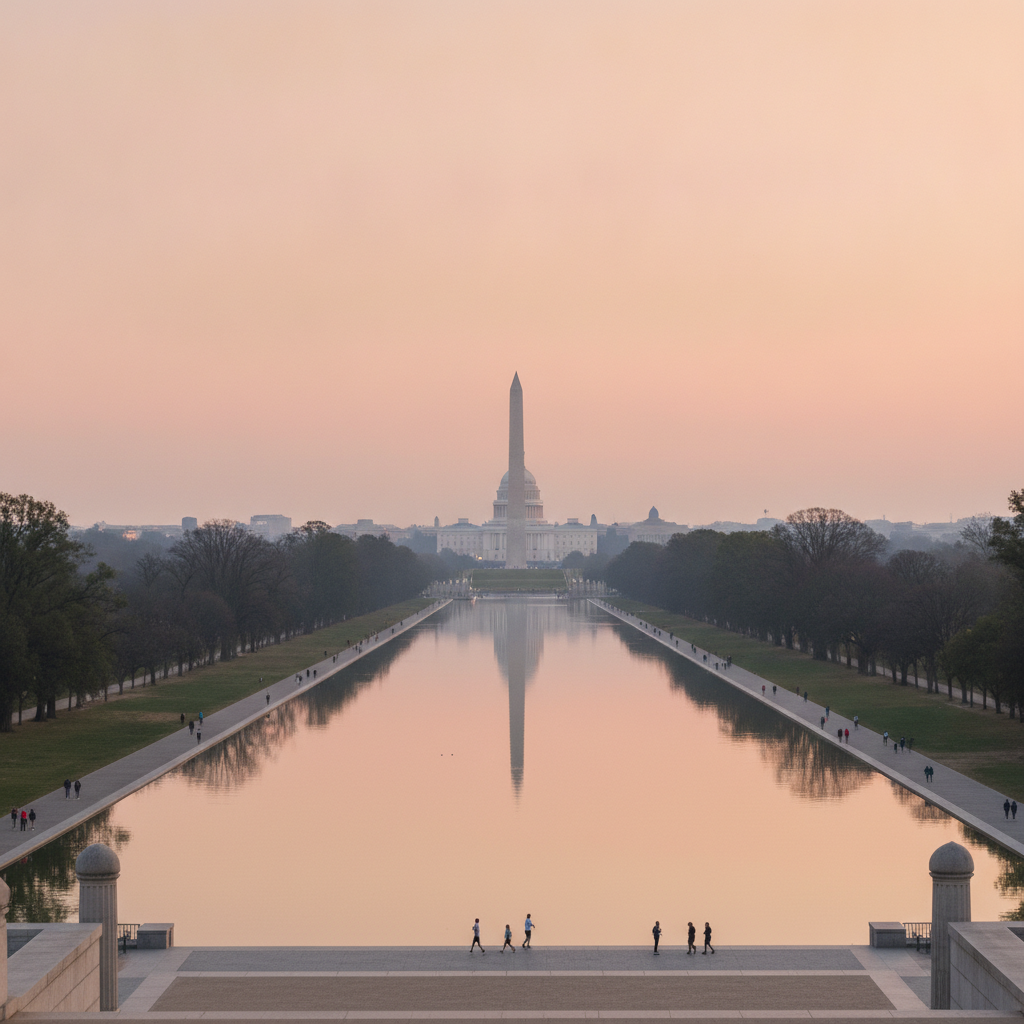
Washington Monument (the 169.3-metre (555-foot 5.125-inch) marble obelisk at the centre of the National Mall, dedicated to George Washington (1732-1799, 1st President of the United States) — the tallest stone structure in the world when completed in 1884 and the tallest structure in Washington DC (the 1910 Heights of Buildings Act limits buildings in DC to a maximum height of approximately 40 metres lower than the Capitol dome — making DC the only major American capital without a conventional commercial skyline)): the Monument (designed by Robert Mills and completed by the US Army Corps of Engineers after a funding gap (the construction was halted 1854-1879 due to lack of funds, creating the visible change in the colour of the marble approximately one-third of the way up the structure — the lighter lower section (to approximately 46 metres (150 feet)) was built 1848-1854 using marble from a different Maryland quarry than the upper two-thirds (built 1879-1884) — the most significant architectural 'mistake' visible in any American monument)) is the most recognisable single structure in Washington DC; the Lincoln Memorial Reflecting Pool (the 618-metre (2,028-foot) long, 51-metre (167-foot) wide shallow pool between the Monument and the Lincoln Memorial, designed by Henry Bacon and completed in 1922 — the most symbolically resonant reflecting pool in the United States, reflecting both the Washington Monument and the Lincoln Memorial simultaneously from the midpoint of the Mall) is the most photographed view in Washington DC.
- 3
US Capitol Building — The Seat of American Legislative Power
United States Capitol Building (the seat of the United States Congress (the Senate and the House of Representatives) at the east end of the National Mall on Capitol Hill — the most symbolically important building in the United States and the building most associated with American democracy in the world): the Capitol (the current building completed in stages from 1800 to 1868, with the famous cast-iron dome (the 88-metre (289-foot) dome completed in 1863, during the Civil War — Lincoln insisted on continuing the dome's construction during the war as a symbol of national unity, the same motivation that led him to begin the Washington Monument construction during the earlier 1861-1865 period)) is simultaneously a working legislature and a public monument; the Capitol dome (the most recognizable dome in the United States, modelled on the dome of St. Peter's Basilica in Rome and the Panthéon in Paris) is the focal point of the L'Enfant Plan of Washington (the 1791 city plan by Pierre Charles L'Enfant (1754-1825, the French-American engineer and city planner appointed by President Washington) that placed the Capitol at the highest point of Capitol Hill at the east end of the central axis of the city, with the broad avenues (Pennsylvania Avenue, Maryland Avenue, and the others) radiating outward from the Capitol in all directions in the characteristic L'Enfant diagonal street pattern); the Capitol Visitor Center (the underground visitor facility beneath the East Capitol grounds, opened 2008 — the most comprehensive introduction to the US Congress and the history of the Capitol available to the public) and the Capitol guided tours (offered free through Congressional offices) are the best ways to experience the building.
- 4
Vietnam Veterans Memorial — The Wall That Changed War Memorials
Vietnam Veterans Memorial (the memorial to the 58,281 American service members killed or missing in the Vietnam War, in Constitution Gardens on the north side of the National Mall — the most visited memorial on the National Mall (approximately 5 million visitors per year) and the most emotionally powerful war memorial in the United States, perhaps in the world): the Memorial Wall (designed by Maya Lin (born 1959, the Yale University architecture student who submitted the winning design in the 1981 open competition for the memorial — the most significant memorial design competition in American history) as a V-shaped cut into the earth (the two walls of the 'V' pointing east toward the Washington Monument and northeast toward the Lincoln Memorial): the black granite panels (the 144 panels of polished black granite from Bangalore, India, each approximately 3 metres (10 feet) tall at the apex of the V and tapering to approximately 25 cm (10 inches) at the tips of the two walls) are inscribed with the 58,281 names of American service members killed or missing in Vietnam, arranged not alphabetically but chronologically by date of death or going missing (from 1959 to 1975) — the design choice that makes each visit to the Wall a personal temporal journey through the war); the reflective surface of the black granite (the polished black granite reflects the visitor's own face in the surface of the wall alongside the inscribed names, creating an involuntary confrontation between the living and the dead) is the most powerful design element of the memorial, and the reason the Wall has become the paradigm-shifting model for all subsequent American war memorials.
- 5
Jefferson Memorial & Martin Luther King Jr. Memorial
Thomas Jefferson Memorial (the neoclassical memorial to Thomas Jefferson (1743-1826, 3rd President of the United States, principal author of the Declaration of Independence) on the south shore of the Tidal Basin in East Potomac Park — the most beautiful memorial setting in Washington DC, particularly during the Cherry Blossom Festival (late March-early April, when the 3,800 Yoshino cherry trees (Prunus × yedoensis) surrounding the Tidal Basin bloom simultaneously — the most spectacularly beautiful public floral display in the United States)): the Memorial (designed by John Russell Pope in the Roman Pantheon style and completed in 1943) contains the 5.8-metre (19-foot) bronze standing statue of Jefferson (the 1947 casting by Rudulph Evans, replacing the original plaster model) and the inscribed texts of four of Jefferson's most significant writings on democracy, freedom, and religious liberty on the interior walls; the Martin Luther King Jr. Memorial (the 4-acre (1.6-hectare) memorial to the civil rights leader (1929-1968) on the northwest shore of the Tidal Basin, between the Lincoln Memorial and the Jefferson Memorial — the first National Mall memorial dedicated to a non-president (other than the memorials to groups of veterans)): the 'Stone of Hope' (the 9-metre (30-foot) granite image of Dr. King emerging from a 'Mountain of Despair' — a reference to his 'I Have a Dream' speech) is the central sculpture, inscribed with 14 quotations from King's speeches and writings.
- 6
The National Mall Smithsonian Museums — Free World-Class Culture
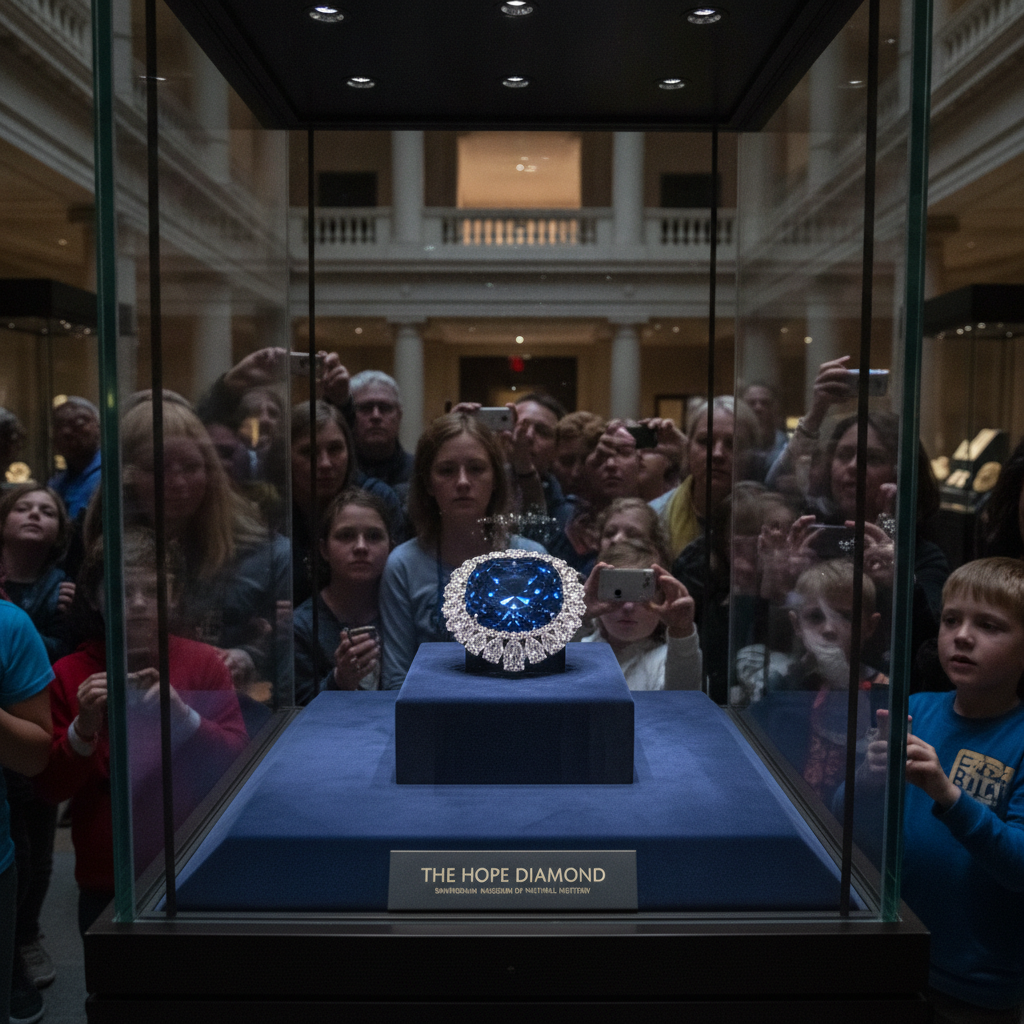
The Smithsonian Institution museums on the National Mall (the cluster of 11 free museums along the National Mall and its immediate surroundings — the largest museum complex in the world by total floor space (approximately 1.4 million m² of exhibition space across 19 museums, 21 libraries, 9 research centers, and a zoo) and the most-visited museum complex in the United States (approximately 28 million visits per year across all Smithsonian facilities)): the National Mall museums include: the National Museum of Natural History (the museum that contains the Hope Diamond (the 45.52-carat deep-blue Type IIb diamond — the most famous gemstone in the world, formerly property of Louis XIV of France and now on permanent display in the Janet Annenberg Hooker Hall of Geology, Gems, and Minerals — the most-visited single object in the Smithsonian), the 8-metre (26-foot) African elephant mounted in the rotunda (the largest land animal museum mount in the United States), and a collection of approximately 145 million natural history specimens); the National Air and Space Museum (the museum with the single highest annual attendance of any museum in the United States — approximately 7 million visitors per year — containing the Wright Brothers' 1903 Flyer, Charles Lindbergh's Spirit of St. Louis, John Glenn's Friendship 7 Mercury capsule, and the Apollo 11 Command Module Columbia); the National Museum of American History (the museum containing the original Star-Spangled Banner (the 1813 flag that inspired the national anthem)); and the National Gallery of Art (the finest art museum in Washington DC, with masterworks from Leonardo da Vinci, Raphael, Rembrandt, Vermeer, and the Impressionists).
Walk this route with audio
Stories play automatically as you reach each stop — no tapping needed.
More in washington-dc
K Street, Think Tanks & the World of Washington DC Power
Washington DC Food Scene — From Ethiopian to Fine Dining
White House, Capitol Hill & the Architecture of American Power
Cherry Blossoms & the Tidal Basin — Washington in Spring
Arlington Cemetery, the Pentagon & DC's Military Heritage