Wrocław University, Museums & the National Forum of Music — Cultural Capital Legacy
Wrocław's cultural infrastructure was dramatically expanded during its tenure as European Capital of Culture 2016, the designation producing a wave of renovation and new construction that transformed the city's museums and performance venues into the most modern in Poland outside Warsaw.
- 1
Wrocław University — the Baroque Aula Leopoldina
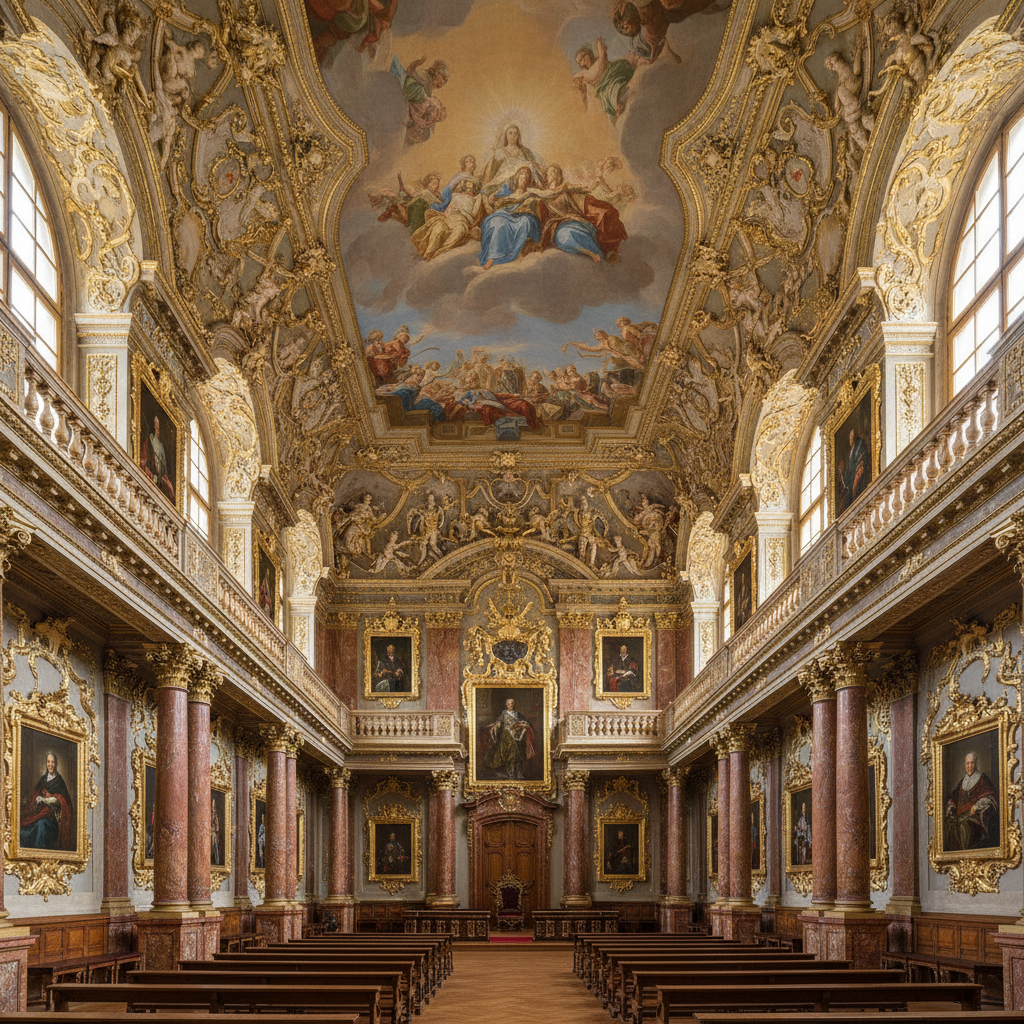
Wrocław University (Uniwersytet Wrocławski, the oldest university in Lower Silesia, founded 1702 by the Habsburgs as the Jesuit Leopoldine Academy, the main university building on the Odra river bank at Plac Uniwersytecki 1 — the Baroque palace built 1728-1741, the most important Baroque civic building in Wrocław) is the architectural centrepiece of the university quarter. The Aula Leopoldina (the ceremonial hall of the university, the most spectacular Baroque interior in Silesia — the trompe-l'oeil ceiling fresco of the Glorification of Divine Wisdom by Johann Christoph Handke 1732, the gilded stucco work by Franz Josef Mangoldt, the marble columns and the woodcarved tribune, the hall still used for university ceremonies and concerts, €4 adults for the Aula and the Mathematical Tower, Saturday-Sunday 10am-5pm and weekdays during non-ceremony periods) and the Oratorium Marianum (the Baroque concert hall adjacent to the Aula, the painted ceiling and the orchestra gallery, the room used by the Wrocław Philharmonic for chamber concerts) are the primary destinations in the university building. The Mathematical Tower (the observatory tower above the university building, the view from the top over the Odra and Cathedral Island, accessible with the same ticket as the Aula).
- 2
The National Forum of Music — the New Concert Hall
The National Forum of Music (Narodowe Forum Muzyki, Plac Wolności 1, the purpose-built concert hall opened 2015, the primary legacy project of the Wrocław 2016 European Capital of Culture preparation, the building the most significant new concert venue built in Central Europe in the 21st century — the four concert halls in a single building: the main Witold Lutosławski Hall seating 1,800, the chamber halls, the rehearsal spaces — the acoustics designed by the Japanese firm Nagata Acoustics, the same firm responsible for the Berlin Philharmonie renovation and the Copenhagen Concert Hall, the programming including the Wrocław Philharmonic, the Wrocław Opera, and the international touring orchestras) is the correct evening cultural destination in Wrocław. The building's exterior (the curvilinear glass and steel facade reflecting the Wolności Square and the Świdnica Street, the most architecturally ambitious post-communist building in Wrocław) and the schedule (available at the NFM website, tickets from €10 for the chamber concerts to €80 for the main-hall programme, the student discounts making the chamber concerts accessible at €5-8).
- 3
The Museum of Contemporary Art — MWW
The Museum of Contemporary Art Wrocław (Muzeum Współczesne Wrocław, Plac Strzegomski 2a, the contemporary art museum in the former anti-aircraft tower — the 1942 Nazi-built concrete fortification tower converted to a museum space in 2011, the conversion keeping the raw concrete of the tower walls as the gallery background, the most unusual museum building in Poland, €6 adults, Tuesday-Sunday 11am-7pm, the collection of Polish and international contemporary art from the 1950s to the present, the particular strength being the Polish conceptual art of the 1960s-80s, the Jerzy Bereś, Zbigniew Warpechowski, and Jerzy Rosołowicz works the most important in the collection, the museum also programming the WRO Media Art Biennale every odd year — the international new media art festival based in Wrocław since 1989, the oldest media art festival in Central Europe) is the correct destination for visitors with contemporary art interest. The tower roof (the view from the former gun platforms on the roof of the anti-aircraft tower, the panorama of the western districts of Wrocław visible from 35m altitude, free with the museum ticket).
- 4
The Panorama of the Battle of Racławice
The Panorama of the Battle of Racławice (Panorama Racławicka, Jana Ewangelisty Purkyniego 11, €20 adults, Tuesday-Sunday 9am-5pm, timed-entry tickets required — book in advance online for July-August, the panoramic painting 15m high and 114m in circumference depicting the Battle of Racławice of 4 April 1794 when the Polish forces of Tadeusz Kościuszko defeated the Russian Imperial army, the battle the most celebrated Polish military victory of the 18th century, the painting completed in Lwów in 1894 by Jan Styka and Wojciech Kossak for the centenary, the painting hidden in Lwów during World War II, transported to Wrocław in 1946 after Lwów became Soviet Ukrainian territory but kept rolled in a tube because the communist government was unwilling to display a painting celebrating a victory against Russia — the painting not displayed until 1985) is the largest and most emotionally powerful painting in Poland. The circular painting technique (the painting mounted in a rotunda with the viewer in the centre at the level of the battlefield, the ground level of the canvas at eye height with the painted terrain continuing at 360 degrees, the foreground relief objects and sound effects creating the total environment) is the defining 19th-century panorama experience in Central Europe.
- 5
Wrocław as the City of Meetings — the Multi-Ethnic Heritage
Wrocław's identity as the city of meetings (the official city brand since 2006, the slogan reflecting the city's history as the meeting point of German, Polish, Czech, and Jewish cultures over 1,000 years — a history unique in Central Europe in its density of cultural overlap): the four cultures (the German Protestant bourgeoisie of Breslau who built the university and the concert halls; the Polish Catholic population who replaced them in 1945 bringing the Kresy eastern borderland culture from Lwów and Wilno; the Silesian German-Polish mixed community that remained after 1945 as a bridging population; and the Jewish community that was 25 percent of the city's population in the early 20th century and was entirely destroyed in the Holocaust) are documented at the Historical Museum of Wrocław (Sukiennice 14, the museum in the former Cloth Hall, €6 adults, Tuesday-Sunday 10am-5pm, the exhibition covering all four communities), and physically visible in the surviving buildings — the Gothic and Baroque German, the Jewish pre-war urban fabric of the Przedmieście Świdnickie, and the post-war Polish additions that have made the city its current form.
- 6
Wrocław Practical — Getting There, Getting Around
Wrocław practical information: the Nicolaus Copernicus Airport (Strachowice, 10km west of the city centre, direct flights from London, Berlin, Paris, Amsterdam, Vienna, and many Central European cities, the bus 106 to the city centre in 25 minutes at €1.60, the taxi at approximately €15-20, Uber at €10-15), the train from Warsaw (the PKP Intercity Express, 3 hours, €15-30, the trains hourly from Warsaw Central, the Wrocław Główny station 10 minutes walk from the Old Town), from Kraków (2.5 hours by fast train, €12-25). City transport: the tram network (the most efficient way to move across the city, the stops at the Rynek and the University the central nodes, €1.50 per journey), walking (the Old Town, Cathedral Island, and the University Quarter are all within 15 minutes walk of each other, the compact geography the defining advantage of Wrocław over larger Polish cities). Accommodation: the Old Town (the most convenient for the sights, the boutique hotels in the townhouse buildings on the Rynek perimeter, €80-150 for a double in season), the Śródmieście (the central district surrounding the Old Town, the business hotels in the neoclassical buildings of the 19th-century city, €60-120). The Wrocław Tourist Card (the 24/48/72-hour passes with free public transport and museum discounts, available at the tourist office in the Town Hall).
Walk this route with audio
Stories play automatically as you reach each stop — no tapping needed.
More in wroclaw
Wrocław Dwarf Hunt, Bridges & Walking Routes — the Complete City Circuit
Wrocław Food — Silesian Pierogi, the Market Hall, Craft Beer & Local Restaurants
Wrocław Cathedral Island — Gothic Towers, Gas Lamps & the Odra Islands
Wrocław Practical Guide — Seasons, Transport, Christmas Market & Day Trips to the Sudeten