Yogyakarta: World's Largest Buddhist Monument at Borobudur, the Active Sultan-Governor & Gudeg at Dawn on Malioboro
Java's cultural heartland—Borobudur's 9 stacked platforms, 504 Buddha statues, and 2,672 relief panels built by the Sailendra Dynasty (the entire Buddhist cosmological universe in stone, the world's largest Buddhist monument), Prambanan's 47-metre Shiva tower and sequential Ramayana reliefs with full-moon Ramayana Ballet in front of the floodlit temples May–October, the Kraton's 1755 founding axis from Merapi to the Indian Ocean and the Sultan who simultaneously serves as lifetime Governor of Yogyakarta Special Region, Merapi's 2010 eruption that killed 353 and left Kinahrejo village in ruins as a 4WD jeep tour destination, Malioboro's batik tulis and Kotagede silver filigree, and gudeg's sweet jackfruit and 300,000 students from 137 universities making Jogja Indonesia's most artistically active city per capita.
- 1
Borobudur – The World's Largest Buddhist Monument
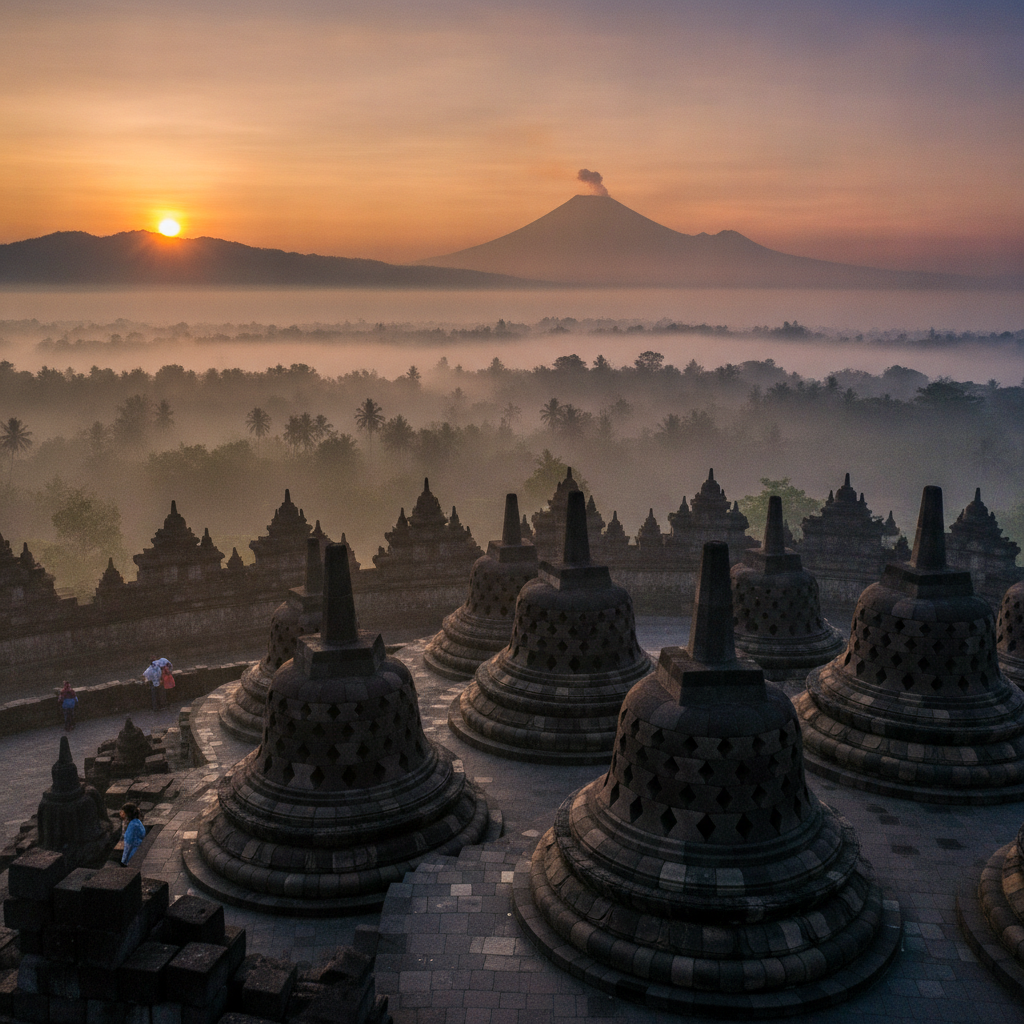
Borobudur—42 km northwest of Yogyakarta in the Kedu Plain, a UNESCO World Heritage Site since 1991—is the largest Buddhist monument in the world: a 9th-century Mahayana Buddhist temple built during the Sailendra Dynasty, consisting of nine stacked platforms (six square, three circular) topped by a central dome. The structure: 2 million stone blocks, 504 Buddha statues, 2,672 relief panels (depicting the life of the Buddha, Buddhist cosmology, and scenes of 9th-century Javanese life—the relief panels alone constitute the world's largest and most complete set of Buddhist narrative reliefs, covering 2.5 km if placed end to end), and 72 latticed stupas each containing a seated Buddha. The symbolism: Borobudur represents the Buddhist cosmological universe in three dimensions—the base (kamadhatu—the world of desire), the middle terraces (rupadhatu—the world of form), and the upper circular platforms (arupadhatu—the world of formlessness). The sunrise: arriving at Borobudur before dawn to watch the sun rise over the Menoreh Hills with Mount Merapi smoking in the background—the volcanic landscape framing the Buddhist monument—is the most celebrated dawn experience in Java.
- 2
Prambanan – The Hindu Temple Complex of the Mataram Kingdom
Prambanan—17 km northeast of Yogyakarta, a UNESCO World Heritage Site—is the largest Hindu temple complex in Southeast Asia and one of the finest examples of Hindu temple architecture in the world: a compound of 240 temples built in the 9th century during the Mataram Hindu Kingdom (contemporaneous with Borobudur's Buddhist construction 40 km away—the two monuments were built within decades of each other by rival dynasties practising different faiths on the same island, an extraordinary cultural juxtaposition). The main complex: three central towers (candi—the Javanese temple form) dedicated to the Trimurti—Shiva (47 metres—the tallest), Brahma, and Vishnu—each paired with a subsidiary temple containing the divine mount (Shiva's bull Nandi, Brahma's goose Hamsa, Vishnu's eagle Garuda). The Ramayana reliefs: carved panels covering the inner galleries of the Shiva temple depict the entire Ramayana epic in sequential scenes of extraordinary narrative clarity. The Ramayana Ballet: an outdoor performance on the open-air theatre stage facing Prambanan (May–October full moon performances—the most spectacular traditional performance in Java, with the floodlit temples as backdrop).
- 3
The Kraton – Yogyakarta's Living Royal Palace
The Kraton (Keraton—'Palace of the King')—the royal palace of the Sultan of Yogyakarta, built from 1755 when Sultan Hamengkubuwono I founded the kingdom as an independent polity within the Dutch colonial structure—is the only royal palace in Indonesia that is still the actual residence of the current Sultan. The palace complex: a series of alun-alun (great squares), pavilions (pendopo—open teak pavilions of extraordinary elegance), ceremonial halls, and inner sanctuaries arranged on a cosmological axis running from Mount Merapi (north) through the palace to the Indian Ocean (south); the axis represents the cosmic connection between the Javanese universe's spiritual poles. The current Sultan: Sri Sultan Hamengkubuwono X—also simultaneously the Governor of Yogyakarta Special Region (Indonesia's only feudal monarchy that retains formal governmental power, with the sultan serving as lifetime governor)—is one of the most popular regional leaders in Indonesia, renowned for his role in the 1998 democratic movement (he sheltered student protesters from military crackdown). Kraton museum: the oldest artefacts date to the 1755 founding; the gamelan collections are among the finest in Java.
- 4
Mount Merapi – Java's Most Active and Dangerous Volcano
Mount Merapi ('Mountain of Fire')—the most active volcano in Indonesia (and one of the world's most dangerous), 25 km north of Yogyakarta—is the geological and spiritual presence that defines the entire Yogyakarta landscape. The geology: Merapi sits at the junction of the Indo-Australian and Eurasian tectonic plates; it erupts with significant frequency (major eruptions in 1930, 1994, 2006, 2010, 2014)—the 2010 eruption killed 353 people, produced pyroclastic flows that reached 15 km from the summit, and caused the evacuation of 350,000 people from the surrounding area. The spiritual significance: Merapi is considered by Javanese tradition to be the seat of Kyai Sapujagad, a spirit whose relationship with the Sultan of Yogyakarta (whose palace faces Merapi on the north-south cosmological axis) is maintained through ritual offerings sent to the summit. The volcano tourism: Merapi is accessible by 4WD jeep tours to the lava fields and the ruins of Kinahrejo village (destroyed in the 2010 eruption and left partially standing as a memorial)—the most dramatic landscape near Yogyakarta and the most visceral reminder that 26 million people live within 100 km of an active stratovolcano.
- 5
Yogyakarta's Batik & Silver Crafts – Jl. Malioboro
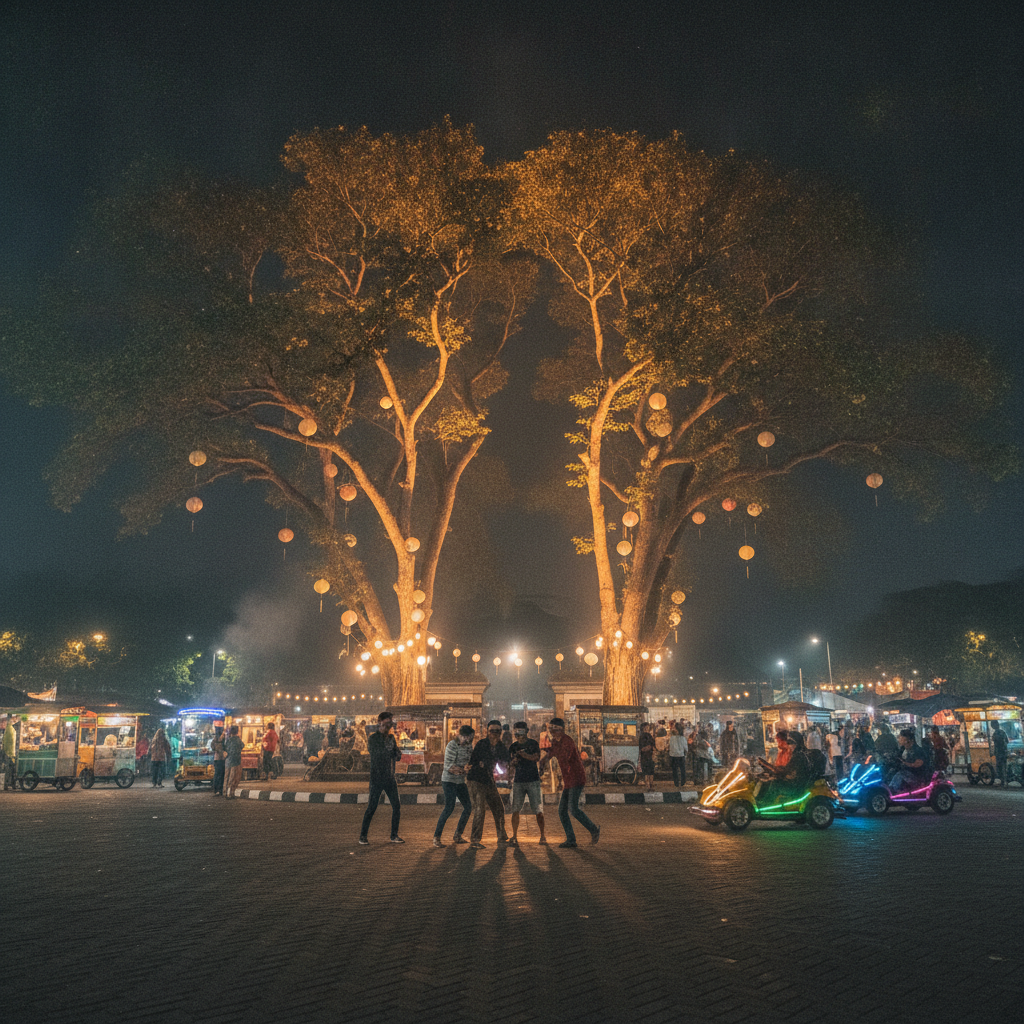
Jl. Malioboro—the main commercial street of Yogyakarta, running 1 km north from the railway station toward the Kraton—is Indonesia's most famous shopping street and the primary retail destination for Javanese batik, silver jewellery, and traditional crafts. The street: lined with warungs (food stalls) and shops selling batik cloth, silver jewellery from Kotagede (the silver-working district 5 km southeast of the city centre—Indonesia's finest silver repousse and filigree workshops), and leather wayang kulit puppets. Batik: Yogyakarta's batik tradition (particularly the batik tulis—hand-drawn using a canting wax pen—of the royal household workshops and the specialist studios in the Kraton area) is the most prestigious in Indonesia; the Yogya batik patterns (the parang—diagonal interlocking wave pattern—and the kawung—four-petal floral geometry) are protected court designs, and certain patterns can only be worn by members of the royal family. The Taman Sari Water Castle (Taman Sari—'Scented Garden'—built 1758 as the Sultan's pleasure garden and royal bathing complex, 1 km west of the Kraton): a partially ruined complex of pools, underground tunnels, and a mosque, now partially occupied by Batik artists' workshops in the residential kampung that grew within the ruins.
- 6
Yogyakarta's Student City Culture – Arts, Activism & Gudeg
Yogyakarta (universally called 'Jogja' by Indonesians)—home to 137 universities and colleges (including the prestigious Gadjah Mada University—founded 1949, the oldest state university in Indonesia) and approximately 300,000 students from across the archipelago—is the most intellectually and artistically active city in Indonesia per capita: a city of 422,000 permanent residents that functionally houses nearly twice that number when students are in session. The artistic tradition: Yogyakarta has been the centre of Javanese classical arts (gamelan, wayang, batik, classical dance) since the founding of the sultanate in 1755, and has simultaneously developed Indonesia's most active contemporary art scene (the Cemeti—Institut Kesenian Jogja, founded 1988—one of the oldest independent art spaces in Southeast Asia; the Indonesian Visual Art Archive—IVAA). The political tradition: Yogyakarta's students have been at the centre of every major political movement in Indonesian history (the 1945 independence proclamation was supported from Yogyakarta, which served briefly as the Indonesian capital; the 1998 Reformasi movement's student activists in Yogyakarta were among the first to occupy parliament buildings). Gudeg (the city's signature dish—young jackfruit cooked in coconut milk and palm sugar for hours until it reaches a sweet, soft consistency, served with rice, chicken, egg, and spicy sambal): the taste of Yogyakarta.
Walk this route with audio
Stories play automatically as you reach each stop — no tapping needed.
More in Yogyakarta
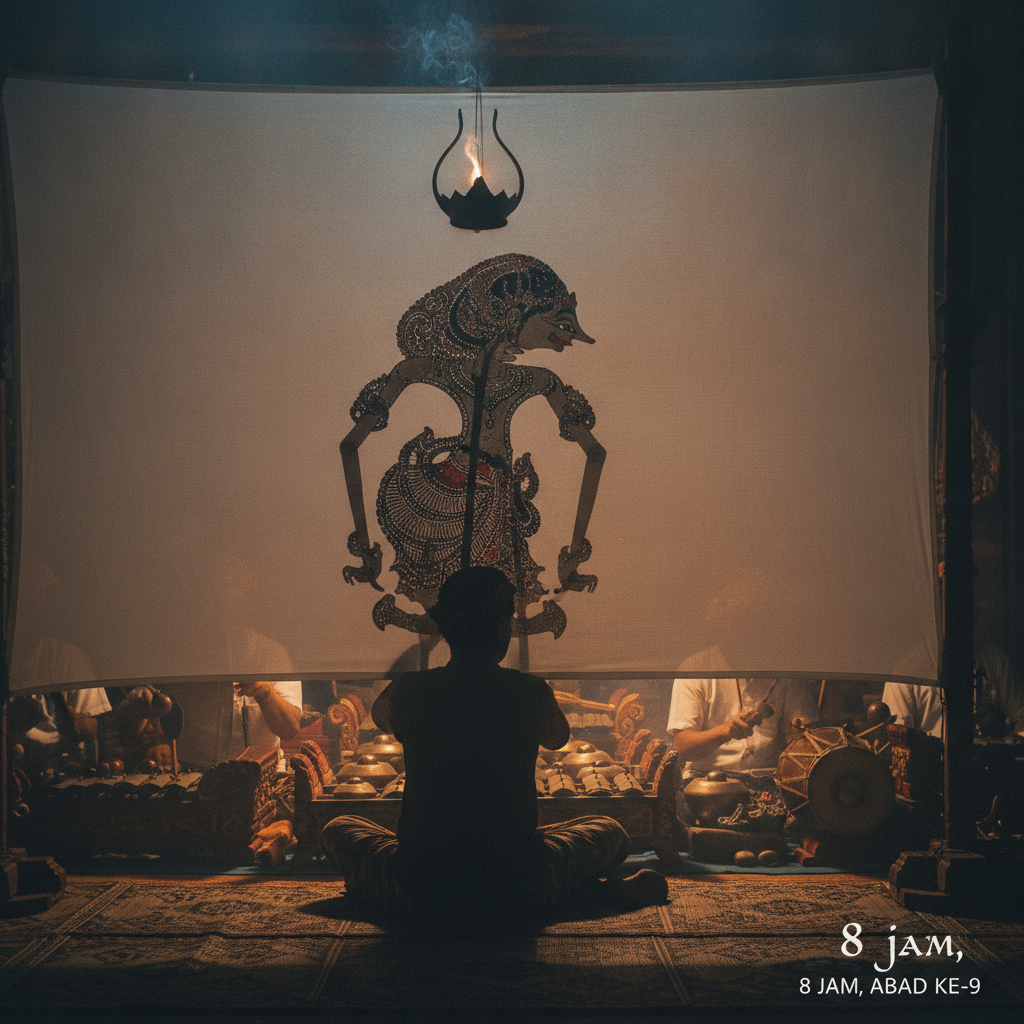
Yogyakarta's Arts: 9-Hour Wayang Kulit at Dawn, Gamelan's Influence on Debussy & Angkringan Cart Food After Dark
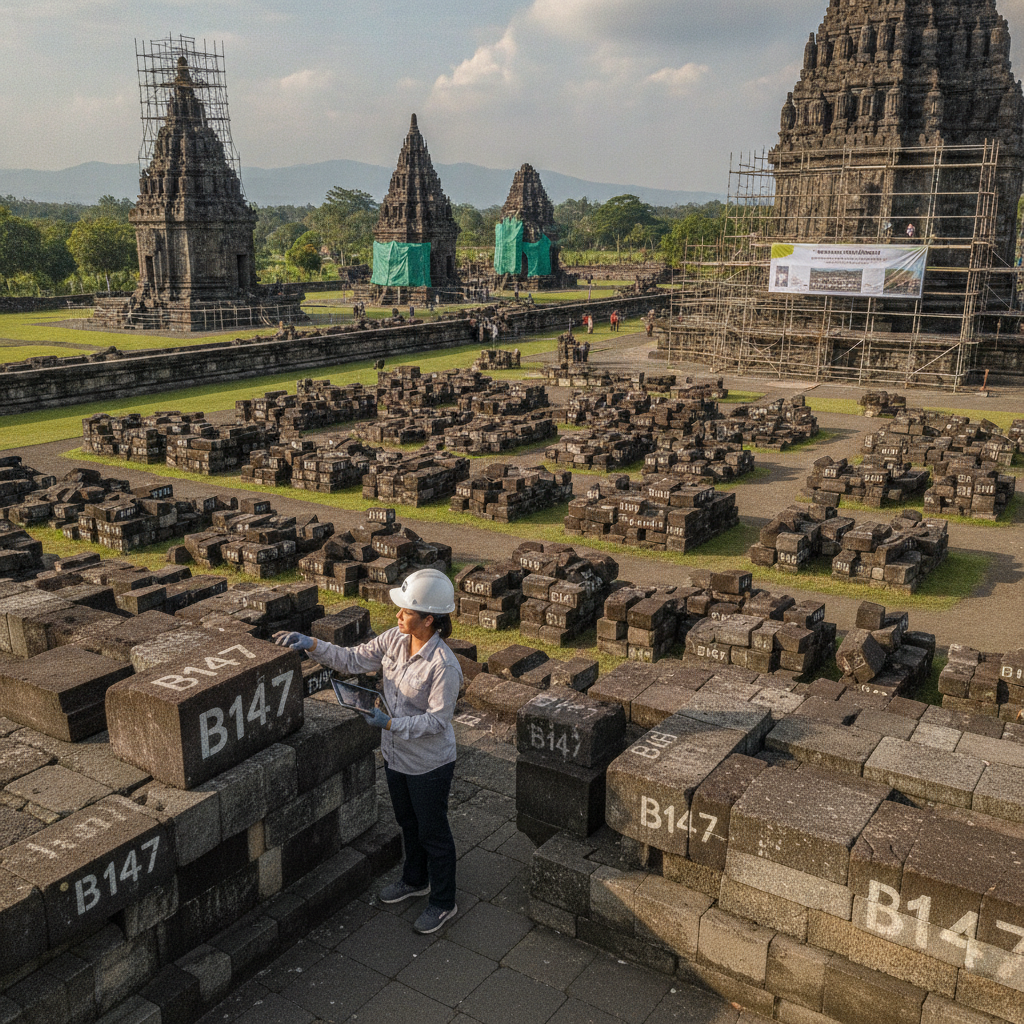
Yogyakarta's Foundations: Muhammadiyah's 50 Million Members Founded Here, Solo's Batik Laweyan & the Sultan's Meditation Practice
Yogyakarta's Soul: Kotagede Silver Filigree, the Republican Government in the Kraton & Nyi Roro Kidul's Green Sea