Yogyakarta After Dark and Beyond: Alun-Alun Kidul's Blindfolded Wish Walk, Candi Plaosan's Interfaith Love Story & Gunung Kidul's Spider Gondola
The final Yogyakarta—Gunung Kidul's cove beaches 70 km south by motorcycle (Wedi Ombo's calm double bay, Timang's hand-pulled cable gondola to a fishermen's island), Candi Plaosan's twin Buddhist towers built by a Hindu king for his Buddhist queen (a 9th-century royal interfaith marriage materialised in stone), the Batik Research Centre's 12,000 pattern library documenting which lurik stripe patterns are appropriate for weddings versus funerals, Candi Sambisari's 9th-century temple still partially buried under 6 metres of Merapi volcanic deposits discovered only in 1966, the Alun-Alun Kidul's masangin tradition where the blindfolded walk between two sacred banyan trees grants wishes, and the Argo Wilis eksekutif train to Surabaya across East Java's volcanic landscape for Rp 350,000.
- 1
Wedi Ombo & Gunung Kidul's Hidden Beaches
Gunung Kidul Regency—the karst limestone plateau that forms the eastern hinterland of Yogyakarta Special Region, 45–70 km from the city—contains some of Java's most spectacular and least-touristed coastal scenery: a series of small cove beaches backed by white limestone cliffs, accessible by motorcycle via winding hill roads. Wedi Ombo (70 km south of Yogyakarta, 1.5 hours by motorcycle): a double-bay beach with rock outcrops, calm water for swimming in the eastern bay, and the drama of the Indian Ocean surf on the western exposure. Timang Beach (65 km—accessible via a 15-minute motorcycle track from the main road): famous for the traditional spider gondola (a wooden platform on cables, pulled by hand across a 200-metre gap to Timang Island)—a transport originally used by fishermen to reach the island, now operated as a tourist experience. The sea caves (gua laut) of Gunung Kidul: several beaches have sea caves formed in the limestone that can be explored at low tide. The Gunung Kidul beaches are best visited on weekdays (they become crowded with domestic tourists on weekends and public holidays); the road conditions require a well-maintained motorcycle or 4WD.
- 2
Yogyakarta's Puppet & Mask Traditions Beyond Wayang Kulit
Yogyakarta's performance traditions extend beyond the celebrated wayang kulit shadow puppetry to include several distinct forms that are less internationally known. Wayang golek (three-dimensional wooden rod puppets—the West Javanese equivalent of wayang kulit, using carved and painted wooden figures manipulated from below): less common in Yogyakarta than wayang kulit but present; the puppet workshops produce exquisite carved figures. Topeng dance (masked dance): the use of intricately carved and lacquered wooden masks in performance dates to the pre-Islamic Javanese court; the Topeng Panji dance cycle (stories of the legendary Prince Panji—a uniquely Javanese narrative, predating the Ramayana/Mahabharata tradition) is performed in Yogyakarta at the Kraton and special cultural events. Kethoprak: a popular traditional theatre form combining dialogue, song, and dance in Javanese historical stories (different from the Sanskrit-origin wayang repertoire—kethoprak stories are set in the Javanese historical period and draw on local legendary and historical characters); it was the most popular entertainment form in Central Java before cinema and television. Jathilan: a trance-dance tradition in which performers riding bamboo hobby horses enter trance states, sometimes including fire-eating and glass-chewing, performed at village festivals.
- 3
Yogyakarta's Textile Heritage – From Kraton to Contemporary
Yogyakarta's textile heritage extends from the protected court batik patterns of the Kraton (the parang rusak—the diagonal wave pattern reserved for the Sultan and direct family; the semen—an ornate floral pattern for court officials) through the commercial batik production of Malioboro's shops to the contemporary textile art scene emerging from the city's art institutes. The Batik Research Centre (Balai Besar Kerajinan dan Batik—established 1947 in Yogyakarta): the primary Indonesian government institution for batik research, documentation, and development—maintaining a library of over 12,000 batik pattern records, conducting chemical research on natural dyes, and providing accreditation for the 'authentic batik' certification that distinguishes hand-made from printed fabric. The lurik weaving tradition (lurik—a traditional handwoven textile in striped patterns, produced primarily in Klaten and Bantul regencies surrounding Yogyakarta): less internationally known than batik but equally significant in Javanese textile culture; the narrow horizontal stripe patterns carry meanings (certain lurik patterns are auspicious for weddings, others for funerals). The contemporary designers: several ISI (Institut Seni Indonesia) textile design graduates have built careers merging traditional Javanese textile techniques with contemporary fashion and product design.
- 4
The Prambanan Plain's Archaeological Landscape
The Prambanan plain—the flat agricultural land stretching between Yogyakarta and Solo in the Klaten area—contains a concentration of ancient temples and archaeological sites second only to Bagan in Southeast Asia in density. Beyond the main Prambanan compound and the Sewu temple: Candi Sojiwan (a 9th-century Buddhist temple 2 km south of Prambanan, with finely carved relief panels depicting animal fables in a Buddhist morality tale format—less visited and more atmospherically situated than the main compound); Candi Plaosan (a twin Buddhist temple complex 2 km north of Prambanan—two identical walled compounds, each with identical towers, built in the 9th century by Rakai Pikatan, a Hindu king, for his Buddhist queen Pramodhawardhani—an extraordinary act of interfaith royal affection); Candi Kalasan (the oldest dated Buddhist monument on Java, 778 CE, inscribed on the Kalasan Inscription—the earliest Sanskrit inscription found in Java); Candi Sambisari (a 9th-century Shaivite temple discovered in 1966, still partially buried, the original ground level 6 metres below the present surface, created by volcanic deposits from Merapi eruptions over the centuries).
- 5
Yogyakarta by Night – Alun-Alun, Street Food & the Torch Fire
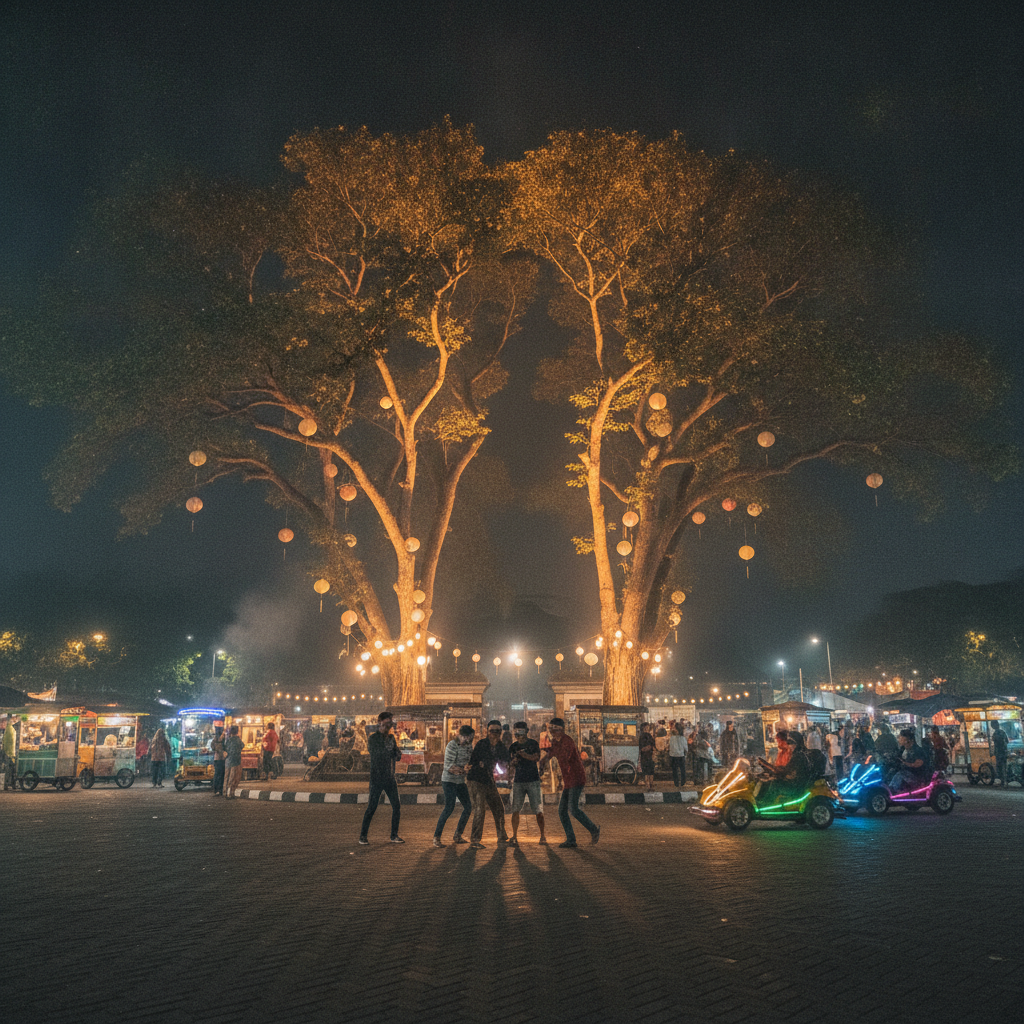
Yogyakarta's nocturnal character—centred on the Alun-Alun Kidul (the southern square of the Kraton compound, immediately south of the palace walls) and Jl. Malioboro by night—is as distinctive as the daytime heritage circuit. The Alun-Alun Kidul ('South Great Square'): two enormous banyan trees (beringin kurung—sacred figs enclosed in white-painted fences) stand in the centre of the square; the Javanese tradition holds that blindfolded visitors who can walk between the two trees without touching either will have their wishes granted—the activity is called masangin. The square at night: lit by the lanterns of food vendors, occupied by becak drivers and their passengers, with young Javanese families on rented fluorescent go-karts circling the square—a scene of extraordinary charm. Jl. Malioboro by night: the same commercial street becomes a nocturnal event when the batik and craft stalls close and the warung food stalls set up on the pavement—nasi goreng cooked to order on charcoal, sate skewers, es campur (crushed ice dessert with coconut milk, palm sugar, and tropical fruits). The torch fire at the Kraton: ceremonial lanterns are lit at the palace gates after nightfall; the combination of architectural lighting, sound of gamelan from within the walls, and the nighttime crowd makes the Kraton's outer walls most atmospheric after dark.
- 6
The Yogyakarta Train Journey – Java's Slow Travel Circuit
The train journey from Yogyakarta—the hub of Java's rail network—is the finest way to experience Central and East Java as a continuous landscape. The primary routes: Yogyakarta to Surabaya (Argo Wilis—the most prestigious express, 5.5 hours; Bima—the overnight sleeper, 7 hours) passing the volcanic landscape of East Java, the rice paddies of the Brantas plain, and arriving at Java's second city and gateway to Bali. Yogyakarta to Jakarta (Argo Lawu or Argo Dwipangga—5 hours; the night trains take 8 hours), passing Purwokerto, Cirebon, and the rural landscapes of West Java. Yogyakarta to Solo (Prameks commuter, 1 hour—the cheapest and most frequent train in Central Java, used by commuters and students as much as tourists). Yogyakarta to Bandung (7 hours—the 'Argo Wilis' or the slower 'Lodaya')—passing the Dieng Plateau approaches and the West Java highland tea country. The train culture: Indonesian long-distance trains are divided into eksekutif (executive—air-conditioned reserved seats), bisnis (business—reserved seats, less AC), and ekonomi (economy—unreserved, crowded)—the eksekutif class is comfortable and affordable (Rp 150,000–350,000/€9.50–22 for most inter-city journeys); seat reservations are required and sold online through the KAI (Kereta Api Indonesia) booking system.
Walk this route with audio
Stories play automatically as you reach each stop — no tapping needed.
More in Yogyakarta
Yogyakarta's Arts: 9-Hour Wayang Kulit at Dawn, Gamelan's Influence on Debussy & Angkringan Cart Food After Dark
Yogyakarta's Foundations: Muhammadiyah's 50 Million Members Founded Here, Solo's Batik Laweyan & the Sultan's Meditation Practice

Yogyakarta's Soul: Kotagede Silver Filigree, the Republican Government in the Kraton & Nyi Roro Kidul's Green Sea