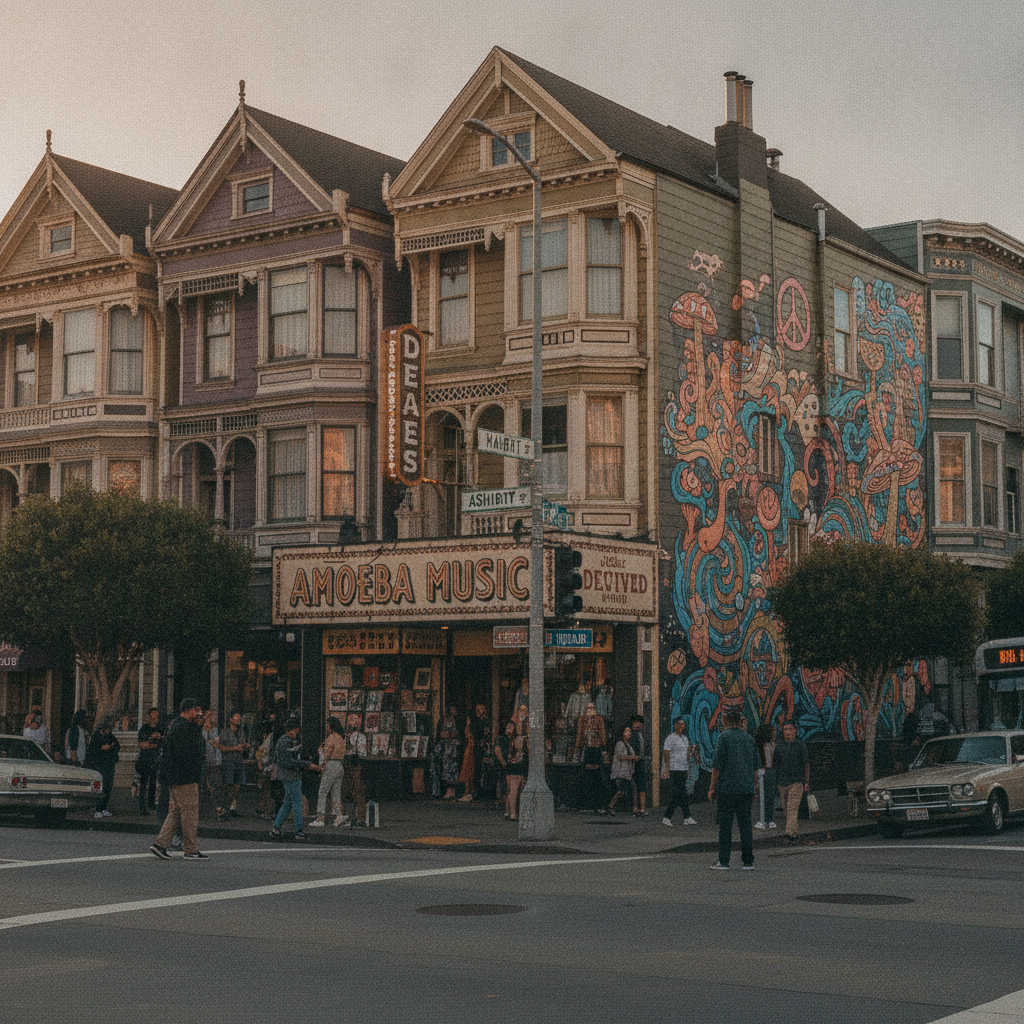
Haight-Ashbury, Golden Gate Park y el Legado de la Contracultura de los 60
The Haight-Ashbury neighbourhood — the Victorian residential district west of Buena Vista Park that became the epicentre of the 1967 Summer of Love and the psychedelic counterculture movement, and that today preserves more of the visual and commercial character of that era than any other neighbourhood in San Francisco — and the adjacent Golden Gate Park (the 3 miles by half-mile rectangular park that constitutes San Francisco's largest green space) are the twin anchors of western San Francisco's cultural and recreational landscape.
- 1
Haight-Ashbury — The Summer of Love's Address
Haight-Ashbury (the residential neighborhood where Haight Street meets Ashbury Street, 10 minutes by bus from downtown) was the centre of the Summer of Love (1967, 100,000 young people flooded the neighbourhood June–September, making it the defining event of the 1960s counterculture) — the Grateful Dead lived at 710 Ashbury Street (still residential, exterior photographable from the sidewalk), Janis Joplin at 635 Ashbury; the neighbourhood is still visually recognizable from the 1967 photographs — the Victorian houses, the Rainbow Flag (invented by Gilbert Baker in 1978, based on the Summer of Love's rainbow imagery).
- 2
Amoeba Music — The Cathedral of American Record Stores
Amoeba Music (1855 Haight Street, the former Golden State Theater bowling alley, the largest independent record store in the world by inventory — 250,000+ CDs, 100,000+ LPs, plus movies, memorabilia, and free in-store concerts) is San Francisco's most important cultural institution that isn't a museum — the in-store concert series (Amoeba's 'What's in My Bag?' video series on YouTube where celebrities show their record purchases has 150+ episodes); the used section (the largest used vinyl selection in California) and the local SF artist section are the most important for music tourists.
- 3
Golden Gate Park — Bigger Than Central Park, Fully Engineered
Golden Gate Park (1,017 acres, 3 miles long by 0.5 miles wide, larger than Central Park in New York, created from sand dunes 1870–1910 by horticulturist John McLaren) contains the de Young Museum (fine art, $16 adults, the copper facade is weathering to green to blend with the park), the California Academy of Sciences (natural history museum with a living roof, $40 adults), the Japanese Tea Garden (1894, the oldest public Japanese garden in the US, $12 adults), the Conservatory of Flowers (1878, the oldest public conservatory in the Western US, $13 adults), and Stow Lake (pedal boats, $19.50/hour).
- 4
Panhandle and Hippie Hill — The Park's Cultural Extension
The Panhandle (the 8-block greenbelt connecting the main park to Haight-Ashbury) was the site of the first free rock concerts (1967, Jefferson Airplane, Grateful Dead) that defined the Summer of Love's park culture — Hippie Hill (the eastern knoll of Golden Gate Park's Main Meadow) continues to host drum circles every Sunday afternoon (free, ongoing for 40+ years) and the annual 420 celebration (April 20, the largest public cannabis gathering in the US, 20,000+ attendees, in the park meadow).
- 5
Painted Ladies — Victorian Houses Against the City Skyline
The Painted Ladies (Seven Sisters, 710–720 Steiner Street, Alamo Square, the six-house Victorian row facing the park, built 1892–1896) is the most photographed block in San Francisco — the image of the brightly painted Victorian Italianate houses against the downtown skyline is the city's dominant visual symbol (used in the Full House TV series opening, 1987–1995); Alamo Square Park (the park opposite, free) is the viewpoint; the houses are private residences and cannot be entered; the best view is from the park in the early morning when the city lights are still on.
- 6
Ashby Flea Market and Haight Street Market — The Counterculture Economy
Haight Street's vintage and secondhand economy (Wasteland, Crossroads Trading, Static, and the Piedmont Boutique — the most theatrical clothing shop in San Francisco, 1520 Haight, costume and camp clothing displayed in elaborate window installations) is the commercial continuation of the 1960s ideology — the Alemany Farmers Market (100 Alemany Boulevard, the oldest farmers' market in California, Saturday mornings, lower prices than the Ferry Building) and the Ashby Flea Market (Berkeley, Sunday mornings) extend the spirit; the Bay Area's resale and swap culture is the most developed in any American city.