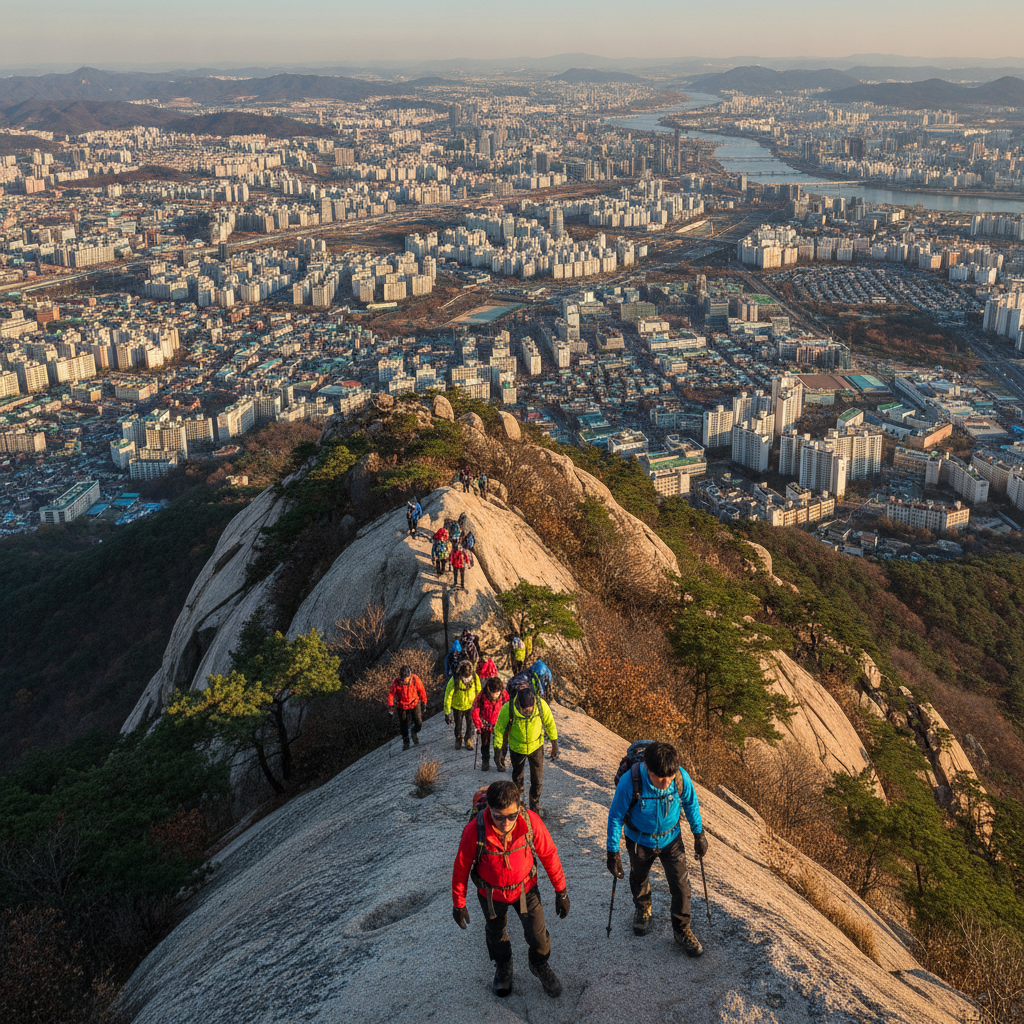
Parque Nacional Bukhansan — Picos de Granito y las Murallas de la Fortaleza de Seúl
Bukhansan National Park (북한산국립공원, 'north of the Han Mountain National Park' — the 80-square-kilometre national park in the northern outskirts of Seoul, encompassing the Bukhansan massif (the highest peak Baegundae 836 metres) and the Dobongsan massif (Jaunbong 740 metres) — is the most visited national park in the world per unit area, with over 5 million visitors annually accessing it directly from Seoul's subway system.
- 1
Bukhansan National Park — Granite Peaks Above Seoul
Bukhansan National Park (the mountain range immediately north of Seoul, 79.92km², the most-visited national park per unit area in the world with 5 million+ visitors/year) rises to 836m at Baegundae peak — the park encompasses a 2,300-year-old Joseon-era fortress (Bukhansanseong, 8.5km of restored stone walls encircling the mountain's main ridge), 100+ Buddhist temples, and the granite dome peaks (Insubong, Baegundae, Mangyeongdae) that are rock climbing destinations; the Dobongsan area (the park's eastern section) offers the most dramatic rock faces.
- 2
Bukhansan Fortress — The 2,000-Year-Old Mountain Walls
Bukhansanseong Fortress (the mountain fortress encircling Bukhansan's main peaks, originally built during the Three Kingdoms period in 132 CE, expanded by Joseon king Sukjong in 1711, 8.5km of walls including 15 gates) was built as a refuge for the royal family in case of invasion — the fortress was used twice: during the Japanese invasion of 1636 and during the 1894 Donghak Peasant Revolution; the Waryong Reservoir (inside the fortress walls, the emergency water supply for the fortified population) and the 13 temples within the walls (including Daedongmun Gate) are accessible on a 4-hour fortress circuit walk.
- 3
Dobongsan Rock Climbing — Seoul's Granite Gym
Dobongsan (740m, the eastern section of Bukhansan National Park, accessible from Dobongsan Metro Station in 30 minutes from central Seoul) has the most popular rock climbing terrain in the Seoul metropolitan area — the climbing crags (Seoninjang, Manguiram) have 100+ established routes from beginner (5.5) to advanced (5.13); the mountain is renowned for the autumn maple colour (mid-October) which turns the granite rock faces orange and red; the trail to Jaunbong Peak (40 minutes from the entrance) is the most accessible hiking challenge with a fixed rope section.
- 4
Inwangsan Shamanist Mountain — Urban Ritual Above the Palace
Inwangsan (338m, the mountain immediately west of Gyeongbokgung Palace, accessible from Dongnimmun Metro Station, 30-minute hike) is Seoul's shamanist mountain — the large flat boulder (Guksadang, the shamans' worship site) and the Seon-bawi Rock (the twin granite boulders, the primary shamanist prayer site in Seoul where mudang/Korean female shamans hold gut ceremonies on auspicious lunar calendar days) are the distinctive features; the Inwangsan trail passes through the traditional village neighbourhood of Buam-dong (the artists' and writers' neighbourhood, the 'Seoul equivalent of Montmartre').
- 5
Namhansanseong — The Mountain Fortress That Held in 1636
Namhansanseong (South Han Mountain Fortress, 30km southeast of Seoul, accessible by Metro to Namhansanseong station + bus, 1.5 hours, UNESCO, the mountain fortress where King Injo of Joseon and 14,000 soldiers endured a 47-day siege by the Manchu Qing forces in 1636–1637 before surrendering) is Seoul's most historically significant fortress — the 11.76km perimeter of stone walls (intact, the most complete Korean mountain fortress walls) and the Haenggung (the royal temporary palace within the walls) are accessible on a 4-hour perimeter walk; the fortress is the setting of the Korean film 'The Fortress' (2017).
- 6
Seoul's 4 Inner Mountains — The Geomantic City
Seoul's traditional urban planning (following Chinese geomantic principles — pungsu, Korean feng shui) required the capital to be protected by 4 mountains in the cardinal directions — Bugaksan (북악산, the northern 'Main Mountain', 342m, behind Gyeongbokgung, the presidential residence trail requires pre-registration), Naksan (낙산, the eastern 'Left Mountain', 125m, most accessible), Namsan (남산, the southern 'Front Mountain', 265m, the N Seoul Tower), and Inwangsan (인왕산, the western 'Right Mountain', 338m, the shamanist mountain) form the geomantic enclosure of Seoul; hiking all four in a single day is a Korean urban hiking tradition.