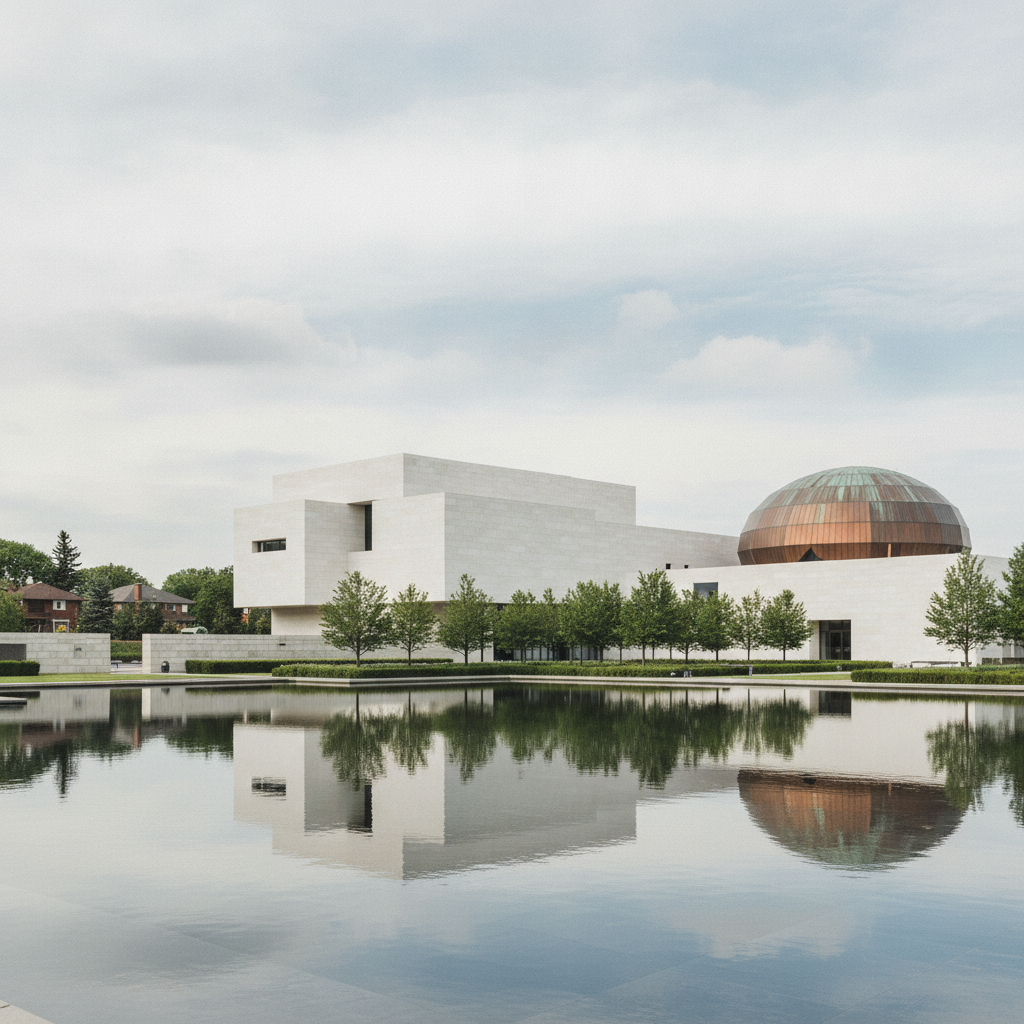
Museo Aga Khan, North York y la Diversidad Suburbana de Toronto
Toronto is the most ethnically diverse large city in the world — approximately 50% of Toronto residents were born outside Canada (the highest proportion of any large city in the world), and the city is home to communities from over 200 countries speaking over 140 languages; the suburban areas of Toronto (North York, Scarborough, Etobicoke) house the majority of Toronto's immigrant communities and represent one of the most extraordinary experiments in multicultural urbanism in history.
- 1
Aga Khan Museum — Islamic Art in Modernist Architecture
The Aga Khan Museum (77 Belmont Park Drive, North York, Don Mills MRT then 15-minute walk, ¥20 adults, Tuesday–Sunday 10am–5:30pm Wednesday to 8pm) is the only museum in North America dedicated exclusively to Islamic art, architecture, and culture — the building (2014, Fumihiko Maki architect, the Japanese modernist, surrounded by the Ismaili Centre Toronto and Aga Khan Park) and the permanent collection (1,000+ objects spanning 1,400 years of Islamic civilization from Spain to China: the Persian manuscripts, the Fatimid rock crystal, the Mughal jade daggers) represent the Aga Khan Trust for Culture's most complete public expression; the basement concert hall (the finest acoustic chamber music venue in Toronto) programs year-round.
- 2
Ismaili Centre and Aga Khan Park — Sacred Garden in the Suburbs
The Ismaili Centre Toronto (the religious and cultural centre of Canada's Ismaili Muslim community, adjacent to the Aga Khan Museum on Belmont Park Drive, the garden between the museum and centre open to the public free, daily dawn to dusk) is designed by Charles Correa (the Mumbai-based architect, the most celebrated South Asian architect of the 20th century) as a geometric garden representing Islamic garden traditions — the chahar bagh (the four-part garden plan of the traditional Persian/Islamic garden, representing the four rivers of paradise) is expressed through the water channels, marble paving, and the 40-metre linear fountain axis connecting the Museum to the Centre across the garden.
- 3
North York Diverse Dining — The Suburban Food Belt
North York (the former borough north of Toronto, now the most ethnically diverse suburban area in Canada) contains the highest concentration of Korean restaurants outside Korea (Koreatown on Bloor West, and the newer North York Koreatown on Yonge Street north of Sheppard), the largest concentration of Persian restaurants outside Iran (the 'Tehrangeles of Canada' on Yonge north of Lawrence), and the most comprehensive collection of South Asian restaurants in Canada (on Gerrard Street East and in the Scarborough Tamil corridor) — the specific addresses: Arang Korean BBQ (4894 Yonge Street, North York, ¥40/person, the most authentic Korean BBQ in Toronto).
- 4
Don Valley — The River Ravine That Cuts Through the City
Don Valley (the river valley of the Don River, running 38km from Richmond Hill in the north to the Toronto Harbour in the south, containing 1,500 hectares of park and trail despite being surrounded by urban development) is Toronto's most important ecological corridor — the Don Valley Trail (39km, from Evergreen Brick Works to the Lakefront, the most-used long-distance trail in Toronto), the Evergreen Brick Works (the former brickyard, 2010 conversion to the market and environmental centre, Saturday farmers market May–November the largest in Toronto), and the Sunnybrook Park (the 150-hectare equestrian and walking park in the valley) make the Don Valley the outdoor alternative to the waterfront.
- 5
Ontario Science Centre — The 1969 Brutalist Ravine Museum
Ontario Science Centre (770 Don Mills Road, North York, 15 minutes from downtown by TTC, ¥23 adults, daily 10am–5pm) is built into the Don Valley ravine by Raymond Moriyama (1969, the most significant work of Canadian Brutalist architecture in a museum context — the building's 8 levels descend 26m into the ravine from the entrance pavilion, connecting via enclosed ramps over the forest canopy) — the permanent galleries (the Science Arcade — the most visited interactive gallery in Canada with 650,000 hands-on interactions per week — the Space and the Living Earth galleries) are supplemented by the OMNIMAX Theatre (the largest screen in Canada, 24m dome, first-run science documentary programming).
- 6
Markham — The Chinese Technology Suburb
Markham (the city immediately north of Toronto, 33km from downtown, the suburb with the highest proportion of East Asian residents of any large municipality in North America — 65% of Markham's 350,000 residents identify as East or Southeast Asian) has transformed from a small Ontario town to the technology and financial services suburb of the GTA — the Pacific Mall (4300 Steeles Avenue East, the largest Asian-themed indoor shopping mall in North America, 450+ stores, the best bubble tea, Taiwanese oyster vermicelli, and Japanese stationery in the Toronto region) and the IBM Canada headquarters (Markham Stouffville Road, reflecting the tech corridor concentration) define contemporary Markham.