Astana Religious Architecture Diversity Mosques Cathedral
Explore the religious architecture of Astana — the capital deliberately designed to showcase Kazakhstan's multi-religious character, the Hazrat Sultan Mosque (Central Asia's largest), the Russian Orthodox Cathedral, the Roman Catholic church, and the synagogue all visible from each other in the new city, the religious plurality a stated principle of Kazakhstan's national identity.
- 1
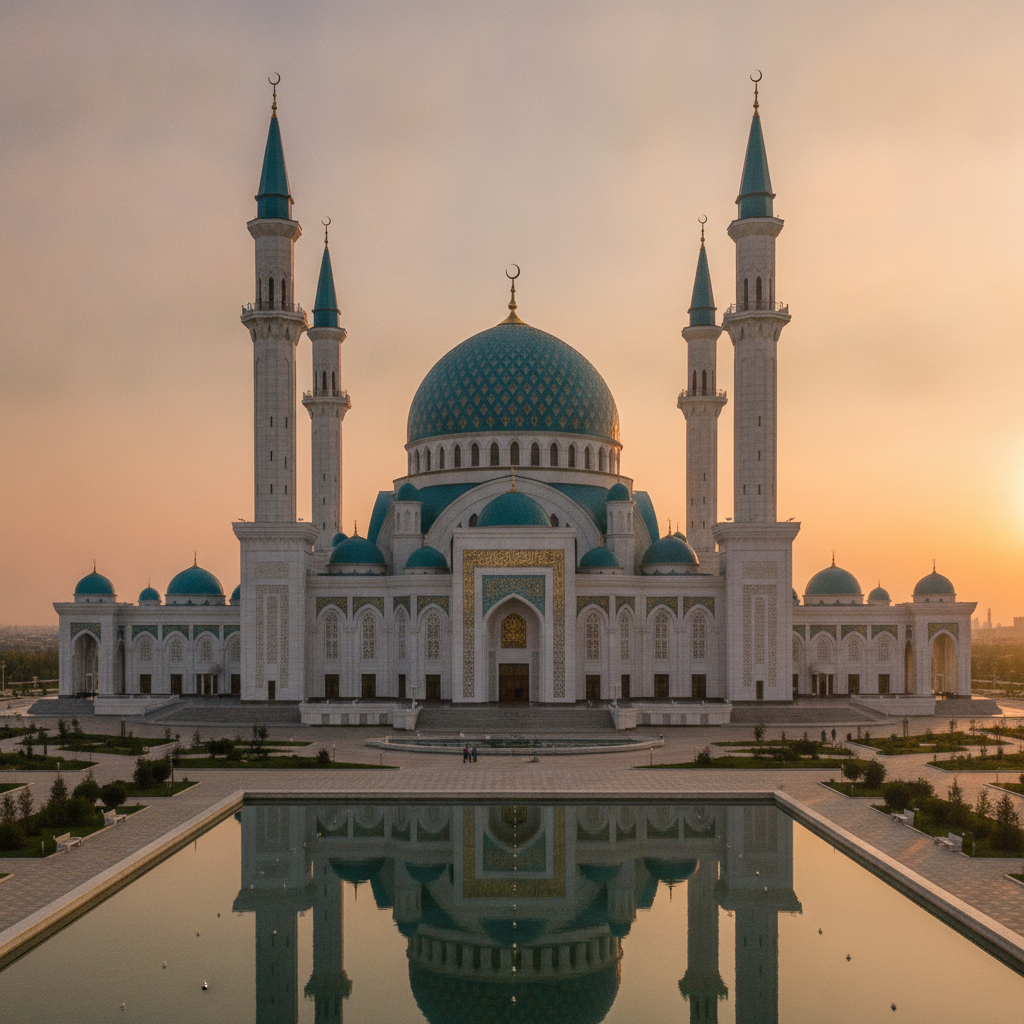
Hazrat Sultan Mosque
The Hazrat Sultan Mosque — Central Asia's largest mosque completed in 2012, the building combining traditional Islamic architectural elements with a modern construction scale, the main dome rising 51 meters, the four minarets reaching 77 meters, the mosque accommodating 10,000 worshippers indoors and 30,000 in the surrounding plaza, the building a statement of Kazakhstan's Muslim majority identity.
- 2
Cathedral of Assumption Russian Orthodox
The Cathedral of the Assumption of the Virgin Mary — the Russian Orthodox cathedral of Astana serving the large Slavic minority population of Kazakhstan, the golden domes visible across the flat cityscape, the church a reminder that Kazakhstan's population is approximately 70% Muslim and 26% Russian Orthodox, the religious diversity that the capital's architecture is designed to represent.
- 3
Palace of Peace Multi-Faith
The Palace of Peace and Reconciliation pyramid — the Congress of World and Traditional Religions venue used for the triennial gatherings of religious leaders representing Buddhism, Christianity, Islam, Judaism, Hinduism, and other traditions, the building symbolizing Kazakhstan's policy of inter-religious dialogue as an element of national identity and foreign policy.
- 4
Roman Catholic Cathedral
The Roman Catholic Cathedral of Astana — the church serving Kazakhstan's small Catholic community mostly of Polish, German, and Ukrainian descent, the building in the European Gothic tradition creating an architectural contrast with the modern Islamic and Orthodox buildings nearby, the cathedral a symbol of the religious tolerance that Kazakhstan promotes as a national value.
- 5
Jewish Community Synagogue
The Jewish community synagogue and cultural center of Astana — the building serving the small but historically significant Jewish community of Kazakhstan, a community with roots in the forced deportations of the Stalin era, the synagogue representing the full range of Abrahamic faiths present in the Kazakh capital.
- 6
Religious Plurality Policy
The religious plurality policy of Kazakhstan visible in the capital's architecture — the state's deliberate promotion of tolerance between the Muslim majority and the Orthodox, Catholic, and other religious communities, the policy rooted in the nomadic Kazakh tradition of pragmatic religious syncretism and the Soviet period's forced secularity, the multi-faith capital a diplomatic as well as domestic statement.
Walk this route with audio
Stories play automatically as you reach each stop — no tapping needed.
More in astana

Astana Modern Business Financial Hub Central Asia
Astana Steppe Silk Road Ancient Trade History
Astana Extreme Winter Climate Life Cold Capital
Astana EXPO 2017 Future Energy Innovation Hub

Astana Ishim River Waterfront Embankment