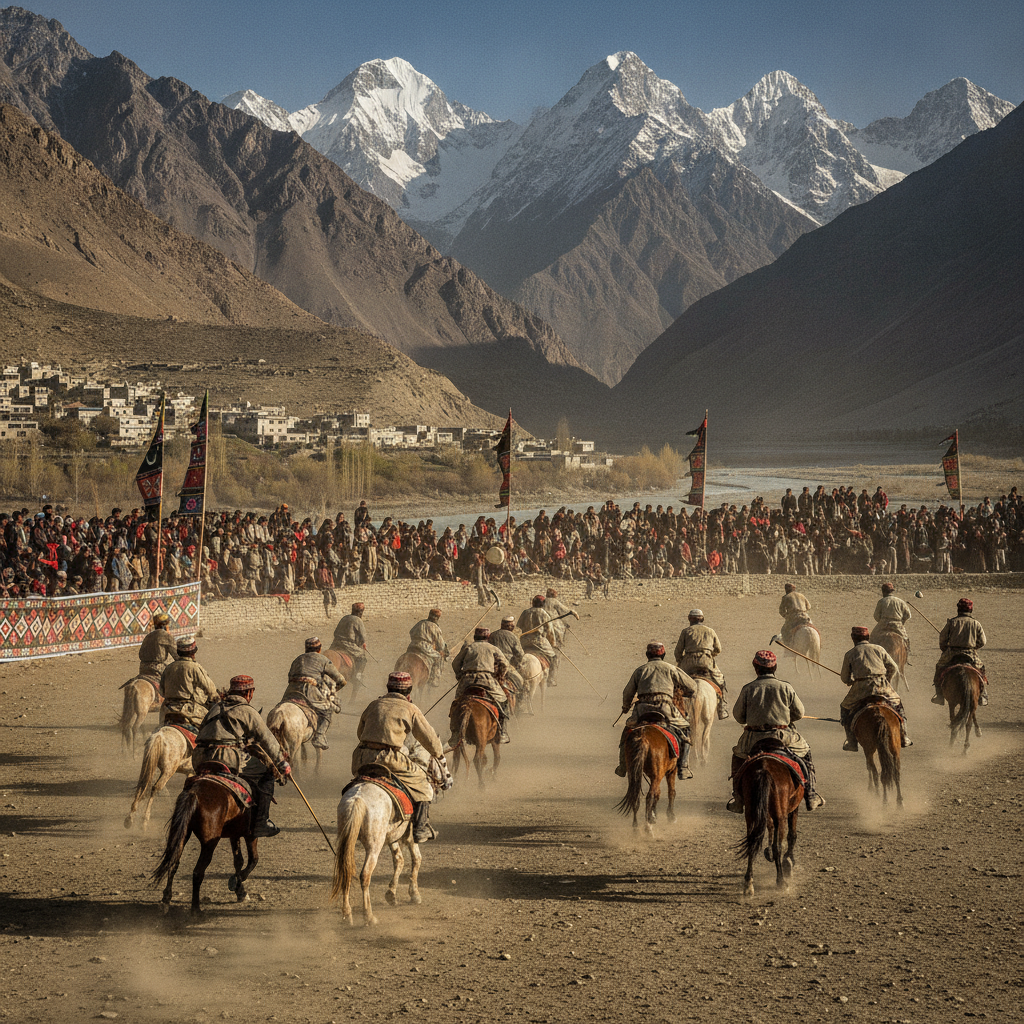
Skardu Baltistani Culture and Mountain Polo
Discover Baltistan's unique culture — the Shia Muslim community of Tibetan origin whose Balti language preserves ancient Tibetan vocabulary, whose polo tradition is the original mountain game played without goals and referees, whose cuisine of buckwheat bread and dried apricot soup reflects the high-altitude environment, and whose music and dance connect to the Tibetan cultural world.
- 1
Skardu Polo Ground
The traditional polo ground in Skardu where the high-altitude game is played — the Baltistani polo without formal rules where teams of riders compete in a fierce, fast game that bears only family resemblance to its modern international descendant, the local festival games drawing crowds from across the valley.
- 2
Balti Language Community
Encounter with the Balti-speaking community — the Tibetan-origin language preserved in Baltistan while Tibet itself was transformed by centuries of political change, Balti retaining archaic Tibetan vocabulary and grammar that linguists use to study Old Tibetan, the language spoken by the Shia Muslim community descended from Buddhist Tibetan settlers.
- 3
Traditional Balti Kitchen
A traditional Balti kitchen where the mountain cuisine is prepared — the buckwheat roti bread eaten with dried apricot soup (khambir), the butter tea churned in wooden cylinders, the dried meat preserved for winter, and the sparse but nutritionally adapted diet of a people who have survived in one of earth's harshest inhabited environments.
- 4
Baltistani Music Performance
A performance of traditional Baltistani music — the surna (double-reed wind instrument) and dohol (double-headed drum) combination that accompanies the traditional dances, the music structure and the dance forms showing the Tibetan roots of Baltistani culture overlaid with centuries of Islamic influence.
- 5
Handicraft Woodcarving Workshop
A woodcarving workshop producing the decorated furniture and architectural elements of traditional Baltistani buildings — the geometric and floral patterns carved into door frames, columns, and screens in the distinct Baltistani style that shows both Islamic geometric traditions and the influence of the Kashmiri woodcarving of neighboring valleys.
- 6
Skardu Old Town Heritage
The old town quarter of Skardu with its traditional Baltistani architecture — the narrow lanes between high stone walls, the older houses with their carved wooden elements, and the sense of a settlement that has existed in the Indus valley for centuries as both a trading post on the Silk Road and the administrative center of the Baltistan kingdom.
Walk this route with audio
Stories play automatically as you reach each stop — no tapping needed.