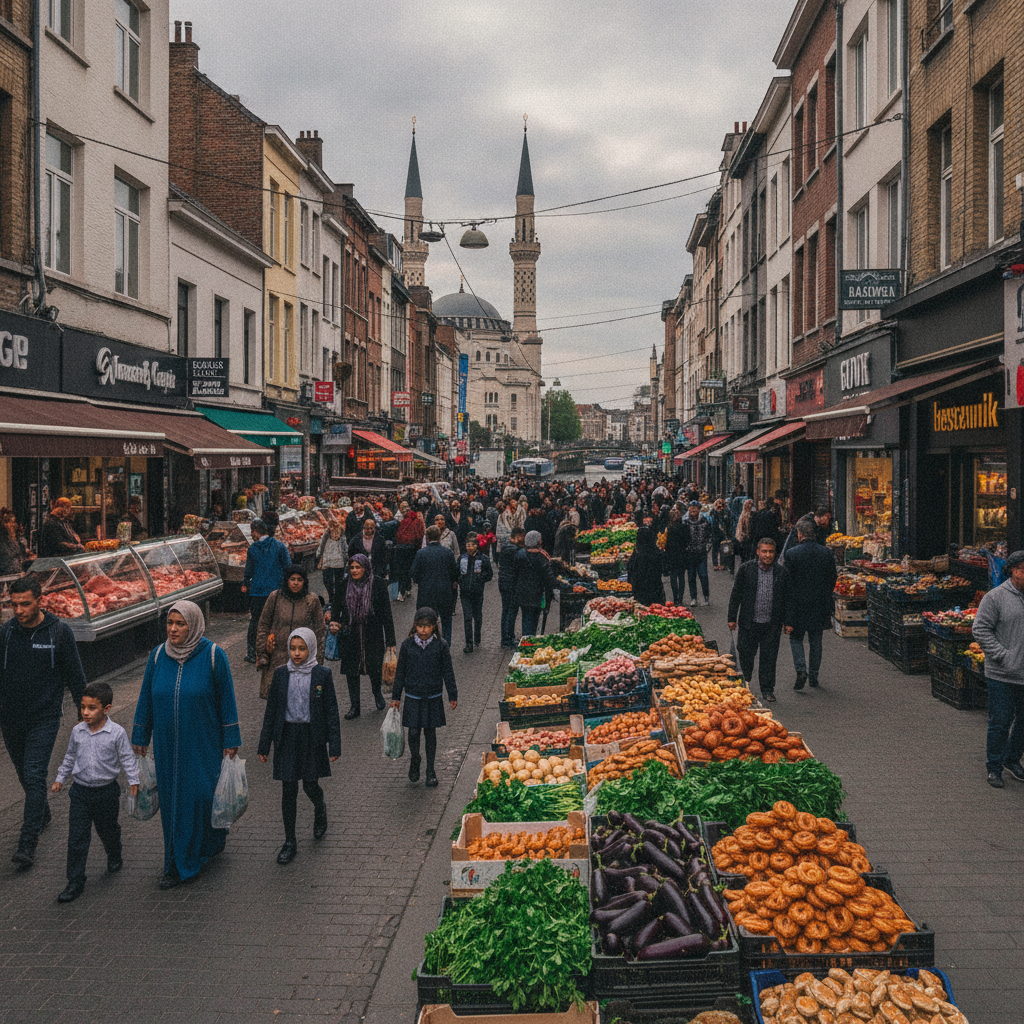
Molenbeek, Anderlecht e la Bruxelles Multiculturale
Brussels is one of the most ethnically diverse cities in Europe — approximately 35% of Brussels residents were born outside Belgium, with the largest communities from Morocco, Turkey, the Democratic Republic of Congo, and the EU member states; the working-class communes of Molenbeek (Sint-Jans-Molenbeek) and Anderlecht immediately west of the city centre are the heart of Brussels' North African and Turkish communities and some of the most economically deprived areas in Belgium, but also among the most culturally vibrant, with their mosques, Moroccan restaurants and pastry shops, Turkish grocery stores, and emerging creative community.
- 1
Molenbeek — Brussels' Moroccan Quarter
Molenbeek is Brussels' most internationally reported neighborhood after the 2015 attacks — a working-class Moroccan-Belgian community built around the 1960s-70s immigration that filled Belgium's industrial labor shortfall. The reality is ordinary neighborhood life, not the media portrayal.
- 2
Anderlecht — Erasmus House & Football Culture
Anderlecht's Erasmus House (where the humanist philosopher Erasmus stayed in 1521) is Brussels' most underrated museum. The Anderlecht neighborhood also hosts RSC Anderlecht, Belgium's most successful football club, whose purple and white colors define local identity.
- 3
Laeken — Royal Greenhouse & Atomium
Laeken houses the Atomium (1958 World's Fair, 102m iron crystal structure), the Royal Greenhouses (open 2 weeks/year), and the Royal Palace of Laeken — a concentration of Belgian state architecture and 20th-century design in the city's north.
- 4
African Museum (Royal Museum for Central Africa) — Tervuren
The Royal Museum for Central Africa in Tervuren (20 minutes from Brussels) reopened in 2018 after a 5-year decolonization renovation — the Congo collection is now presented with contextual honesty about Belgian colonial violence unprecedented in European museum practice.
- 5
Brussels Multicultural Food Scene — Rue Antoine Dansaert
Rue Antoine Dansaert and the Saint-Catherine quarter host Brussels' most creative food scene — Moroccan bastilla, Congolese moambe, and Vietnamese phở served in design-forward spaces that reflect the city's status as Europe's most cosmopolitan capital.
- 6
Train World — Brussels' Railway Museum
Train World in the Schaerbeek station (the neighborhood built by Belgian railway workers) is Europe's most visually dramatic railway museum — historic locomotives presented in theatrical settings designed to evoke the social history of rail travel.