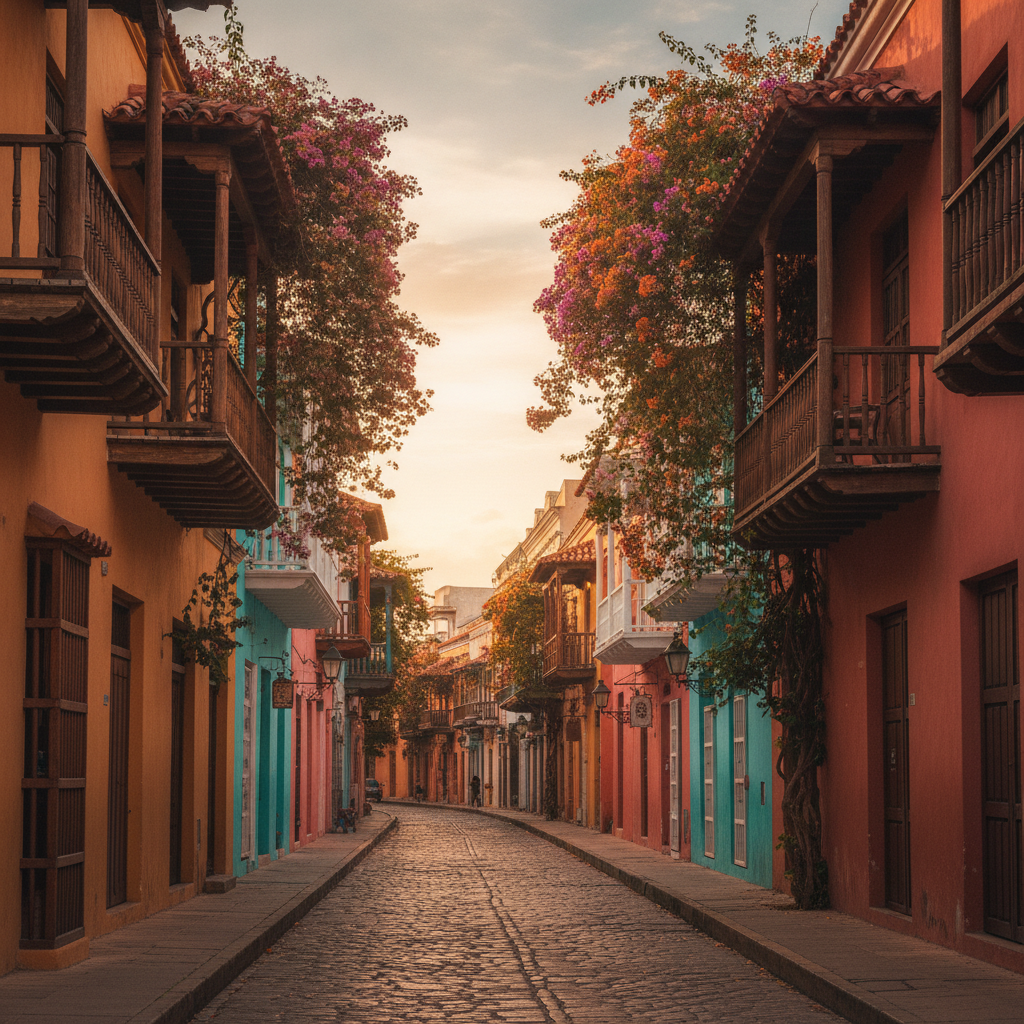
L'Architettura Coloniale Colorata e la Buganvillea di Cartagena
Cartagena's coloured colonial architecture (the ochre, yellow, pink, terracotta, and blue facades of the Spanish colonial buildings in the walled city, draped in the purple, orange, and red bougainvillea that spills over every balcony and rooftop) is the defining visual identity of the city — the image that has made Cartagena the most photographed city in Colombia and one of the most photographed in all of Latin America.
- 1
Balkony Architecture — Yellow, Pink & Blue Colonial Facades
Cartagena's Walled City architecture is defined by colour-coded colonial functions — yellow indicates a house that belonged to the Catholic church; red/orange indicates merchant ownership; white indicates a government building; the colours developed as a practical identifier in a pre-literate era and were codified by city ordinance in the 18th century.
- 2
Sofitel Legend Santa Clara Hotel — 1621 Convent
The Sofitel Santa Clara (built as a convent in 1621, converted to a hotel in 1995) occupies the entire block between Calle del Torno and Calle de la Universidad — guests can see original colonial wall paintings in the chapel corridor; the 190 rooms are built around the original convent cloisters; the rooftop pool looks over the entire Walled City.
- 3
Casa de Rafael Núñez — Presidential Home Museum
Casa de Rafael Núñez (El Cabrero neighbourhood, 1880s) was the home of the Colombian president who wrote the national anthem and the 1886 Constitution that governed Colombia for 100 years — the wooden Caribbean-style house (painted white with green trim) is preserved as a museum with original furnishings and Núñez's library.
- 4
Manga Island Architecture — Early 20th Century Elite
The Manga Island neighbourhood (across the bridge from Getsemaní) was built as Cartagena's elite residential quarter in the 1910s–1930s — Italian-trained Colombian architects built mansions combining Caribbean vernacular balconies with neo-Renaissance facades; the 1920 Club de Pesca (yacht club) on the lagoon is still the social centre of Cartagena's traditional families.
- 5
San Felipe de Barajas Castle — Colonial Military Engineering
The Castillo San Felipe de Barajas (begun 1536, massively expanded 1657–1763) is the largest Spanish colonial fortification in the Americas — a network of 22km of underground tunnels (accessible to visitors) allowed troop movement inside the hill without exposure to enemy fire; the castle successfully repelled Vernon's British fleet of 186 ships in 1741.
- 6
Las Murallas — 11km of Coral Stone City Walls
Cartagena's city walls (begun 1586, completed 1796) were built from coral stone quarried from the nearby reef — 11km in circumference, up to 18m thick at the bastions, and still completely intact; the walls took 208 years to complete, were funded by the silver and gold tax on treasure fleets stopping at Cartagena en route from Peru to Spain.