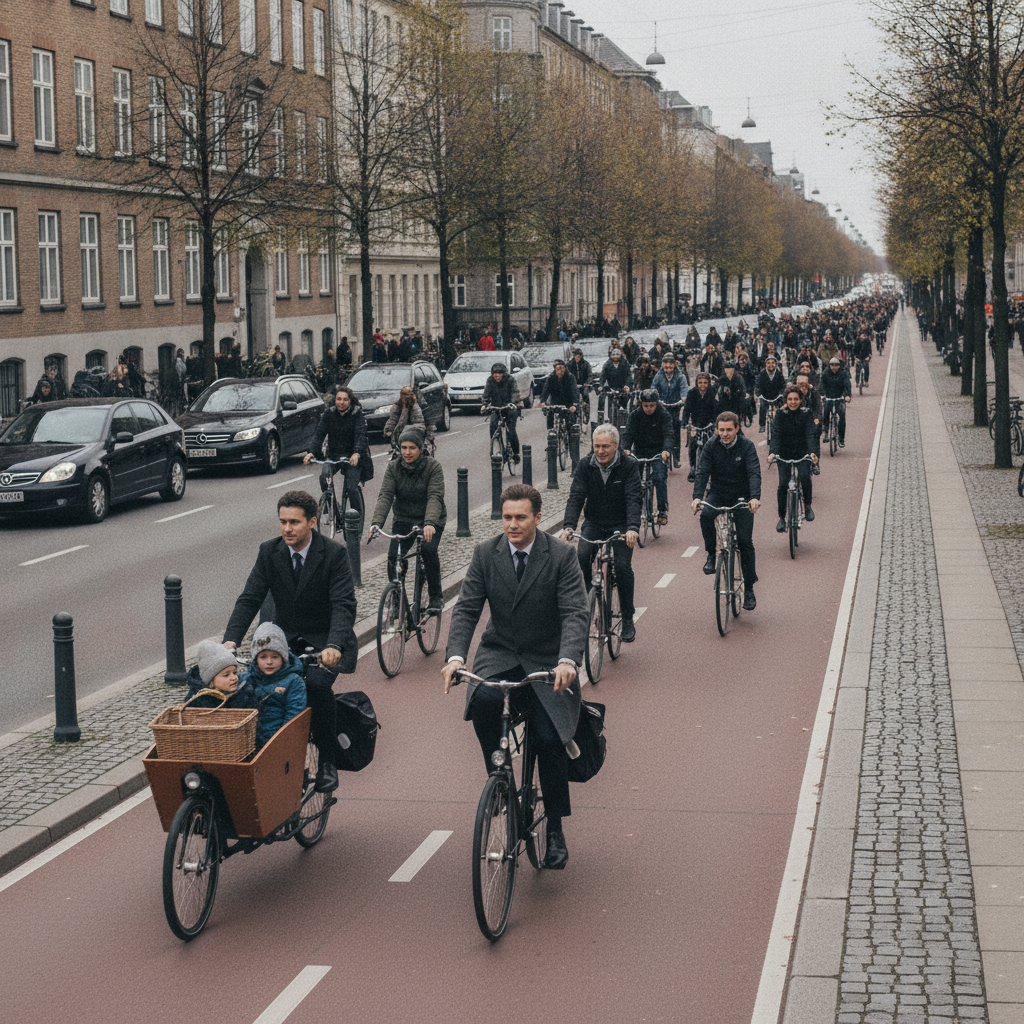
Cultura Ciclistica di Copenaghen — La Città Più Bike-Friendly del Mondo
Copenhagen cycling culture (the city where bicycles are not a lifestyle choice or a leisure activity but the default mode of urban transportation): Copenhagen has the highest rate of bicycle commuting of any capital city in the world, with approximately 62% of residents cycling to work or education every day (regardless of weather), 390 km of dedicated cycle tracks (separated from traffic by raised kerbs), and more bicycles (675,000) than cars (500,000) in the city; Copenhagen's cycling infrastructure is the global benchmark for urban bicycle design.
- 1
62% Modal Share — Cycling as Copenhagen's Default Transport
Copenhagen has the world's highest bicycle modal share of any capital city (62% of residents cycle to work or education daily) — the city maintains 390km of separated cycle tracks; cycling infrastructure is treated as priority transport infrastructure receiving 25% of the transport budget; a dedicated Cycling Embassy of Denmark promotes the Copenhagen model internationally.
- 2
Cykelslangen — The Cycling Serpent Over the Harbour
Cykelslangen (The Cycling Serpent, 2014, Dissing+Weitling Architects) is an elevated orange cycling and pedestrian bridge that curves in a S-shape 4 metres above the harbour at Fisketorvet — designed to allow cyclists to cross at cycling speed without dismounting or stopping; 16,000 cyclists per day use the bridge; it is the most photographed cycling infrastructure in the world.
- 3
Bike Rental — Donkey Republic & 7-Speed City Bikes
Copenhagen's public bike rental system (Bycyklen, electric-assist smart bikes docked at 130 stations) costs DKK 30/hour — the city is flat and the cycle track network makes navigation straightforward; the recommended 2-hour route connects the Nørreport hub, Torvehallerne, Nørrebro, along the harbour, across Cykelslangen, and back through Vesterbro.
- 4
Nørrebro — Most Multicultural Copenhagen Neighbourhood by Bike
Nørrebro (reached by cycling north from the city centre along Nørrebrogade, Copenhagen's busiest cycle track at 40,000 bikes/day) is Copenhagen's most diverse district — Turkish bakeries, Somali restaurants, and Palestinian grocery shops line the street; the Assistens Kirkegård (cemetery, 1760) where Kierkegaard and H.C. Andersen are buried is a cycling shortcut through the neighbourhood.
- 5
Cargo Bike Culture — Picking Up Children in Wooden Boxes
The cargo bike (long-john or box bike with a wooden cargo box at the front) is how 30% of Copenhagen families with children under 10 transport their children — 50,000 cargo bikes are estimated to be in daily use in Copenhagen; the most popular models (Butchers & Bicycles, Bullitt, Nihola) are designed and manufactured in Denmark; cargo bike parks are more common than car parks at many schools.
- 6
Cycling Superpaths — 26 Regional Routes to the Suburbs
Copenhagen is building 26 long-distance cycling 'superpaths' (Supercykelstier) connecting the suburbs to the city centre — routes are 15–40km long, ultra-smooth asphalt, with foot pumps, rain shelters, and green-wave signal timing (traffic lights synchronized so a cyclist doing 20 km/h never stops); the paths allow people to commute from suburban municipalities by bike in 45–60 minutes.