L'Insurrezione di Pasqua del 1916, il GPO e l'Indipendenza Irlandese
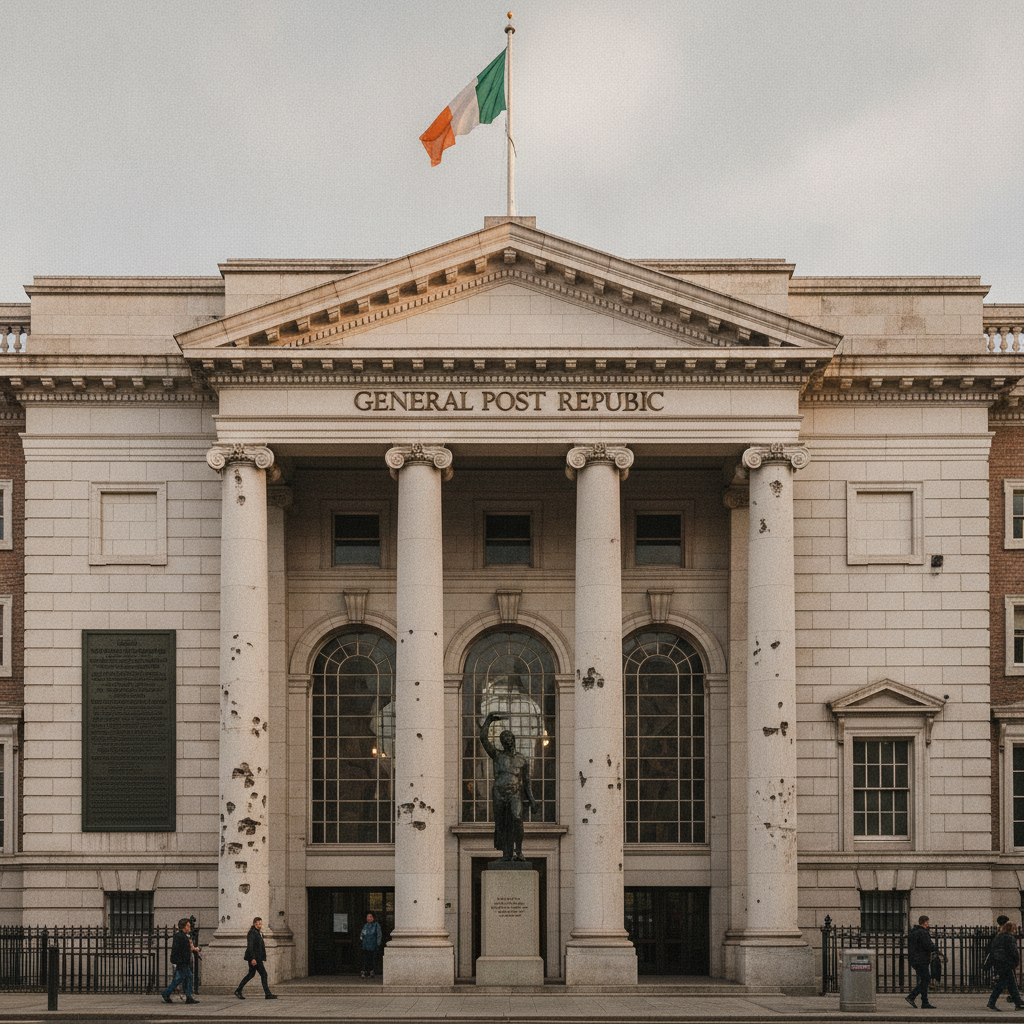
The Easter Rising (An Éirí Amach na Cásca — the armed insurrection against British rule that began on Easter Monday, April 24, 1916, in Dublin): the Easter Rising (led by Patrick Pearse (1879-1916) and James Connolly (1868-1916) at the head of approximately 1,200 Irish Volunteers and Irish Citizen Army) was the pivotal event of modern Irish history — the Proclamation of the Irish Republic (read by Pearse on the steps of the General Post Office (GPO) on O'Connell Street) on April 24, 1916, is the founding document of the Irish state; the Rising was suppressed within a week and its leaders executed, but the executions transformed public opinion and led directly to the Irish War of Independence (1919-1921) and the establishment of the Irish Free State (1922).
- 1
GPO — Where the Rising Was Proclaimed
The General Post Office (O'Connell Street, 1818) served as the headquarters of the 1916 Easter Rising — the bullet holes in the portico columns are original and deliberately preserved; the GPO Witness History exhibition (entered from Prince's Street) includes the original tricolour flag raised over the building and the Proclamation of the Irish Republic read by Pádraig Pearse on Easter Monday, 24 April 1916.
- 2
Kilmainham Gaol — Last Walk of 16 Executed Leaders
Kilmainham Gaol (Inchicore, tours by advance booking only) is the most significant political prison in Irish history — the 16 leaders of the 1916 Rising (including James Connolly, tied to a chair because he was too badly wounded to stand) were executed by firing squad in the stone breaker's yard between May 3–12, 1916; the guided tour narrates each execution individually.
- 3
National Museum of Ireland — Archaeology — Bog Bodies and Viking Gold
The National Museum of Ireland — Archaeology (Kildare Street, free) houses the world's largest collection of prehistoric Irish gold artefacts (Bronze Age lunulae, gorgets, and torcs), the Viking settlement artefacts from Wood Quay excavations (1978–1981), and preserved Iron Age bog bodies including Old Croghan Man and Clonycavan Man (100 BC–100 AD, recovered from midland bogs).
- 4
EPIC The Irish Emigration Museum — 70 Million Descendants
EPIC (Custom House Quay, 2016) documents 1,500 years of Irish emigration — 70 million people worldwide claim Irish descent (10x Ireland's current population); the museum covers the Viking age, Norman settlement, 18th-century transportation, the Great Famine (1845–1852, when 1 million died and 2 million emigrated), and contemporary Irish diaspora; technology-focused with interactive galleries.
- 5
Trinity College & Book of Kells — 800 AD Illuminated Manuscript
Trinity College (College Green, 1592, Ireland's oldest university) houses the Book of Kells (800 AD, created by Columban monks on the island of Iona, brought to Kells Abbey for safekeeping from Viking raids) — the Long Room library (65m, 200,000 leather-bound volumes, Brian Boru's harp) accompanies the manuscript; entry to the Book of Kells exhibition costs €18; book in advance.
- 6
14 Henrietta Street — Dublin's Most Important Georgian House Museum
14 Henrietta Street (North City, 2018) is the only Georgian townhouse museum in Dublin open to the public — the house was built in 1748 as a single elite family home; by 1911 it housed 100 people in 17 tenement households; the museum guides the visitor through 250 years of social history using objects found in the walls during restoration (toys, newspapers, buttons, bottles of patent medicine).