Harry Potter a Edimburgo — La Città che ha Ispirato un Mondo Magico
J.K. Rowling wrote the first Harry Potter novel (Harry Potter and the Philosopher's Stone) in Edinburgh between 1991 and 1995, primarily in the Elephant House café (George IV Bridge) and Nicolson's Café (now closed, Nicolson Street), while living in Leith as a single mother: the Edinburgh cityscape, street names, and architectural atmosphere are visible throughout the early Harry Potter books, and Edinburgh has become a major destination for Harry Potter fans drawn to the city's associations with Rowling and the fictional world she created.
- 1
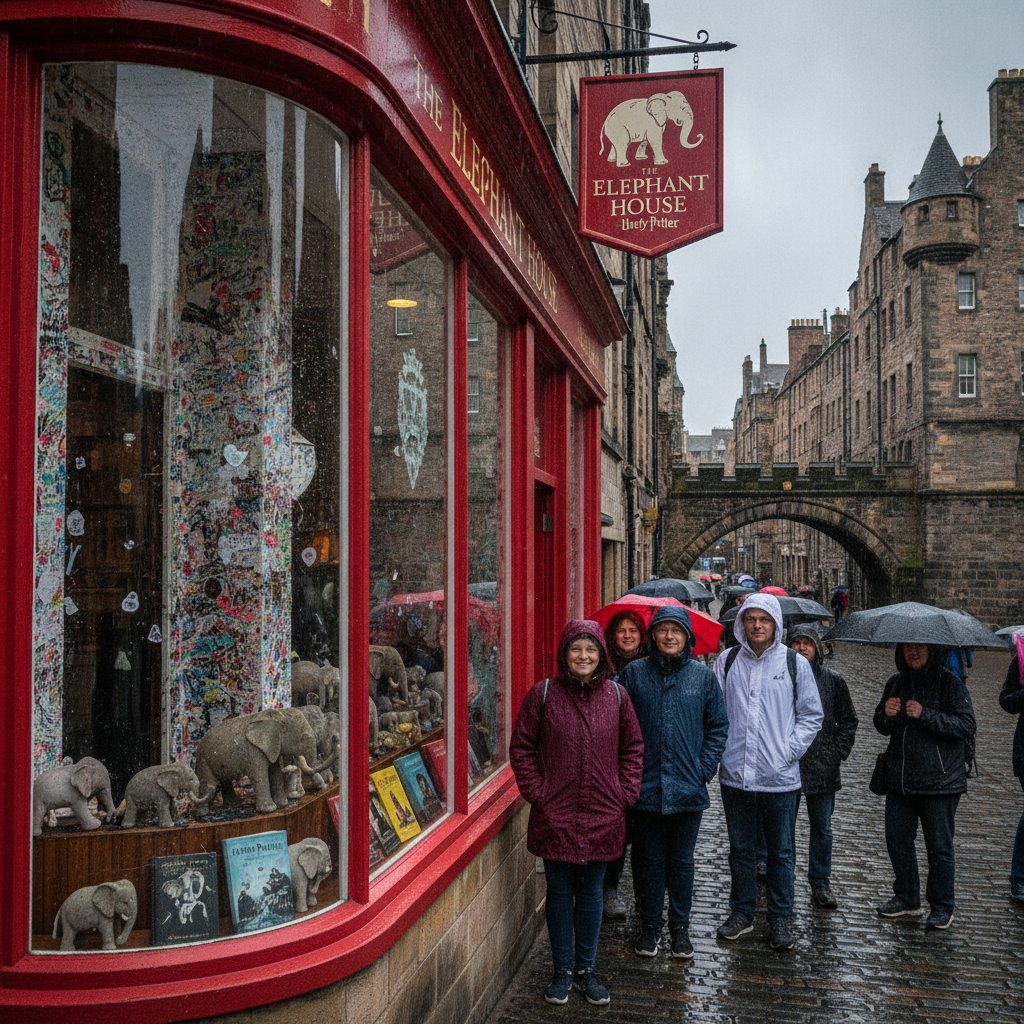
The Elephant House — Where J.K. Rowling Wrote Early Chapters
The Elephant House (George IV Bridge, 1995) is the café where J.K. Rowling wrote early chapters of Harry Potter while her daughter napped — the back room looks out over Greyfriars Kirkyard and Edinburgh Castle, providing the moody Gothic atmosphere she transposed to Hogwarts; the café was severely damaged by fire in 2021 but has since been reopened with Rowling's assistance.
- 2
Greyfriars Kirkyard — McGonagall's Grave & Voldemort's Name
Greyfriars Kirkyard (adjacent to Elephant House) contains gravestones that Rowling borrowed for character names — Thomas Riddell (Tom Riddle, Lord Voldemort's real name) is on a gravestone dating to 1806; William McGonagall (the poet, not the teacher) has a memorial nearby; Greyfriars Bobby (the loyal Skye Terrier who guarded his master's grave for 14 years) is buried at the kirkyard gate.
- 3
Victoria Street — Diagon Alley's Architectural Model
Victoria Street (Old Town, curving cobbled street with coloured shopfronts built on two levels) is the architectural model most consistently cited as the inspiration for Diagon Alley — the street curves in both directions with shops built into the hillside including a blue-fronted pharmacy, a red toy shop, and a purple gift shop creating the characteristic patchwork effect.
- 4
George Heriot's School — Hogwarts Architectural Inspiration
George Heriot's School (Lauriston Place, 1659, founded as a school for 'puir faitherless bairns' orphaned by Edinburgh's frequent wars) has a Renaissance courtyard with four corner towers that directly matches Hogwarts' architectural description — the school is private and only visible from outside, but walking around its perimeter reveals how closely it matches the Hogwarts movie sets.
- 5
Edinburgh Castle — Floating Above the City Like Hogwarts
Edinburgh Castle (built on a volcanic plug, Castle Rock) is approached via a bridge-like esplanade from the Royal Mile — Rowling herself has acknowledged that Edinburgh Castle's position, floating above morning mist on its volcanic rock, contributed to her mental image of Hogwarts; the castle houses the Honours of Scotland (Scottish Crown Jewels, 1540s) and the Stone of Destiny.
- 6
Scottish Storytelling Centre — The Tradition Behind the Magic
The Scottish Storytelling Centre (High Street, Netherbow, 100m from John Knox House) hosts the Edinburgh Storytelling Festival (October) and year-round storytelling events — Scotland's oral tradition (Gaelic, Norse, and Lowland Scots) is the deep well from which Scottish fantasy literature (R.L. Stevenson, Walter Scott, J.K. Rowling) draws; free taster sessions run Tuesday evenings.