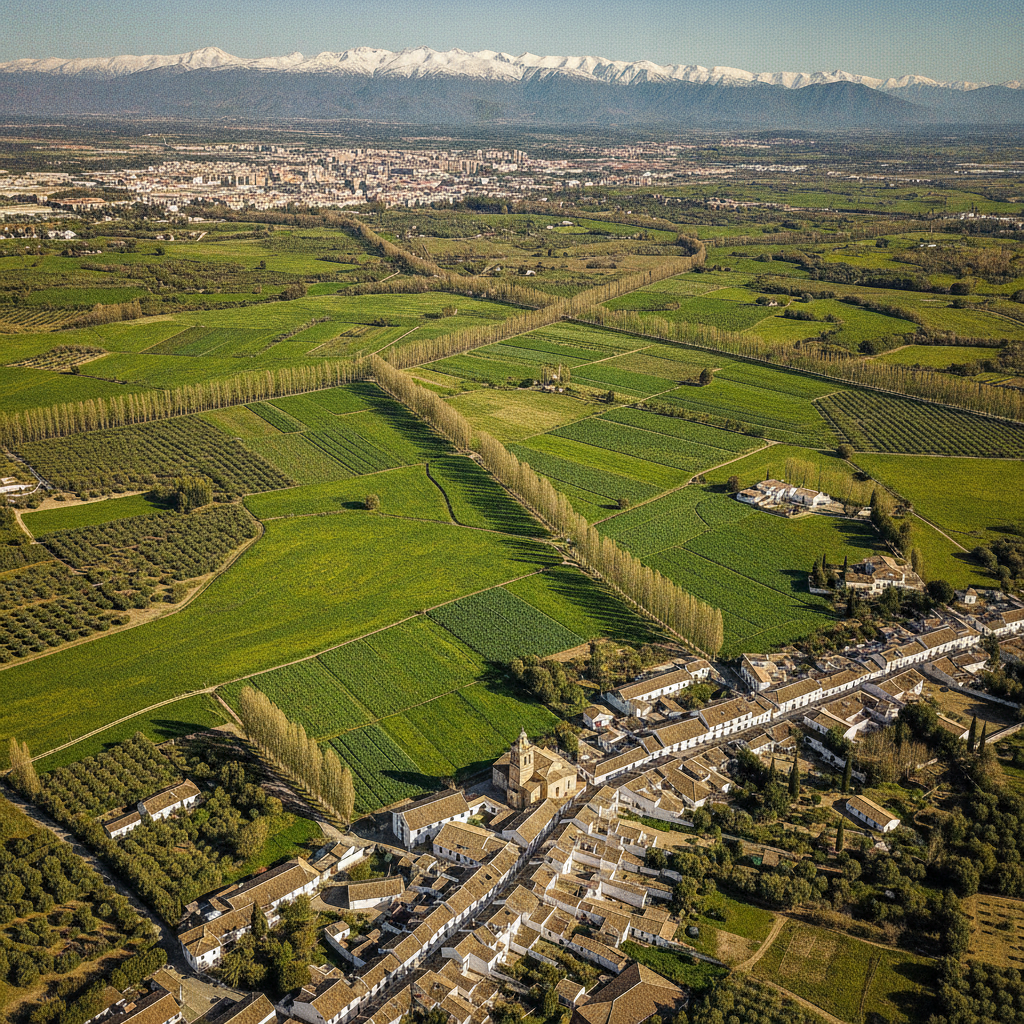
La Granada di Lorca, Fuente Vaqueros e la Vega
The 'Vega de Granada' (the fertile irrigated plain surrounding Granada, the agricultural heartland of the Nasrid Emirate and the landscape that inspired the greatest lyric poetry of Federico García Lorca (1898-1936)) and Fuente Vaqueros (the village 17 km west of Granada where Lorca was born, now the site of his birthplace museum) together form the essential literary and cultural landscape of modern Granada.
- 1
Federico García Lorca's Huerta de San Vicente
Federico García Lorca (1898–1936, Granada's greatest writer) spent summers at the Huerta de San Vicente (now a house museum on Federico García Lorca Park) — the García Lorca family's summer villa is preserved with the poet's piano, his bedroom, and manuscripts of Romancero Gitano and Blood Wedding written here; Lorca was executed by Nationalist forces in August 1936 near Víznar, 9km from the house.
- 2
Fuente Vaqueros — Lorca's Birthplace Museum
Fuente Vaqueros (18km from Granada, reached by bus) is the village where Lorca was born in 1898 — the museum occupies his birth house and contains his correspondence (including letters to Salvador Dalí), first editions of his works, and photographs documenting his friendship with Dalí and Luis Buñuel in Madrid's Residencia de Estudiantes in the 1920s.
- 3
Vega de Granada — The Plain Lorca Poeticized
The Vega de Granada (the agricultural plain surrounding the city) is the landscape of Lorca's poetry — the poplar trees, irrigation channels, and sugar beet fields that appear in 'Gacela of the Dark Death' and 'Romance Sonámbulo' are still visible from the road to Fuente Vaqueros; the mists that rise from the Genil River on autumn mornings recreate the atmosphere of Lorca's landscape poems.
- 4
Granada University's Philosophical Faculty — Lorca's Student Years
Lorca studied law at Granada University (founded 1531) while pursuing writing and music — the Faculty of Arts (Calle Puentezuelas) has a small exhibition on Lorca's student years; the 'rinconcillo' (little corner) of the Café Alameda (demolished, now marked with a plaque on Gran Vía) was where Lorca and Manuel de Falla discussed their artistic projects.
- 5
Manuel de Falla's House — The Composer's Albayzín Studio
The Manuel de Falla House Museum (Antequeruela Alta, Albayzín) is where the composer lived from 1921–1939 and wrote 'El Amor Brujo' and 'Noches en los Jardines de España' — the small Andalusian house (garden, workspace, music room) looks directly at the Alhambra; de Falla collaborated with Lorca to produce puppet theater and organized Spain's first Cante Jondo (deep song) competition in 1922.
- 6
Viznar & Alfacar — Site of Lorca's Execution
The Parque Federico García Lorca (Alfacar, 9km from Granada, near Viznar) marks the area where Lorca and other Republican supporters were summarily executed by Nationalist forces on August 17–18, 1936 — no confirmed grave has been located despite multiple investigations; the park, opened in 2009, contains a memorial sculpture and information panels about Lorca's last days.