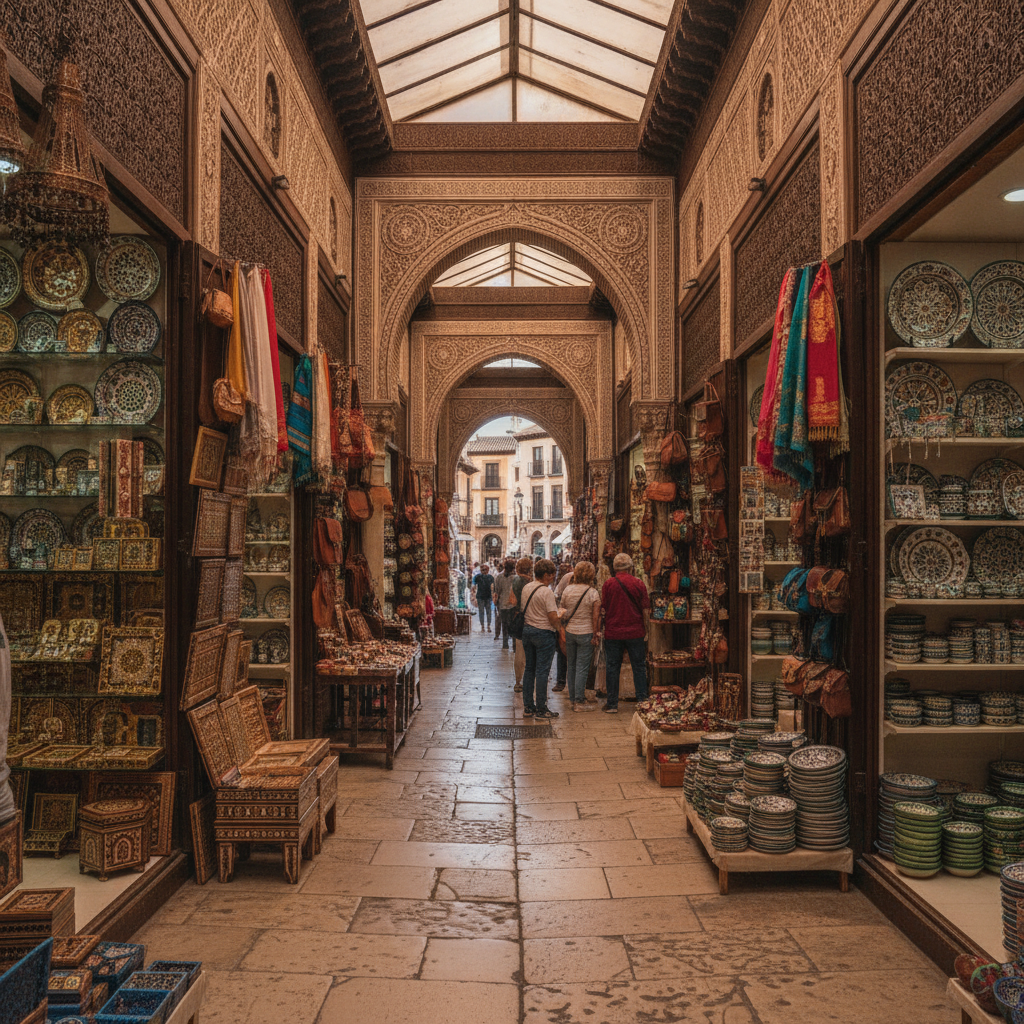
Alcaicería, Bazar Arabo e il Patrimonio del Mercato Islamico di Granada
The Alcaicería (the 'silk market' — the covered market adjacent to the Granada Cathedral, rebuilt in the 19th century on the site of the Nasrid-era royal silk market: the most important commercial district of the Nasrid city of Granada) and the adjacent Calle Calderería Nueva (the 'Moroccan street' with the Moroccan tea houses, the spice shops, and the craft stores) together preserve the commercial spirit of Islamic Granada in the heart of the modern city.
- 1
Zoco de Granada — Arabic Craft Market in the Albayzín
The Zoco de Granada (Corral de los Carbones and the streets between the Albayzín and the Realejo) is an organic Arab market that has evolved since the 1990s — Moroccan artisans sell handmade leather babouches, hand-hammered copper lamps, Berber rugs, and cedar wood carved trays; Calle Elvira and Calle Calderería Nueva ('Tea Street') are the most concentrated sections.
- 2
Calderería Nueva — Tea Rooms and Moroccan Imports
Calderería Nueva ('New Cauldron Street') is a 200-metre lane lined with teterías (Moorish tea rooms) and Moroccan import shops — traditional Moroccan mint tea with pine nuts is served in ornate silver pots on brass trays; the narrow street was the coppersmiths' quarter in the Nasrid era; shops sell handmade products sourced directly from Marrakech, Fez, and Tetouan artisan cooperatives.
- 3
Albayzín — UNESCO Moorish Quarter on the Hill
The Albayzín (UNESCO, 1994, the hillside neighbourhood of Arabic heritage opposite the Alhambra) contains 7km of whitewashed lanes, original Nasrid walls, carmen houses (walled villas with fountains and jasmine gardens), and the best viewpoint over the Alhambra (the Mirador de San Nicolás, always crowded at sunset with flamenco guitarists).
- 4
Hammam Al-Ándalus — Arab Baths Below the Albayzín
Hammam Al-Ándalus (Santa Ana, below the Albayzín, adults only) recreates the Nasrid bath culture in a 15th-century Moorish-style building — three pools (cold 14°C, warm 36°C, hot 40°C) with carved plaster ceilings and star-shaped skylights; the 90-minute session (€38) includes a kese scrub (exfoliation with a traditional glove) and argan oil massage; book 2–3 days in advance.
- 5
Sacromonte — Cave Dwellings and Gitano Culture
Sacromonte (the hill east of the Albayzín) is the historic quarter of Granada's Gitano (Spanish Romani) community — cave houses (cuevas) dug into the hillside have been inhabited for 500+ years; the Cueva Museo de Sacromonte (Barranco de los Negros) documents cave-dwelling culture; the zambra (a Gitano flamenco form unique to Granada) is performed nightly in cave venues at 10pm.
- 6
Mirador de San Miguel Alto — The Alhambra from Above
The Mirador de San Miguel Alto (reached by a 40-minute uphill walk from the Albayzín through lanes of cactus and rosemary) offers a perspective of the Alhambra from above and to its right — the Alhambra's defensive towers are visible in plan; the Sierra Nevada snow (visible October–May) provides the backdrop that the Nasrid architects specifically chose for their palace; sunset viewing is outstanding.