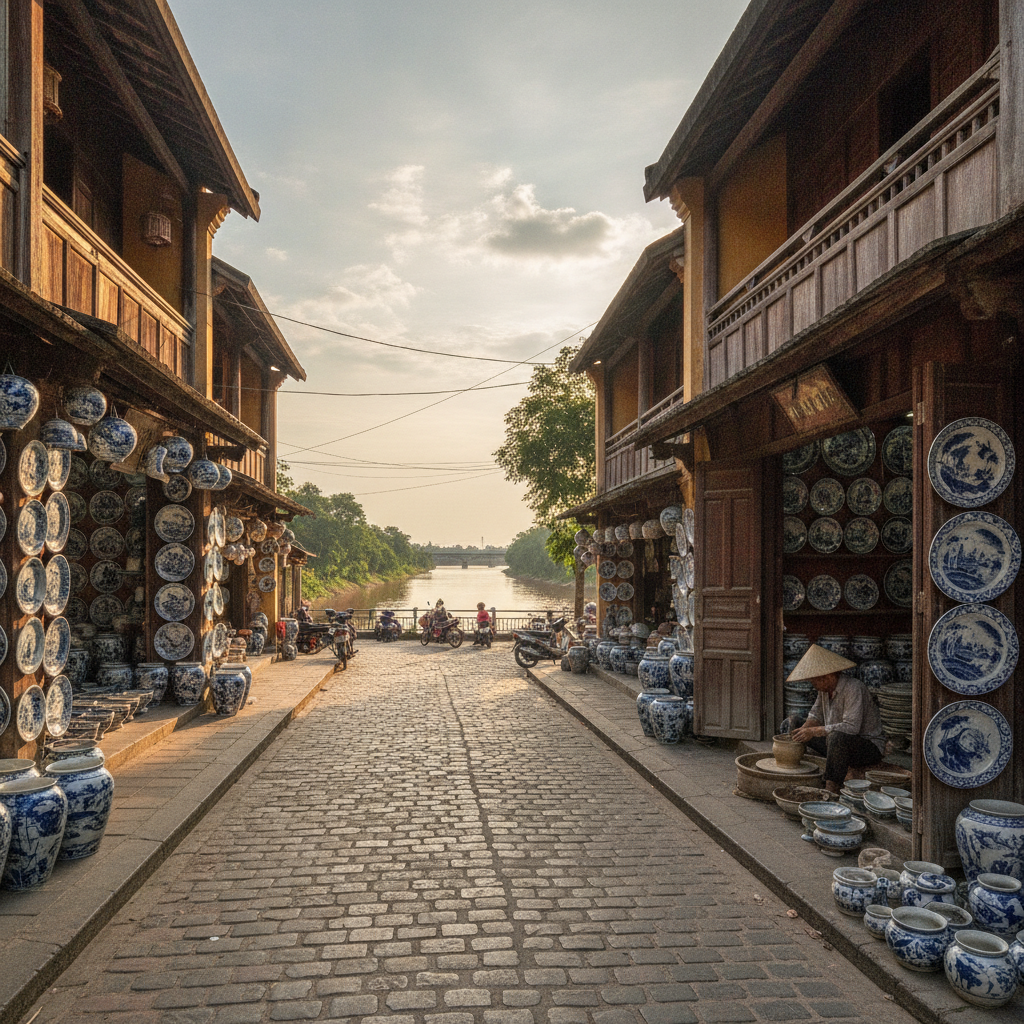
Seta di Van Phuc, Ceramica di Bat Trang e gli Antichi Villaggi Artigianali di Hanoi
Hanoi's ancient craft villages (làng nghề truyền thống — the villages surrounding Hanoi that have maintained traditional craft industries for centuries, many of them established over 500-1000 years ago): the two most celebrated are Van Phuc (Làng lụa Vạn Phúc — the silk weaving village 10 km southwest of Hanoi in the Ha Dong district, the oldest silk production centre in northern Vietnam) and Bat Trang (Làng gốm Bát Tràng — the ceramics village 13 km east of Hanoi on the Red River, producing Vietnamese ceramics continuously for approximately 500 years).
- 1
Bát Tràng — Ceramic Village on the Red River, 13km from Hanoi
Bát Tràng (Gia Lâm, 13km from Hanoi, accessible by public bus #47 or by boat on the Red River) has produced ceramics for 700 years — the village market sells functional and decorative pottery from 200+ family kilns; visitors can enter working workshops to watch hand-painting and throw clay on pottery wheels; the village market (daily, 8am–6pm) is particularly good for blue-and-white underglaze ware.
- 2
Vạn Phúc — Silk Weaving Village, 10km from Hanoi
Vạn Phúc Silk Village (Hà Đông, 10km from Hanoi, bus #1 or #21) has been weaving silk for over 1,000 years and supplied the Nguyễn imperial court — 300 family looms still operate; the main products are lụa (plain silk), the jacquard-woven vân (cloud-pattern silk), and the brocade tơ lụa; fabric sold by the metre costs 80,000–200,000 VND; tailoring available same-day.
- 3
Làng Nghề Tour — Traditional Craft Village Circuit
Hanoi's làng nghề (craft villages) network extends 30km from the city — traditional lacquerware (Hạ Thái), hand-embroidered clothing (Thường Tín), hand-woven conical hats (Chuông), and bronze casting (Ngũ Xã village within Hanoi) represent 1,000+ years of specialized craft tradition; the Hanoi Tourism Centre organizes day tours combining 2–3 villages.
- 4
Đồng Kỵ — Furniture Village, 20km from Hanoi
Đồng Kỵ (Bắc Ninh, 20km from Hanoi) specializes in intricate hand-carved hardwood furniture — rosewood, ironwood, and ebony cabinets, beds, and screens with carved dragons, phoenixes, and floral patterns are made to order and shipped internationally; the village's 2,000 carpentry workshops operate in open-fronted workshops visible from the street; Chinese buyers account for 60% of sales.
- 5
Hanoi Old Quarter — 36 Guild Streets Still Functioning
The 36 Streets of the Old Quarter (Hàng Đào, Hàng Gai, Hàng Thiếc, etc., each named for the guild it housed) still partially specialize in their historical trades — Hàng Gai (silk and embroidery), Hàng Thiếc (tin and sheet metal), Hàng Mã (paper votive offerings burned at funerals and festivals), and Hàng Đồng (bronze and brass household goods) are the most authentic surviving guild streets.
- 6
Paper Votive Crafts — Hàng Mã, the Street of the Dead
Hàng Mã ('paper goods street') is the most surreal of Hanoi's guild streets — paper replicas of smartphones, luxury cars, Louis Vuitton bags, and houses are sold to be burned at funerals and ancestor veneration ceremonies (sending goods to the deceased in the afterlife); the practice (combining Buddhist and Taoist elements) is a living folk tradition; the shops are busiest before the Tết and Thanh Minh (tomb-sweeping) festivals.