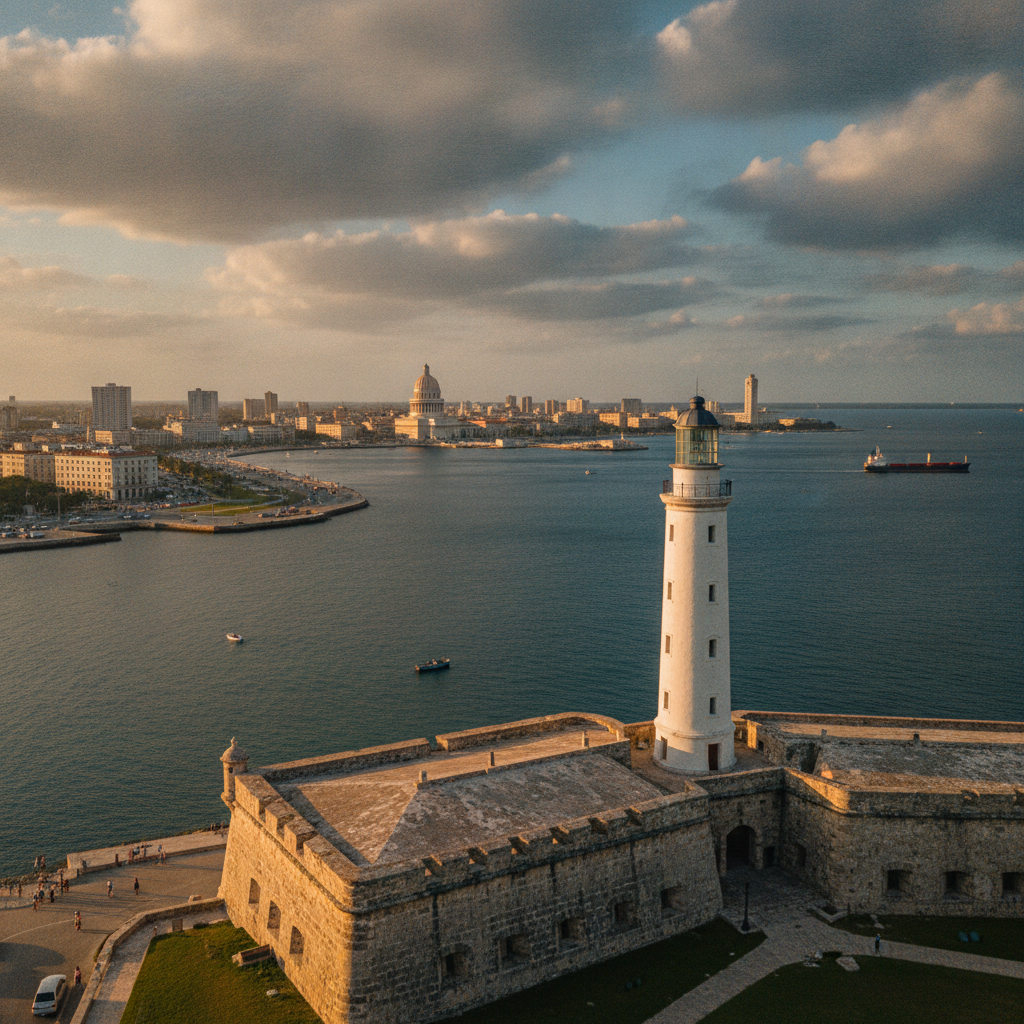
El Morro, il Porto dell'Avana e la Baia
The Castillo de los Tres Reyes del Morro ('El Morro' — the 16th-17th century Spanish colonial fortress on the eastern headland of Havana harbour, the most photographed landmark in Cuba) and the adjoining Fortaleza de San Carlos de la Cabaña (the 18th-century fortress — the largest Spanish colonial fortress in the Americas) together guard the entrance to the Havana Bay, offering the finest panoramic views of Havana and the ritual of the 'Cañonazo' (the nightly 9 PM cannon firing).
- 1
Castillo del Morro — 400-Year Guardian of the Harbour
El Morro (Castillo de los Tres Reyes del Morro, 1589–1630) is built on a promontory 50m above the harbour entrance — the lighthouse (added 1844, the original 1630 lantern having been destroyed by the English in 1762) is still operational; the castle successfully protected Havana's harbour for 170 years until a 44-day British siege captured it in 1762; Britain returned Cuba to Spain in exchange for Florida.
- 2
Cañonazo Ceremony — 9pm Cannon Shot Since 1674
The Cañonazo (cannon shot, La Cabaña Fortress, 9pm nightly) is a ceremony performed by Cuban soldiers in 18th-century military dress that dates to 1674 — the cannon shot originally signalled the closing of the city gates and the raising of the harbour chain (stretched between El Morro and La Punta to prevent unauthorized vessel entry); the ceremony (5 CUC admission) is the most visited nightly event in Havana.
- 3
La Cabaña Fortress — Largest Fortress in the Americas
The Fortaleza de San Carlos de la Cabaña (La Cabaña, 1763–1774, built after the British siege revealed El Morro's weakness) is the largest military fortress in the Americas (700m long, 10 hectares, 20m walls) — after 1959, Che Guevara used the fortress as a prison and execution site for political opponents; the fortress now houses military museums and the annual Havana Book Fair.
- 4
Harbour Tunnel — Crossing to the East Side
The Havana Harbour Tunnel (1958, built by a French company, 700m long, the only road tunnel under a harbour in Cuba) connects Centro Habana to the Parque Histórico Militar (El Morro and La Cabaña) — for pedestrians and cyclists, the public ferry (La Lanchita, 1 CUP) makes 15-minute crossings from Old Havana's waterfront; the ferry view of the Havana skyline from the water is unrepeatable.
- 5
Regla & Guanabacoa — Afro-Cuban Religion Across the Harbour
Regla (accessible by harbour ferry from Muelle Luz, Old Havana) is the centre of Afro-Cuban religious practice in greater Havana — the Santería shrine of La Virgen de Regla (Ochún in Yoruba tradition) draws pilgrims dressed in blue; the Museo Afrocubano documents the Regla de Ocha (Santería), Palo Monte, and Abakuá religious systems that developed from enslaved Yoruba, Kongo, and Calabar African communities.
- 6
Malecon at Dawn — Fishermen and the Straits of Florida
The Malecón at 5–6am is one of Havana's most revelatory experiences — dozens of Cubans fish from the sea wall for chopa (bluefish), snapper, and mojarra using handlines dropped 10m down; the Straits of Florida (180km across to the Florida Keys) carry a current (the Florida Current, 2–3 knots north) that creates a constant chop; the sunrise lights both the Havana skyline and the castle across the harbour simultaneously.