Vedado, Plaza de la Revolución e L'Avana del XX Secolo
Vedado (the upscale 20th-century district west of La Habana Vieja — the district of the Hotel Nacional, the Art Deco apartment buildings, the Universidad de La Habana, and the Coppelia ice cream park) and the Plaza de la Revolución (the enormous civic square with the Che Guevara mural and the José Martí memorial) represent the 20th-century face of Havana, from the opulence of the pre-Revolutionary period to the revolutionary iconography of the post-1959 period.
- 1
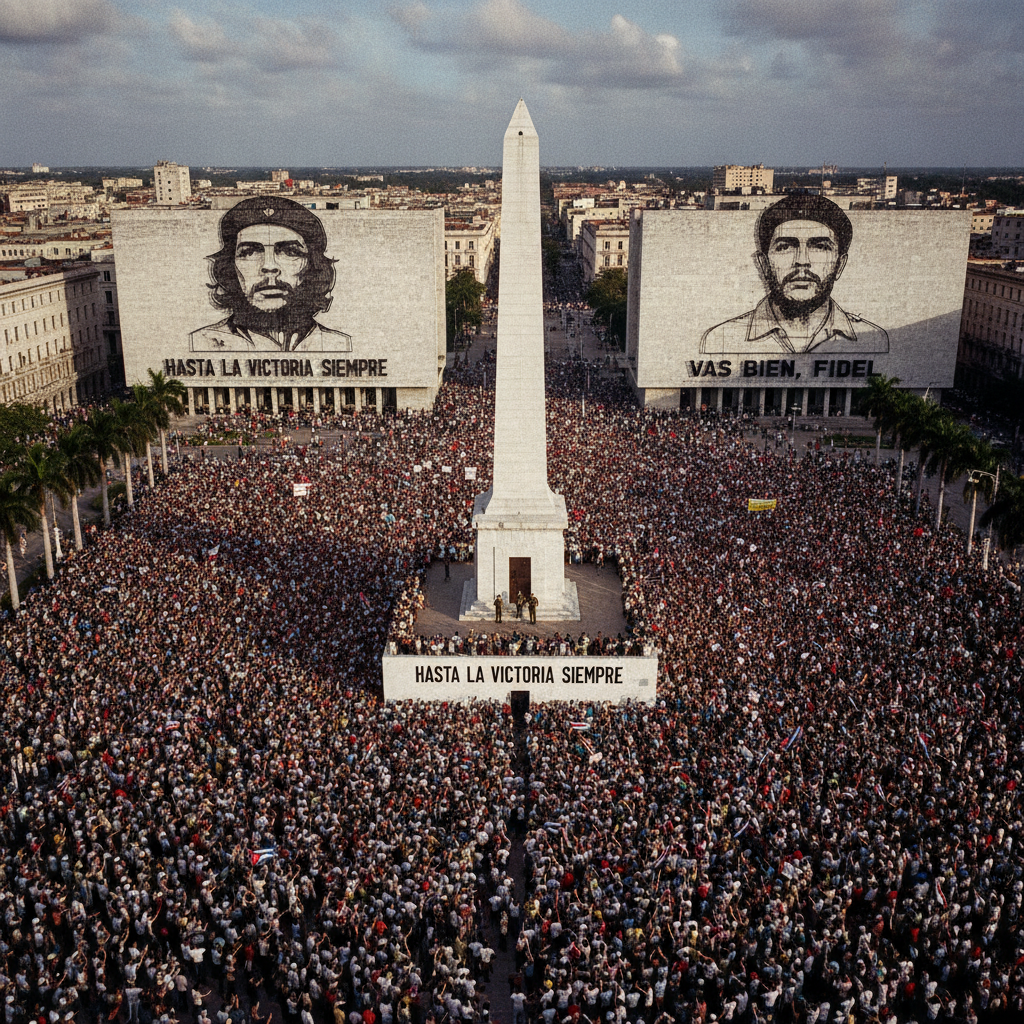
Plaza de la Revolución — Che Guevara's Iron Face
Plaza de la Revolución (covering 72,000m², one of the world's largest plazas) is dominated by a 9-storey Ministry of the Interior building bearing the wire-and-steel portrait of Che Guevara (with his actual words: 'Hasta la victoria siempre') — major political rallies (including Pope Francis's mass in 2015 and the Rolling Stones' free concert in 2016) take place here; the José Martí memorial (1996, 138m obelisk with museum inside) is adjacent.
- 2
Necrópolis Cristóbal Colón — Cemetery as Art Museum
The Colón Cemetery (Vedado, 1876, 56 hectares) is the most spectacular cemetery in the Americas — 800,000 burials, 500+ ornate mausoleums in neo-Gothic, Art Deco, and eclectic styles, with sculptures by Cuba's greatest 19th-20th century artists; the tomb of La Milagrosa (Amelia Goyri de la Hoz, 1901) is a major pilgrimage site where Cubans knock on the marble with their knuckles before praying for miracles.
- 3
Hotel Nacional de Cuba — Mob Summit of 1946
The Hotel Nacional (Malecón, 1930, Frank Steiner & McKim architects) was the gathering point of the American Mafia's Havana Conference of 1946 (where Lucky Luciano, Meyer Lansky, and Frank Costello divided control of Cuban casinos) — the Hall of Fame bar displays photographs of celebrity guests including Winston Churchill, Ava Gardner, Errol Flynn, and Frank Sinatra; Mojitos on the terrace cost CUC$8.
- 4
Coppelia Ice Cream Park — Cuba's Socialist Leisure Institution
Coppelia (L & 23, Vedado, 1966, designed to be an architectural statement of socialist achievement) is a 1,000-seat ice cream park serving 30,000 Cubans daily — there are two queues: the peso queue (Cubans, wait 45 minutes, pay in Cuban pesos, 10 scoops for 5 CUP) and the dollar queue (tourists, no wait, pay in CUC); the 1966 architecture (umbrella roof, radial seating) is listed for protection.
- 5
Universidad de La Habana — Student Uprising History
The University of Havana (1728, current Vedado campus opened 1902) is where Fidel Castro was a law student in the late 1940s and first became involved in leftist politics — the wide stone staircase (with its student Alma Mater statue) was the site of student demonstrations against Batista in the 1950s; the university's history museum documents Cuba's political student movements.
- 6
Fábrica de Arte Cubano — Converted Factory, Arts Complex
FAC (Fábrica de Arte Cubano, 26 & 11, Vedado, open Thursday–Sunday 8pm–4am, 2 CUC entry) is Cuba's most successful contemporary arts complex — a former industrial cooking oil factory (1910) converted in 2014 to house 4 concert stages, 6 gallery spaces, a cinema, and 8 bars simultaneously; Cuban artists of every discipline exhibit and perform here; Silvio Rodríguez and X Alfonso have performed.