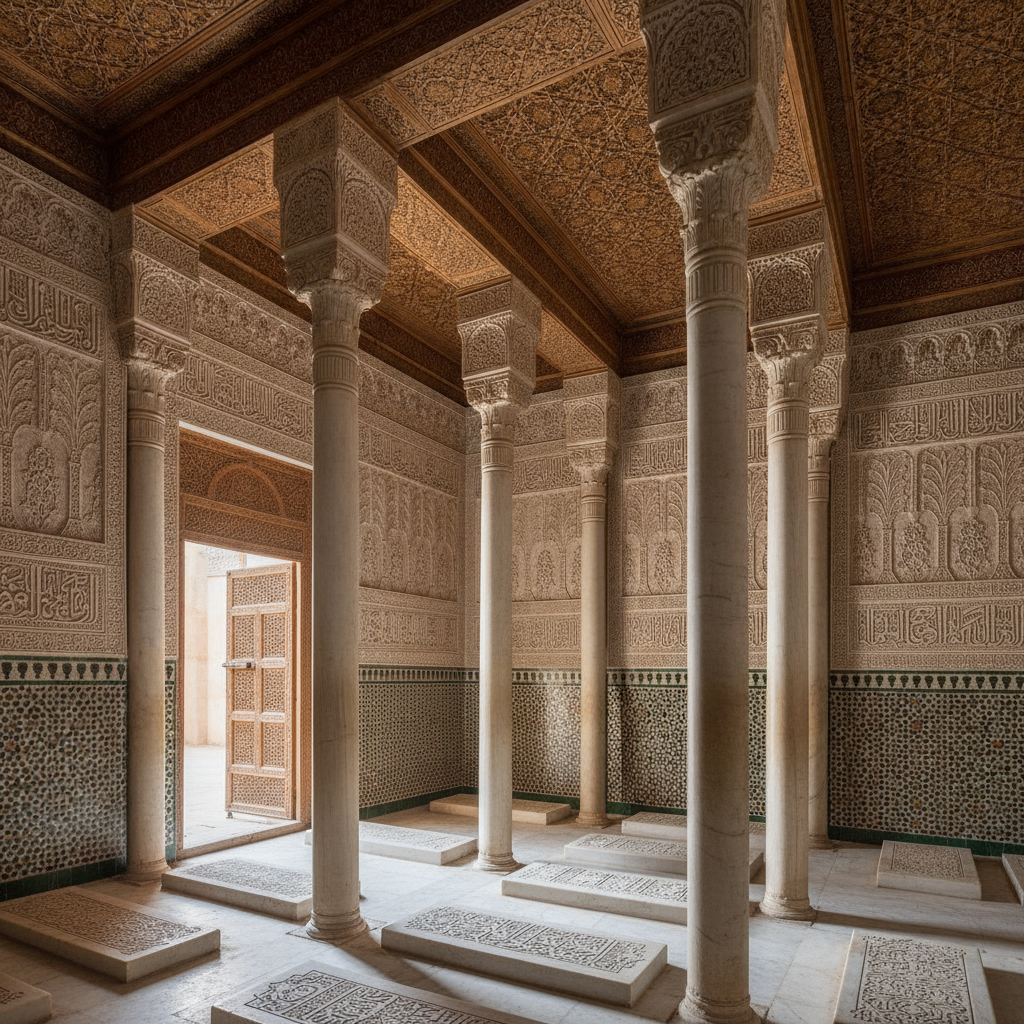
Tombe Saadiane e la Storia Imperiale di Marrakech
The Saadian Tombs (the royal necropolis of the Saadian dynasty (1549-1659), the most important dynasty in Moroccan history, who made Marrakech the capital of a Moroccan empire that stretched from sub-Saharan Africa to the Mediterranean): the tombs were sealed by the Alaouite Sultan Moulay Ismail (who despised the Saadians) in the 17th century and rediscovered in 1917 from aerial photography by the French — the best-preserved Saadian monuments in Morocco.
- 1
Saadian Tombs — 66 Graves Walled Up for 300 Years
The Saadian Tombs (Kasbah quarter, 1578, sealed by Sultan Moulay Ismail in the early 18th century and rediscovered by aerial photography in 1917) contain 66 members of the Saadian dynasty — the Chamber of the Twelve Pillars (Carrara marble columns, Italian tile floors, carved plaster) is considered the finest interior of any Moroccan mausoleum; access is through a narrow passage carved through the Kasbah Mosque's exterior wall.
- 2
El Badi Palace — Ruin of the 'Incomparable' Palace
El Badi Palace (Mellah quarter, 1578, built by Sultan Ahmad al-Mansur from the ransom of Portuguese prisoners taken at the Battle of the Three Kings) was stripped of all its marble, gold, and Carrara stone by Sultan Moulay Ismail in the early 1700s — what remains (the scale of the central pool, 50m × 80m; the sunken gardens; the 25 pavilions' foundations) communicates the scale of what was built and destroyed.
- 3
Bahia Palace — 8,000m² of 19th-Century Moroccan Craft
Bahia Palace (Riad Zitoun el-Jedid, 1894–1900, built by the Grand Vizier Si Musa for his four wives and 24 concubines) covers 8,000m² — the apartments surrounding the Grand Courtyard (1,500m²) are decorated with carved cedarwood ceilings, zellij tile floors, and painted plaster walls that represent the peak of Moroccan decorative arts; the palace is open daily 9am–5pm, entry 70 DH.
- 4
Mellah — Marrakech's Historic Jewish Quarter
The Mellah (Jewish quarter, established 1558) is the oldest Jewish quarter in Morocco — its distinctive double-story houses with carved wooden balconies (a building form found only in Mellah architecture) and the renovated Lazama synagogue (still operational for the small remaining Jewish community) document the 400-year Jewish presence in Marrakech before most emigrated to Israel after 1948.
- 5
Maison Tiskiwin — Saharan Trade Route Collections
Maison Tiskiwin (8 rue de la Bahia, private museum, 1992) collects the material culture of the trans-Saharan trade routes between Marrakech and Timbuktu — Tuareg silver jewellery, Mauritanian indigo robes, Saharan tent textiles, and carved wooden objects from the 19th and early 20th century reveal the extent of Marrakech's commercial reach south of the Sahara; the collection occupies a restored riad.
- 6
Dar Si Said Museum — Moroccan Arts and Crafts Since 1932
Dar Si Said (Riad Zitoun el-Jedid, 1932, recently renovated) is Morocco's oldest museum — the late 19th-century palace houses Moroccan decorative arts: carved cedarwood panels (cedar from the Middle Atlas), Berber jewellery (silver with enamel and coral), embroidered textiles from Fez and Marrakech, and painted leather bookbindings; the 40m² central courtyard with its marble fountain is the most beautiful in any Marrakech museum.