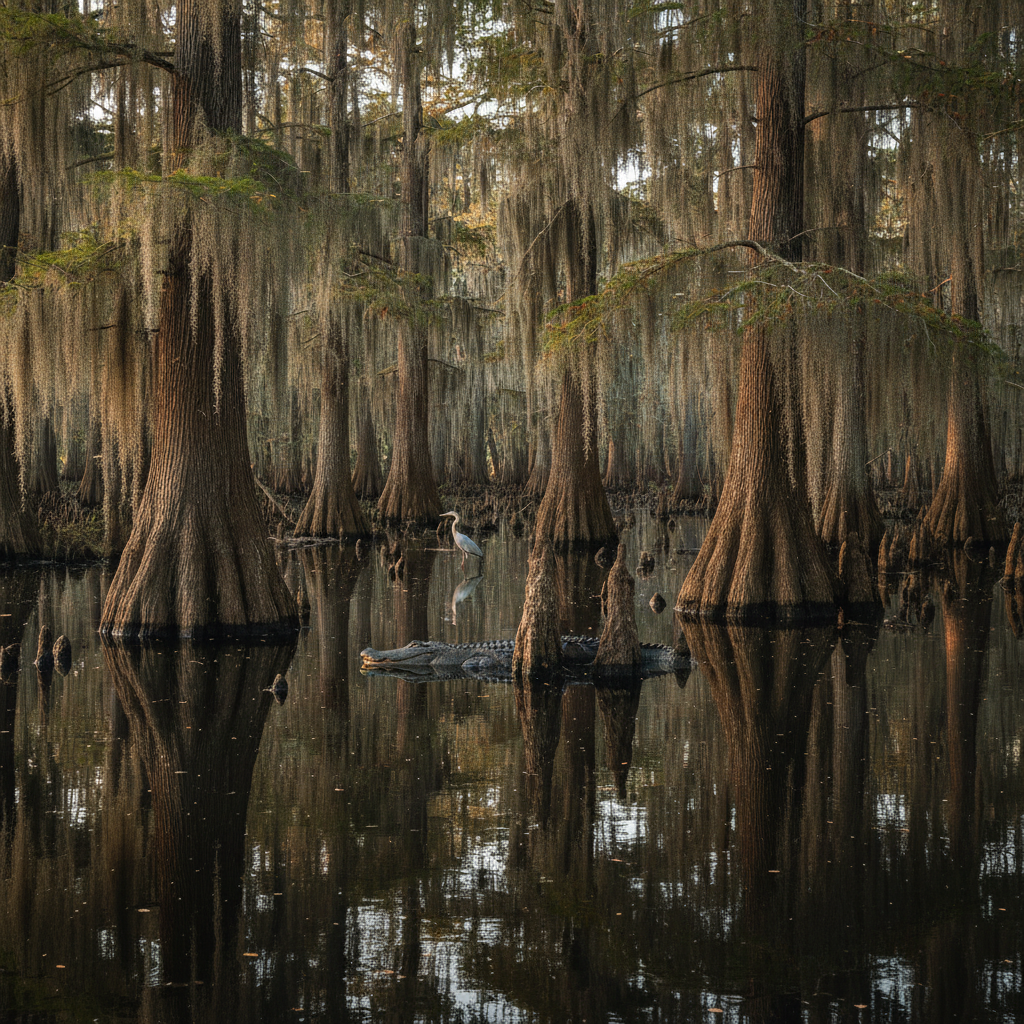
Paludi, Bayous e il Paese Selvaggio dei Cipressi della Louisiana
The Louisiana swamp and bayou landscape (the coastal wetlands of southeastern Louisiana — the largest coastal wetland system in the continental United States, covering approximately 3,600 km² (1,400 sq miles) of cypress swamp, marsh, and brackish bayou between New Orleans and the Gulf of Mexico): the Louisiana swamp ecosystem is simultaneously one of the most productive biological ecosystems in North America and one of the most rapidly disappearing landscapes in the world (Louisiana loses approximately 25-35 square miles (65-90 km²) of coastal wetlands per year to sea-level rise, subsidence, and the loss of Mississippi River sediment behind the levees).
- 1
Honey Island Swamp — The Wildest Wetland Near New Orleans
Honey Island Swamp (Pearl River Wildlife Management Area, 70,000 acres, accessed from Slidell, 45 minutes east of New Orleans) is one of the least-altered river swamp ecosystems in the United States — the Honey Island Swamp has remained largely unchanged since European contact because it was considered commercially valueless; guided boat tours ($25–45, 2 hours) from Dr Paul Wagner's Swamp Tours (the original, since 1979) or Cajun Encounters navigate the cypress-tupelo waterways watching alligators, bald eagles, wood storks, and river otters; the monster catfish are the most surprising encounter.
- 2
Atchafalaya Basin — The Largest Swamp in North America
The Atchafalaya Basin (1.4 million acres, the largest river swamp in North America, the floodplain of the Atchafalaya River, accessible from Henderson and Breaux Bridge, 2 hours from New Orleans) is the most productive freshwater fishery in the US — the basin supplies 60% of Louisiana's freshwater shrimp and 30% of its crawfish; guided pirogue (flat-bottomed swamp boat) tours depart from Henderson Landing; the driving tour on Louisiana Hwy 975 (the 'Bayou Vista' road through the basin) is free and accessible in a regular car.
- 3
Jean Lafitte National Historical Park — Swamp 20 Minutes from Downtown
Jean Lafitte National Historical Park (6588 Barataria Blvd, Marrero, 20 minutes south of New Orleans) provides the most accessible swamp experience from the city — the Barataria Preserve (26,000 acres of barrier island, marsh, and cypress swamp) has 23 miles of trails (mostly boardwalk over the swamp) where alligators, nutria, armadillos, roseate spoonbills, and wood ducks are reliably seen; the visitor center (free, daily 9am–5pm) has natural history exhibits; wildlife is most active in the morning.
- 4
Louisiana Alligator — 2 Million Animals in the State
Louisiana has the largest population of American alligators in the world (2 million+) — the state's alligator farming industry (56,000 alligators in captivity producing 300,000 skins per year) coexists with the wild population; the alligator population was near extinction in 1967 (listed as endangered) and recovered entirely due to hunting restrictions and farming; gator is eaten throughout Louisiana (gator sausage, gator on a stick, fried gator bites) and is the default 'unusual' protein offered to tourists at roadside stands; it tastes like firm white fish.
- 5
Crawfish Season — The Louisiana Ritual March Through May
Crawfish (freshwater crustaceans, called crayfish or mudbugs elsewhere but always crawfish in Louisiana) season (February–May, peak March–April) is when Louisiana stops everything — 100 million pounds of crawfish are boiled annually in Louisiana; the boil (spices, potatoes, corn, and sausage in a 60-gallon pot of heavily seasoned water) is the communal food ritual of South Louisiana; the best crawfish in New Orleans are at Dooky Chase (Treme, a Civil Rights-era restaurant), Clover Grill (French Quarter), and backyard boils to which tourists are rarely invited.
- 6
Lake Pontchartrain Causeway — The World's Longest Bridge Over Water
The Lake Pontchartrain Causeway (2 parallel bridges, the longer 38.6km, built 1956 and 1969, the world's longest bridge over water — title disputed by the Jiaozhou Bay Bridge in China) connects Metairie (New Orleans suburb) to Mandeville on the north shore of Lake Pontchartrain — the 24-minute crossing (toll $5 southbound, free northbound) passes over water with no visible shore in any direction for approximately 16km in the middle; the lake (1,632 sq km) is technically a shallow estuary connected to the Gulf of Mexico.