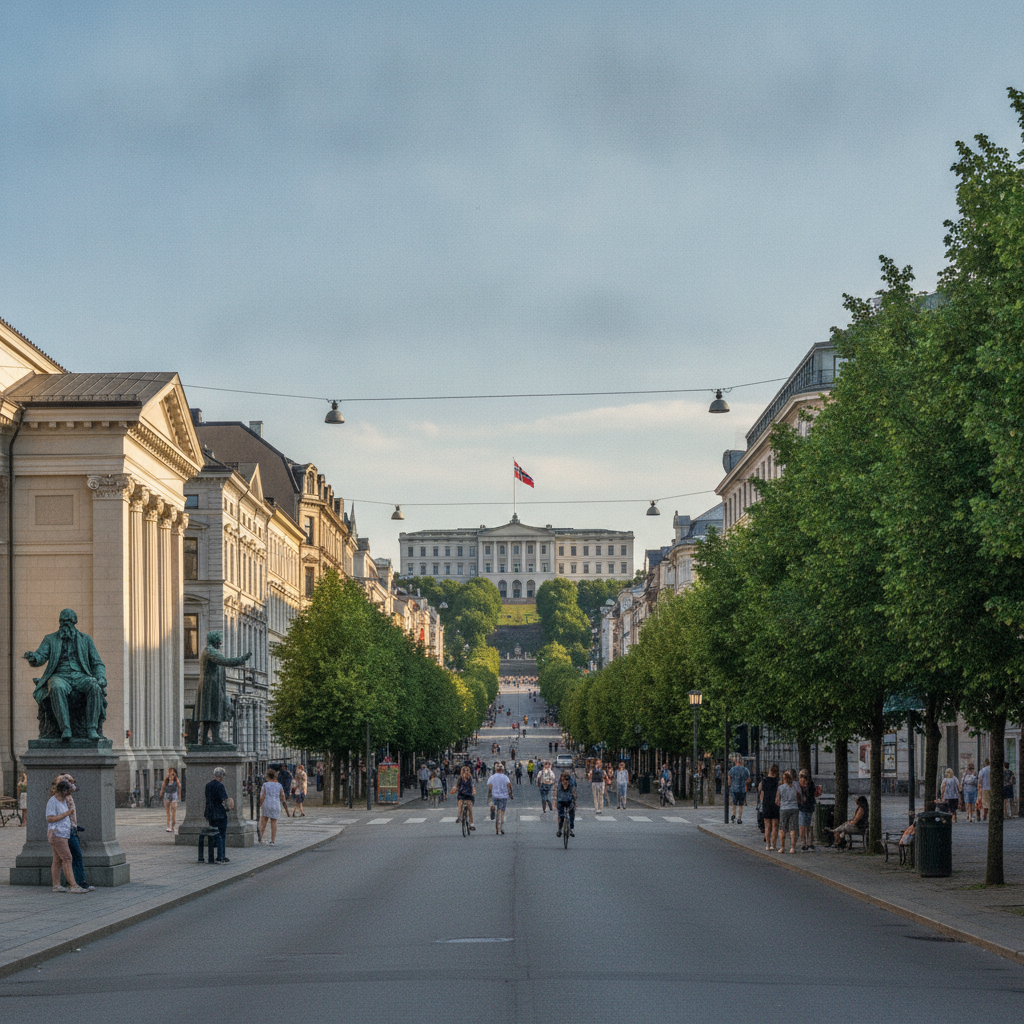
Henrik Ibsen, il Palazzo Reale e il Centro Storico di Oslo
Oslo's historic centre (Karl Johans gate — the main street of Oslo, running 1.6 km from Oslo Central Station (Oslo S) west to the Royal Palace (Slottet), lined with the National Theatre, the Parliament (Stortinget), the University of Oslo, and the Cathedral): Oslo was established as the capital of Norway in 1814 (when Norway became independent from Denmark and established its constitution at Eidsvoll — the most important event in Norwegian history), and the historic centre was planned in the early 19th century in the Neoclassical style on the grid pattern of the new Norwegian capital.
- 1
Nasjonalteatret — Ibsen's Stage
The Nasjonalteatret (Johanne Dybwad Plass 1, 1899, Henrik Bull architect, 780-seat main stage) is Norway's national theatre and the premiere stage for Henrik Ibsen's plays — Ibsen (1828–1906) wrote A Doll's House (1879), Hedda Gabler (1890), The Master Builder (1892), and Peer Gynt (1867) here, revolutionizing European drama; the theatre's statue of Ibsen (main entrance) is the starting point for Oslo's 'Ibsen Trail' (self-guided walk connecting Ibsen's apartment, the Grand Café where he had his daily lunch, and the National Theatre); English surtitles offered on selected productions.
- 2
The Royal Palace and Palace Park — Oslo's Civic Centre
The Royal Palace (Det Kongelige Slott, Drammensveien 1, 1849, H.D.F. Linstow architect) is at the top of Karl Johans Gate, Oslo's main boulevard — the palace (the official residence of King Harald V) hosts the daily Changing of the Guard (13:30, free, 20 minutes) in summer; the Palace Park (Slottsparken, 222 acres, open year-round, free) surrounding the palace contains the equestrian statue of Karl Johan (1814, the first King of independent Norway) and is Oslo's principal urban park; palace guided tours (NOK 165) run July–August only.
- 3
Karl Johans Gate — Oslo's Axis from Palace to Station
Karl Johans Gate (the main boulevard from Oslo Central Station to the Royal Palace, 1km, pedestrianized in the lower section) is Oslo's Champs-Élysées — the street contains the National Theatre, the Parliament (Stortinget), Grand Hotel Oslo (where Henrik Ibsen had lunch at the Grand Café every day 1891–1906 at the same table, preserved), and the University of Oslo's main building (Domus Media, 1854, Edvard Munch painted the interior aula murals in 1916); the street is the setting for Norwegian Constitution Day (May 17) celebrations.
- 4
Stortinget — Norway's Parliament and Its Open Culture
The Stortinget (Karl Johans Gate 22, 1866, Emil Victor Langlet architect) is Norway's parliament (169 representatives, the largest deliberative body in the Nordic countries relative to population) — unlike most European parliaments, the Stortinget offers free guided tours (Norwegian and English, Saturday 10am–3pm, July–August) allowing visitors to see the full legislative chambers; the Parliament's Constitution Day (May 17, Syttende Mai) procession is the most emotionally significant public event in Norway.
- 5
Ibsen Museum — The Playwright's Final Apartment
The Ibsen Museum (Henrik Ibsens Gate 26, 2008, in the apartment where Ibsen lived 1895–1906 and died, full restoration to 1906 condition, NOK 130) shows the domestic circumstances of the world's most-performed non-English-language playwright — Ibsen's writing desk (facing a window, the same view he described looking at while writing his last plays), his library (with personal annotations), and the bedroom where he died on May 23, 1906 after saying 'on the contrary!' (his last words, reportedly correcting a nurse who said he seemed better) are preserved.
- 6
Akershus Fortress — 700 Years of Oslo's Military History
Akershus Festning (the fortress peninsula overlooking the Oslofjord, 1290, expanded 16th–17th century, accessible by walking from Aker Brygge, free) is Oslo's oldest surviving structure — the Medieval castle (the round towers, chapel, and great hall) and the Baroque palace overlay (17th century) are both visible; the Norwegian Resistance Museum (Norges Hjemmefrontmuseum, within the fortress, NOK 70) covers the German occupation 1940–1945; Akershus was used as a site for Norwegian resistance prisoner executions during WWII; the fortress grounds are free and open daily.