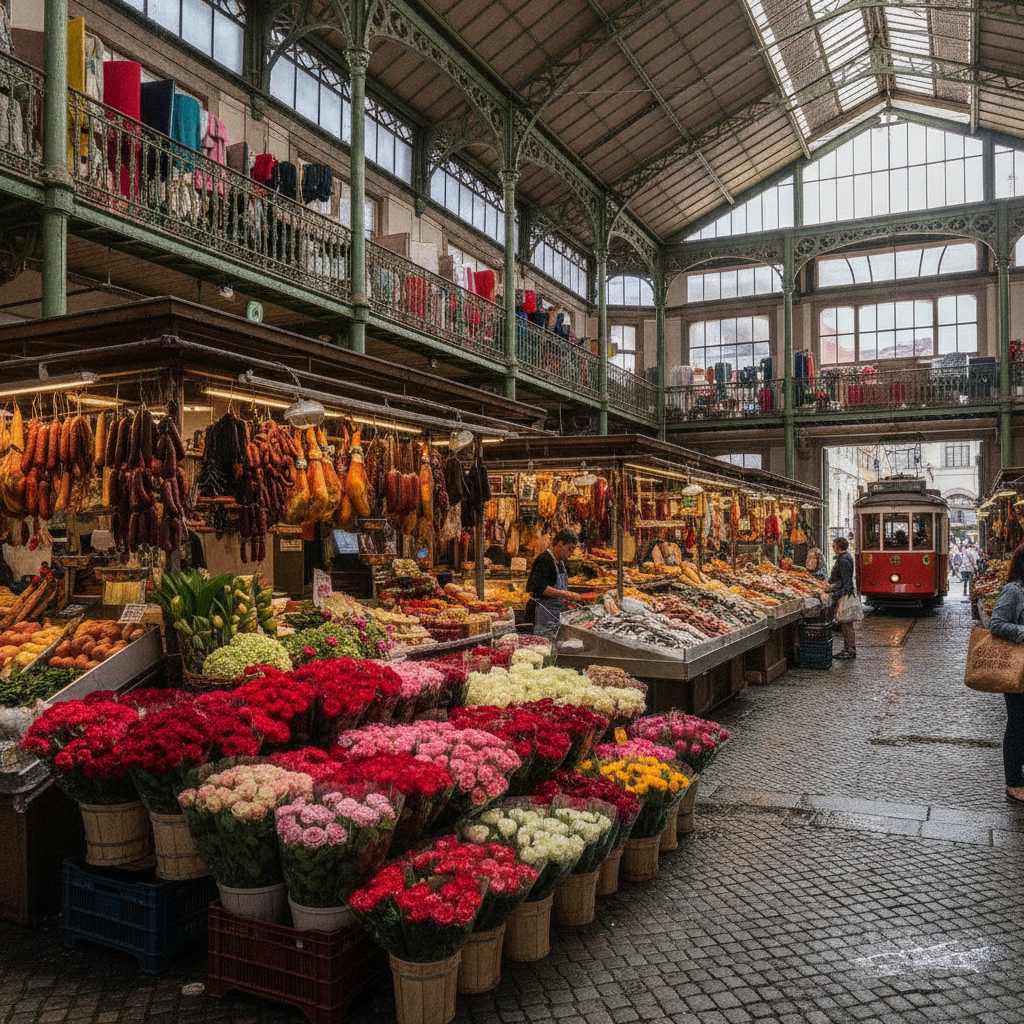
Mercado do Bolhão, Tram e la Vita Quotidiana di Porto
The Mercado do Bolhão (the famous 19th-century covered market in the heart of Porto, reopened after restoration in 2022 — the market of the flower sellers, the cheese vendors, the fish mongers, and the delicatessen stalls that is the most vibrant expression of Porto's market culture) and the historic Porto trams (the vintage Bonde trams that still operate on routes through the historic centre) are at the heart of Porto's everyday cultural identity.
- 1
Mercado do Bolhão — Porto's Historic Iron Market Hall
Mercado do Bolhão (Rua Formosa, Baixa district, 1914, Correia da Silva architect, the largest traditional market hall in Porto, closed for renovation 2018–2022, reopened October 2022) is Porto's social institution — the 2-floor iron structure (upper floor: flower vendors, delicatessens, and cheese stalls; ground floor: fruit, vegetables, fish, and meat) was renovated to its 1914 appearance; the vendors (many families operating the same stall for 3+ generations) sell directly from the farms and boats; the tripe stalls and bacalhau (salt cod) sellers are the most authentically Porto elements.
- 2
Lello Bookshop — The Most Beautiful Bookshop in the World
Livraria Lello (Rua das Carmelitas 144, 1906, Xavier Esteves architect, 210sqm floor area) is consistently ranked among the world's most beautiful bookshops — the Art Nouveau interior (the double spiral staircase in red-painted wood, the stained glass ceiling, the carved wood shelves) was built for €1,500 in 1906; J.K. Rowling worked nearby (1992–1994, teaching English at Instituto Britânico) and the bookshop is claimed as inspiration for Hogwarts; the current entry fee (€5, redeemable against book purchases) was introduced in 2015 to manage 4,000+ daily visitors.
- 3
Porto's Café Culture — Majestic and Guarany
Café Majestic (Rua de Santa Catarina 112, 1921, the finest Art Nouveau café in Portugal) and Guarany (Avenida dos Aliados, 1933, Art Deco) are Porto's historic café institutions — Majestic (€4.50 for a coffee, which J.K. Rowling is claimed to have worked in but this is disputed) is the most photogenic café in Porto; the pastel de nata (custard tarts, at any pastelaria but best at the chain Manteigaria, Rua Alexandre Braga) and the torta de Azeitão (the spiral rolled cream cake) are the essential Porto café pastries.
- 4
Rua de Santa Catarina — Porto's Shopping Street
Rua de Santa Catarina (the 1.2km pedestrianized main shopping street running north from Baixa to the Bolhão market, with the Chapel of Santa Catarina creating a religious node at the street's midpoint) is Porto's commercial artery — the traditional shops (A Pérola do Bolhão, the 1917 delicatessen with original tile facade advertising port wine and sausages; Paris em Lisboa, the oldest department store) survive alongside H&M and Zara; the street's Art Nouveau facades are the most concentrated in Porto outside Avenida dos Aliados.
- 5
Azulejo Tile Culture — Porto's Blue and White Identity
Porto's azulejo (blue and white tin-glazed tile) tradition covers 40+ major buildings in the city — the Chapel of Souls (Rua de Santa Catarina, the entire exterior covered in 15,000 blue-and-white tiles depicting the life of São Francisco de Assis and Santa Catarina, 1929, Eduardo Leite) and São Bento railway station (the entrance hall: 20,000 tiles by Jorge Colaço, 1930, depicting Portuguese history) are the two most visited; the Instituto das Artes e Ofícios da Universidade do Porto teaches the traditional tile-making technique.
- 6
Porto Street Food — Francesinha and Bifanas
Porto's distinctive street food: Francesinha (the 'little French girl', the local sandwich of cured meats, fresh sausage, and steak covered in melted cheese and a tomato-beer-brandy sauce, €8–12, the most caloric meal in Portugal — a Porto invention from the 1950s adapting the French croque-monsieur) and Bifana (marinated pork in a roll with mustard and hot sauce, €2–3, the default working lunch); the best Francesinha is at Café Santiago (Rua do Passeio Alegre), Regaleira, or the historic Café Aliança (Galeria de Paris); eating a Francesinha at midnight is a Porto cultural ritual.