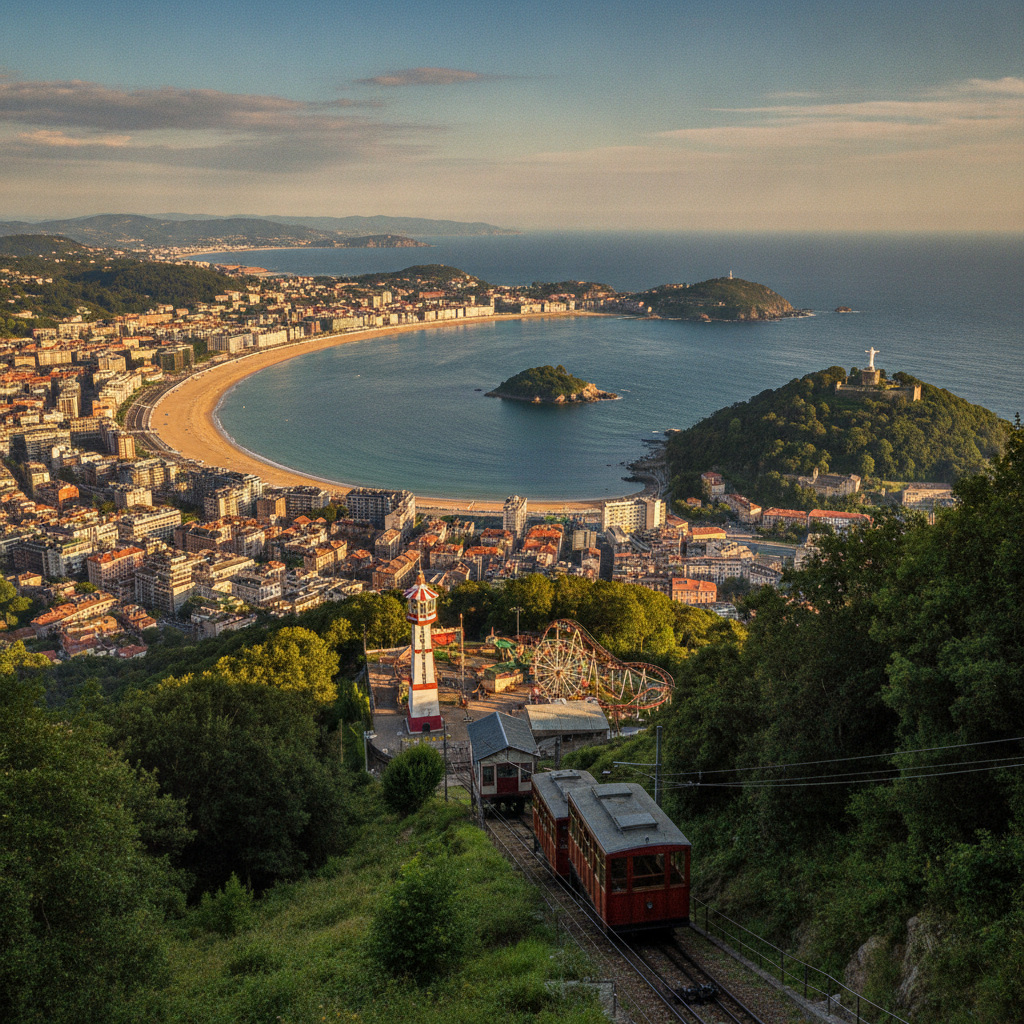
Monte Igueldo, Monte Urgull e le Viste Panoramiche di San Sebastián
The two hills that frame the La Concha bay — Monte Urgull (123 m, topped by the Castillo de la Mota and the Cristo del Castillo) and Monte Igueldo (181 m, accessible by the historic 1912 funicular railway) — offer the most celebrated panoramic views of San Sebastián, the La Concha bay, and the Basque coastline.
- 1
Monte Igueldo — The Funicular to the Bay's Edge
Monte Igueldo (231m, the western headland closing the La Concha bay, accessible by the 1912 funicular from the Ondarreta beach end, €3.90 return, daily 10am–9pm June–September) offers the definitive panorama of La Concha bay — from the summit, the symmetrical arc of the bay (the most beautiful urban bay in Europe by standard European tourist ranking), Isla de Santa Clara (the small island in the bay centre, accessible by summer ferry, €4 return), and Monte Urgull (the fortified eastern headland) are simultaneously visible; the funicular's wooden carriages are original 1912 equipment.
- 2
Monte Urgull — The Fortress Above the Old Town
Monte Urgull (the fortified hill above the Old Town/Parte Vieja, 123m, freely accessible on foot from the old town, no fee) is crowned by the Castillo de la Mota (a succession of fortifications from medieval to 19th century, the most complete military architecture in the Basque Country outside Bilbao) and a 12m statue of Christ (1950, a Basque version of the Rio de Janeiro monument) — the hill's cemetery (English Cemetery, 1830s Carlist War victims) is on the north slope; the Aquarium (Plaza Carlos Blasco de Imaz, €13) is at the hill's base on the Bay of Biscay.
- 3
La Concha Beach — The Most Beautiful Urban Beach in Europe
La Concha (the 'shell' beach, 1.35km, directly below the Promenade, the centre of San Sebastián's resort identity since the 1860s when Queen Maria Cristina established the royal summer court here) is consistently rated Europe's finest urban beach — the balustrade Promenade (1.2km, Art Nouveau railings, cast iron benches, weekly summer concerts) and the white-painted Belle Époque beachside architecture (the Casino/Kursaal, the hotels of the Promenade) frame the beach; the Belle Époque era (1890–1914) transformed San Sebastián from a fishing village to the summer capital of Spain.
- 4
Peine del Viento — Chillida's Wind Combs in the Sea
Peine del Viento (Wind Combs, Eduardo Chillida, 1977, the three forged Cor-Ten steel sculptures embedded in the rock at the base of Monte Igueldo, facing the open Atlantic) is the defining public artwork of the Basque Country — Chillida (1924–2002, San Sebastián-born, the most internationally significant Basque artist) designed the sculptures to interact with the sea (waves crash through the holes in the comb forms; pneumatic tubes in the rock create whistling sounds timed to wave action); best visited in stormy weather when the sculptures are engulfed by breaking waves.
- 5
Miramar Palace — The Royal Summer Residence
Palacio de Miramar (Paseo de Miramar, between La Concha and Ondarreta beaches, 1893, Selden Wornum architect, the English-style seaside palace built for Queen Maria Cristina who established San Sebastián's royal resort status) is now property of San Sebastián city government and used for cultural events — the exterior (Norman-style red brick, corner towers, formal garden) and the position between the two beaches make it the compositional anchor of the western San Sebastián shoreline; the gardens (free, Monday–Friday) overlook both the open sea and La Concha bay.
- 6
Ondarreta Beach — The Local's Beach West of La Concha
Ondarreta Beach (the beach west of La Concha, separated from it by the Miramar Palace headland, 400m of sand, the least touristy of San Sebastián's central beaches) is where San Sebastián residents go to avoid the crowds on La Concha — the beach fronts the residential buildings of the 1920s–1930s (the neighbourhood built for San Sebastián's emerging middle class after the royal court moved its summer residence to Santander in 1913); the Real Club de Tenis de San Sebastián (adjacent, 1902, one of the oldest tennis clubs in Spain) and the Peine del Viento (at the western end) are the bookends.