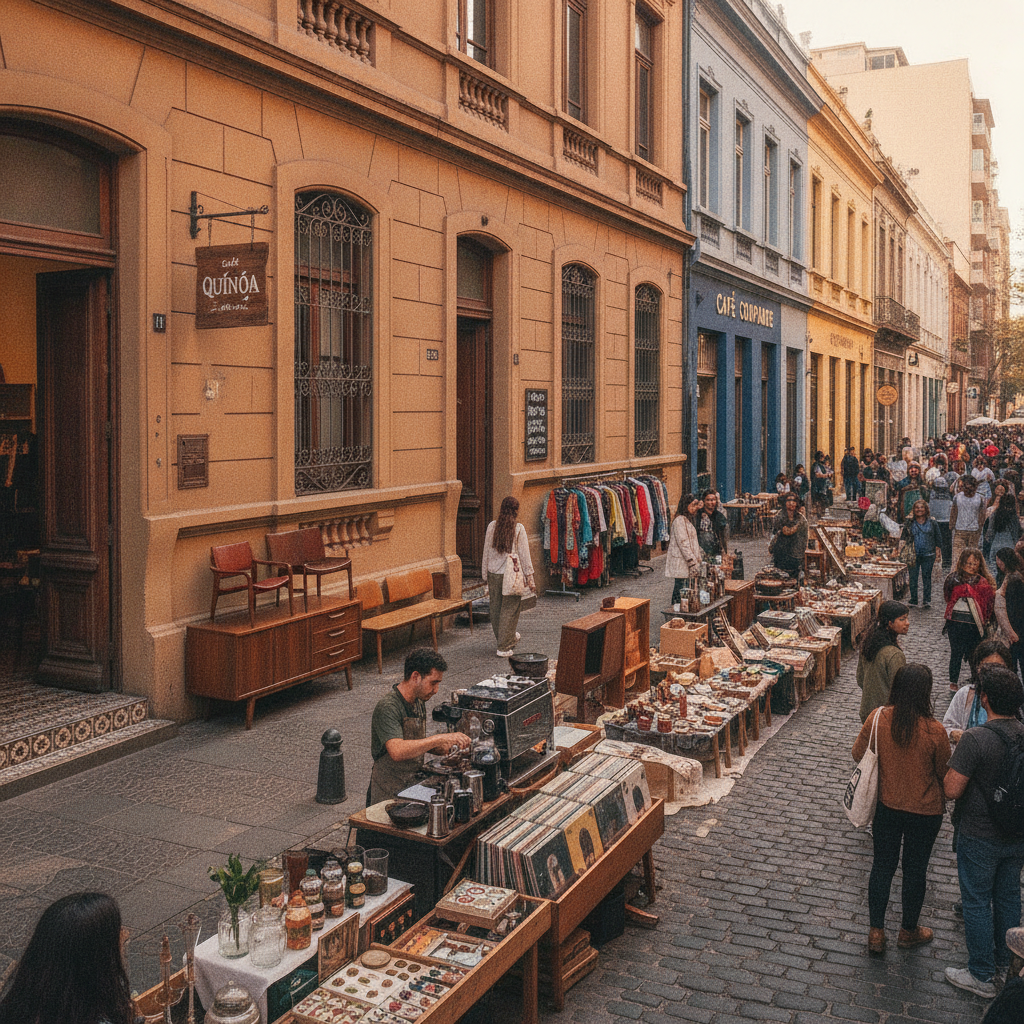
Barrio Italia, Mercati Vintage e il Rinascimento Creativo di Santiago
Barrio Italia (the neighbourhood in the Providencia municipality centred on the Avenida Italia and the parallel Avenida Condell — the neighbourhood that has emerged in the 2010s as the most creative and most rapidly gentrifying neighbourhood in Santiago) is the 'Brooklyn of Santiago': the neighbourhood of mid-century furniture restorers, vintage clothing shops, artisan coffee roasters, independent bookshops, and the design studios and restaurants that define Santiago's creative class.
- 1
Barrio Italia — The Antique and Design District
Barrio Italia (the neighbourhood around Avenida Italia, northeast of the city centre, the residential district developed for Italian immigrant families in the 1920s–1940s) has been transformed since 2010 into Santiago's design and antique district — the Persa Bio Bio Sunday market (the largest antique and secondhand market in Santiago, Bío Bío and Franklin, 500+ stalls, Sunday 8am–4pm, accessible by Metro Estación Franklin) and the Barrio Italia's permanent vintage and design shops (concentrated on Av. Condell and Ernesto Pinto Lagarrigue) represent two ends of the price spectrum.
- 2
Drugstore and the Design District's Nightlife
The cultural and commercial corridor of Barrio Italia (Avenida Italia and Avenida Condell) is also the centre of Santiago's independent restaurant and bar scene — Liguria (the classic Chilean restaurant serving the traditional midday almuerzo: cazuela, pastel de choclo, cazuela de vacuno for $8–12), the wine bars of Calle Condell (Bocanáriz, Chile's most comprehensive wine bar, 300+ Chilean wines by the glass), and the cocktail bars of Barrio Italia make it the neighbourhood that best represents the city's transition from traditional to contemporary culture.
- 3
Museo de la Memoria y los Derechos Humanos — Chile's Truth Commission
The Museo de la Memoria y los Derechos Humanos (Matucana 501, Barrio Yungay adjacent, 2010, Londoño Gómez Platero Estudio architecture, free, Tuesday–Sunday 10am–6pm) is Chile's principal memorial to the victims of the 1973–1990 Pinochet dictatorship — the building's design (opaque exterior copper cladding, transparent interior glass walkways) represents the dictatorship's secrecy and the survivors' demand for truth; the collection (testimony videos, photograph archives, the objects of disappeared people) documents the 3,000+ killed and 40,000+ tortured during the dictatorship.
- 4
Villa Grimaldi — The Disappeared of Santiago's Terror
Villa Grimaldi (Avenida José Arrieta 8200, Peñalolén, eastern Santiago, accessible by bus or taxi, free, Tuesday–Sunday 9:30am–1pm and 2pm–6pm) was the most notorious detention and torture centre of the DINA (Pinochet's secret police) from 1973–1977 — the garden (the only part of the villa that survived demolition by the military when leaving in 1987) has been reconstructed as a memorial park with the names of the disappeared carved in stone; the piscine (the pool used for water torture) and the 'tower' (isolation cells) are documented in the landscape.
- 5
Persa Bio Bio — Santiago's Great Flea Market
Persa Bio Bio (the outdoor flea market at Calle Bío Bío and Calle Franklin, San Diego neighbourhood, Sunday 8am–3pm, free entry, 3+ hectares) is Santiago's most interesting urban market — the stalls (500+) sell antique furniture, vintage clothing (the section near the Bio Bio bridge has the best mid-century Chilean furniture), secondhand electronics, and the extraordinary miscellany of Chilean domestic life from 1940 to 2000; the market is adjacent to Barrio Franklin (the restaurant and botillería neighbourhood) where post-market lunch (a cazuela or empanadas at the Mercado de Barrio Franklin) is the natural conclusion.
- 6
Barrio Yungay — The Most Preserved Historic Neighbourhood
Barrio Yungay (the neighbourhood between Barrio Brasil and Barrio Italia, developed 1839–1920, the most intact 19th-century residential quarter in Santiago) retains the palimpsest of Chilean urban history — the church of San Vicente de Paul (1872, neo-Gothic, the cornerstone of the neighbourhood), the early-20th-century conventillos (the collective housing for working-class families), and the Parque Yungay (with the Piedra Feliz, the rock where Chile's national anthem was signed in 1847) are the historical anchors; the neighbourhood's recent gentrification (wine bars, gallery spaces, natural food shops) reproduces the Barrio Italia trajectory 5 years later.