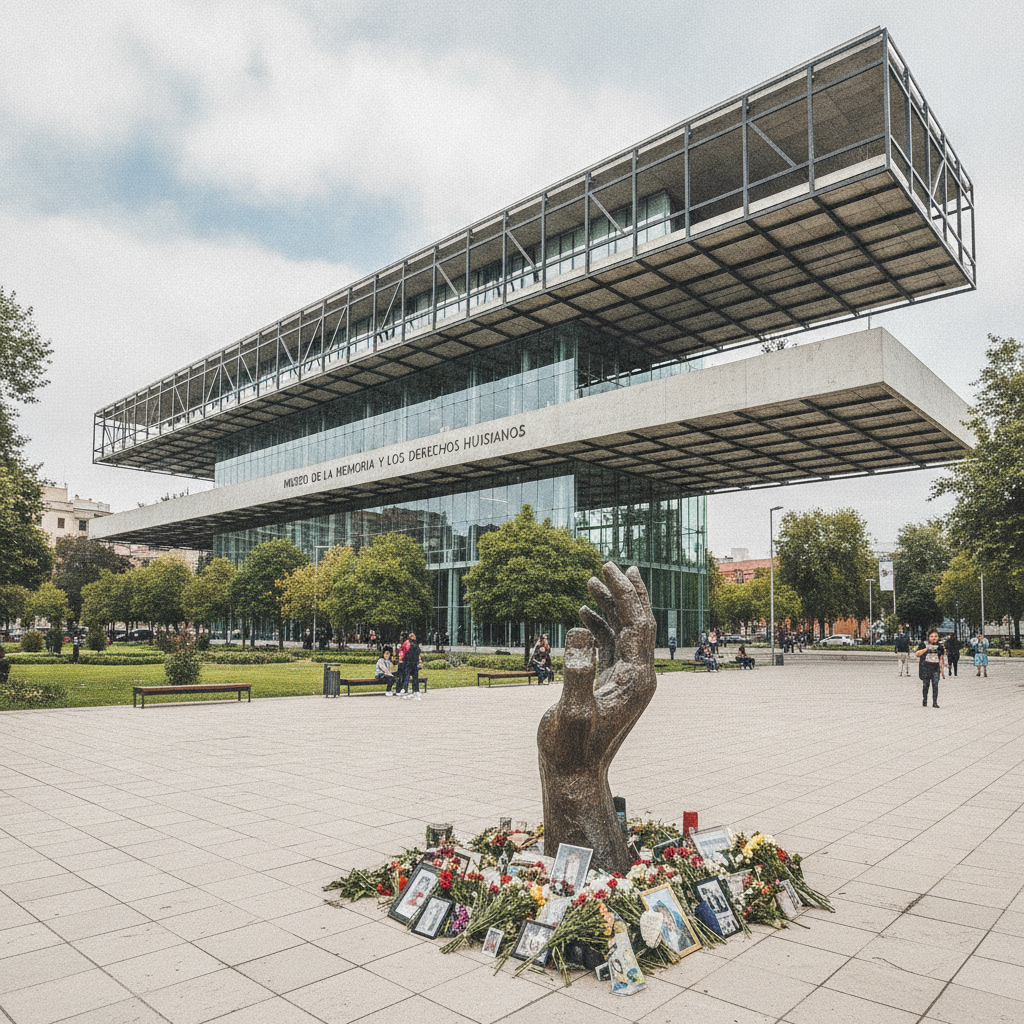
Museo della Memoria, Diritti Umani e il Recupero Democratico del Cile
The Museo de la Memoria y los Derechos Humanos (the Museum of Memory and Human Rights in Santiago — the museum dedicated to documenting the human rights violations committed by the military dictatorship of Augusto Pinochet (1973-1990)) is one of the most important human rights museums in the world and an essential part of understanding modern Chile — the country that transformed from military dictatorship to vibrant democracy in one of the most remarkable political transitions of the 20th century.
- 1
September 11, 1973 — The Coup That Changed Latin America
The Chilean coup of September 11, 1973 (the military overthrow of democratically elected President Salvador Allende, the first elected Marxist leader in the Americas, by General Augusto Pinochet) was the Cold War's most consequential moment in South America — the CIA's role (Operation FUBELT, the U.S. government's covert program to prevent Allende's election and then to destabilize his government, declassified 2000–2020) and the Nixon-Kissinger policy are documented in the Museum of Memory; the coup was the direct cause of 17 years of military dictatorship (1973–1990).
- 2
DINA — The Secret Police Network
The Dirección de Inteligencia Nacional (DINA, 1973–1977) was the Pinochet regime's secret police and torture apparatus — the DINA operated approximately 100 clandestine detention centres in Chile, in which 40,000+ people were tortured and 3,000+ were killed or disappeared (the 'detenidos desaparecidos', the disappeared, whose fate was denied by the regime and established by the Rettig Commission in 1991); Villa Grimaldi, Londres 38, and the 'Venda Sexy' (the sexual torture centre on Irán 3037) are the three most documented sites.
- 3
Operación Cóndor — The International Network of State Terror
Operación Cóndor (1975, the coordinated intelligence operation among the South American military dictatorships — Chile, Argentina, Uruguay, Paraguay, Bolivia, Brazil — to locate and assassinate political opponents across borders) was headquartered from Santiago — the operation killed or disappeared 60,000+ people across South America; the assassination of Chilean former diplomat Orlando Letelier and his American colleague Ronni Moffitt in Washington DC (September 21, 1976, a car bomb on Embassy Row) was Cóndor's most internationally visible act; the DINA officers responsible were eventually convicted.
- 4
Rettig Commission and Truth After Pinochet
The Comisión Nacional de Verdad y Reconciliación (Rettig Commission, 1990–1991, established by President Patricio Aylwin within weeks of Chile's return to democracy) documented 3,197 deaths attributable to the regime — the commission's report (the Informe Rettig) established the factual record that Chile's courts have used in subsequent prosecutions; the follow-up Valech Commission (2004, 2010) documented 40,018 people who suffered torture; over 300 military officers have been convicted of human rights crimes in Chilean courts since 2000; Pinochet died in 2006 without conviction, under house arrest.
- 5
Gabriela Mistral Cultural Centre — Democracy's Architectural Response
The GAM (Gabriela Mistral Cultural Centre, Avenida Libertador Bernardo O'Higgins 227, free entry, the brutalist concrete building originally built for the 1972 UNCTAD III international conference, used as the Ministry of Public Works under Pinochet, returned to cultural use and renamed 2010) is Santiago's principal contemporary arts venue — the building's political history (designed under Allende, occupied by the dictatorship, reclaimed for democracy) makes it the most politically symbolic arts venue in Chile; the GAM bookshop and the rooftop Terraza GAM are both free and open to the public.
- 6
Isla de Maipo — Wine Country Within an Hour of Santiago
Isla de Maipo (the municipality 60km south of Santiago, in the Maipo Valley wine region, the most important wine appellation in Chile) is accessible by car or organized tours — the Maipo Valley (designated appellation since 1979) is the origin of Chile's wine export success: Cabernet Sauvignon dominates, producing wines with a cassis and dusty mineral character from the alluvial soils and intense sunshine moderated by cold Andean nights; the wineries (Concha y Toro, Santa Carolina, Cousiño-Macul — all dating from the 1870s–1880s) offer cellar door visits (free, advance booking recommended).