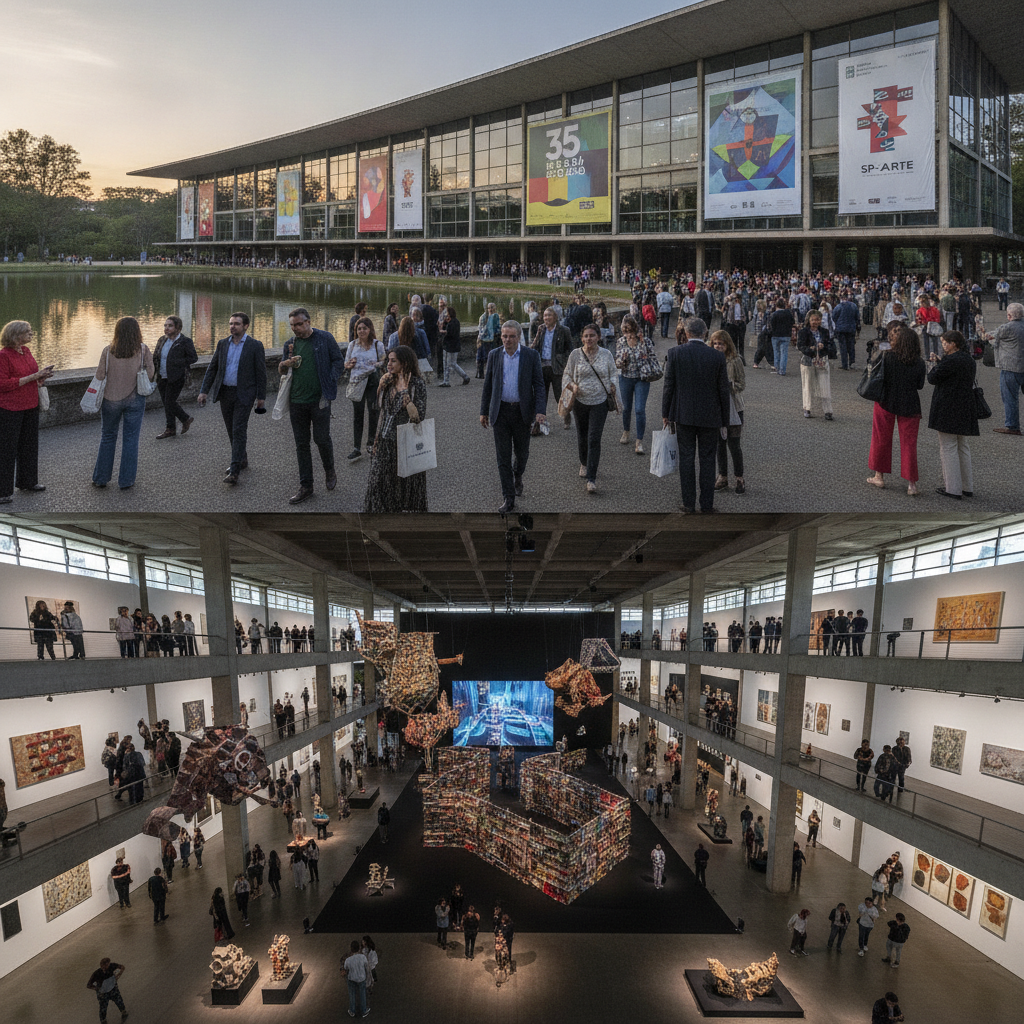
SP-Arte, Musei e la Scena Culturale di Livello Mondiale di São Paulo
São Paulo's cultural scene (the arts and culture infrastructure of the city that is the most important art market in Latin America — the city that hosts the SP-Arte (the São Paulo International Art Fair — the most important contemporary art fair in Latin America, held annually in April at the Pavilhão da Bienal in Ibirapuera Park), the São Paulo Biennial (the 'Bienal de São Paulo' — the second oldest art biennial in the world (after the Venice Biennale), the biennial that has showcased international contemporary art in São Paulo since 1951)) represents the most important art ecosystem in the Southern Hemisphere.
- 1
São Paulo Architecture — Vilanova Artigas and Paulo Mendes da Rocha
São Paulo has the largest concentration of Brutalist architecture in the world — the school of Brazilian Brutalism (1960s–1970s, developed by FAU/USP faculty including Vilanova Artigas and Paulo Mendes da Rocha) used exposed concrete in service of democratic public space: FAU-USP (Rua do Lago 876, the architecture school building itself, 1969, Artigas, a continuous ramp connecting all floors without stairs — a spatial democracy metaphor), the SESC Pompeia, and the MASP are the three pillars; Mendes da Rocha won the Pritzker Prize in 2006 as the São Paulo school's ultimate recognition.
- 2
Bienal de São Paulo — The World's Second Oldest Art Biennale
The São Paulo Bienal (Pavilhão Ciccillo Matarazzo, Ibirapuera, established 1951, the second oldest international art biennale after the Venice Biennale) takes place in October–December of even years — the Niemeyer pavilion (the curved concrete building with spiral ramp access to 3 floors, 30,000m² exhibition space) and the adjacent Oca (the flying saucer pavilion) house the main exhibition and national pavilions of 80+ countries; the 35th Bienal (2023) had the theme 'Choreographies of the Impossible' and drew 750,000 visitors; free admission.
- 3
Casa do Povo — São Paulo's Jewish Cultural Heritage
Casa do Povo (Rua Três Rios 252, Bom Retiro neighbourhood, founded 1946 by Eastern European Jewish immigrants as a cultural centre, now a contemporary arts institution) is São Paulo's most historically significant community cultural building — Bom Retiro (the neighbourhood around Rua José Paulino, the Jewish commercial district that evolved into São Paulo's Korean and Bolivian commercial area as successive immigrant waves replaced each other) is the best example of the city's layered immigration geography; the current Casa do Povo programming (independent cinema, political debate, experimental art) maintains the original progressive culture.
- 4
Museu do Ipiranga — The Independence Monument Museum
Museu do Ipiranga (Parque da Independência, Ipiranga, the museum in the neoclassical palace built on the site where Dom Pedro I proclaimed Brazilian independence on September 7, 1822 — 'Independência ou Morte', re-opened 2022 after 10 years of restoration, R$30 adults, Tuesday–Sunday) is the most historically symbolically charged museum in Brazil — the monument (the equestrian statue of Dom Pedro I, 1885, Maximino Cerqueira) in the Independence Park garden marks the exact spot of the declaration; the museum's collection (250,000 objects documenting 400 years of São Paulo history) is the most comprehensive in the state.
- 5
Graffiti in São Paulo — OSGEMEOS and the World's Capital of Street Art
São Paulo is the world capital of legal street art — the city decriminalized graffiti in 2008 (graffiti is legal on any surface where the owner grants permission; pixação — the São Paulo tagging style, with a distinctive tall angular script — is illegal but tolerated); OSGEMEOS (Gustavo and Otavio Pandolfo, the São Paulo twin brothers who began painting in the 1980s and have shown work at the Tate Modern, the Garage MoMA, and the Venice Biennale) are the most internationally known São Paulo street artists; the giant golden boy on Avenida 23 de Maio (under the MASP overpass) is OSGEMEOS.
- 6
Teatro Municipal de São Paulo — The Opera House That Opened with Anna Pavlova
Teatro Municipal de São Paulo (Praça Ramos de Azevedo, Centro, 1911, Ramos de Azevedo architect, the most ornate building in São Paulo, modelled on the Paris Opéra Garnier) was inaugurated with a 2-week ballet season by Anna Pavlova (the Russian prima ballerina who chose São Paulo for her South American debut) — the theater's interior (painted ceilings, gold leaf, Carrara marble, mirrored foyer) is the finest Belle Époque interior in Brazil; guided tours (free, Monday 9am–11am and 2pm–4pm) include the stage and the principal rooms; the Symphonic Orquestra Sinfônica do Estado de São Paulo (OSESP) is based here.