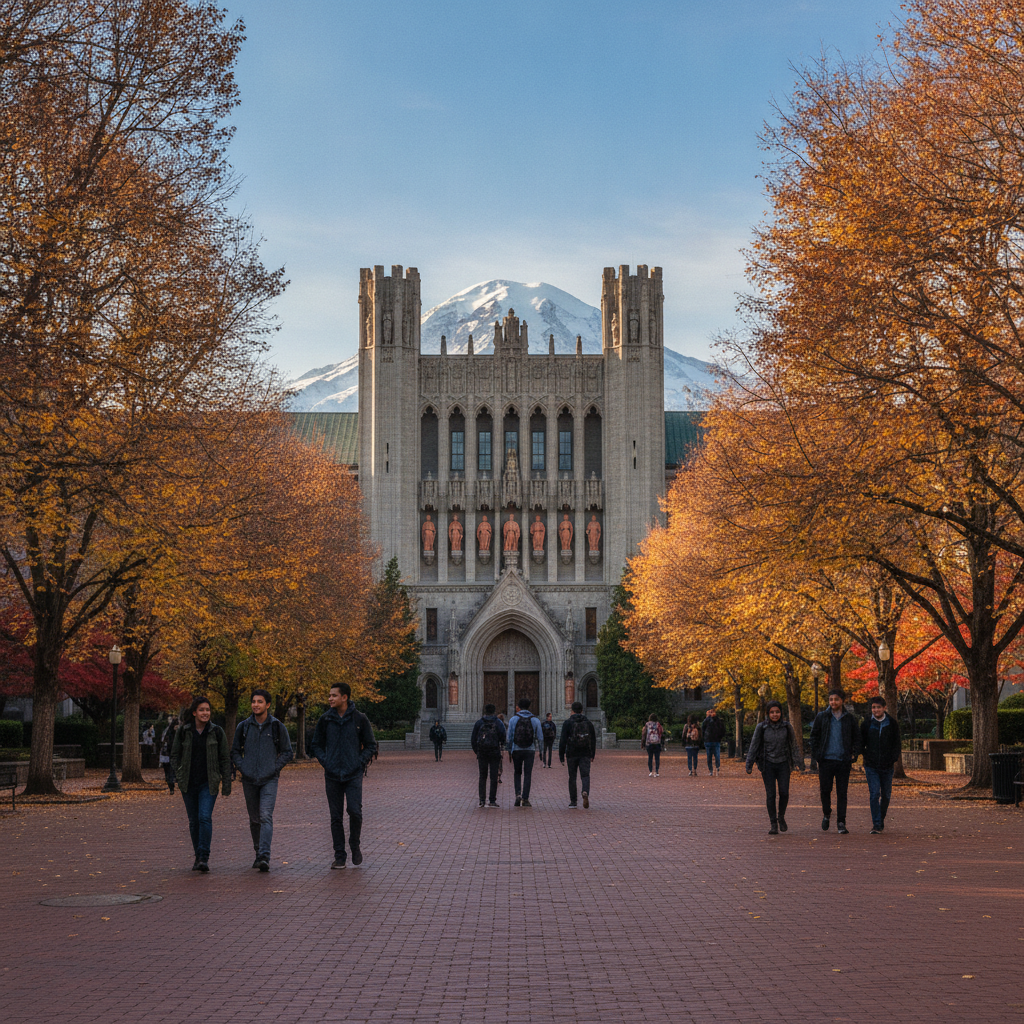
Distretto Universitario, Fremont e i Quartieri Creativi di Seattle
The University District ('The Ave' — University Way NE, the main commercial street of the University District, running north-south through the neighbourhood east of the University of Washington campus) and the surrounding neighbourhoods (Fremont, Wallingford, Ballard, and Green Lake) form the most distinctively Pacific Northwest residential culture in Seattle — the neighbourhoods where the city's outdoor-oriented, coffee-saturated, independent-minded character is most concentrated.
- 1
University of Washington — The Research University in an Urban Forest
The University of Washington (UW, Seattle, founded 1861, 50,000 students, the most research funding of any public university in the US) is set on a 703-acre campus above Lake Washington — the UW Quad (the central courtyard with 30 Yoshino cherry trees, the most crowded viewing location for cherry blossoms in Seattle, late March, 2 weeks of peak bloom) and the Husky Stadium (70,138 capacity, the only major college stadium accessible by light rail — the UW Station opens directly into the stadium) are the campus highlights; the Henry Art Gallery (UW campus, the oldest art museum in Washington State, $10 adults) shows contemporary art.
- 2
Capitol Hill — Seattle's LGBTQ+ and Music District
Capitol Hill (the neighbourhood east of downtown, the summit ridge between Puget Sound and Lake Washington) is Seattle's most culturally concentrated neighbourhood — the Pike/Pine Corridor (Pike and Pine Streets between Broadway and 12th Avenue) is the city's densest bar and restaurant strip; the LGBTQ+ community anchors the neighbourhood (the Seattle Pride parade, the largest annual event on Capitol Hill, draws 200,000+); the music venues (Neumos, Barboza, the Crocodile on Pike) maintain Seattle's indie rock tradition after the 1990s grunge era.
- 3
Sub Pop Records — The Label That Signed Nirvana
Sub Pop Records (2013 4th Avenue, Belltown/Capitol Hill, founded 1988 by Bruce Pavitt and Jonathan Poneman) is the record label that defined the Seattle grunge sound — the label signed Nirvana (Bleach, 1989, before their major label breakthrough), Mudhoney (Superfuzz Bigmuff, 1988, the first Sub Pop classic), and Soundgarden (Screaming Life/Fopp, 1987); the Sub Pop Mega Mart (the in-office record store, open to the public Monday–Friday) sells current Sub Pop releases, vintage catalogue, and merchandise; the annual Sub Pop loser edition newsletter and the company's self-deprecating marketing are as significant as the music.
- 4
Benaroya Hall — Seattle Symphony's World-Class Home
Benaroya Hall (200 University Street, downtown Seattle, 1998, LMN Architects, the most acoustically advanced concert hall built in the US in the 1990s) is the home of the Seattle Symphony — the Mark Fisher-designed hall (2,500 seats, the multi-layered wood acoustic panels, 4,264-pipe Watjen Concert Organ) has hosted recordings that won 4 Grammy Awards for the Seattle Symphony; the lobby (free access, the Art Deco-influenced lobby glass by Dale Chihuly, the most visible free public art in downtown Seattle) and the pre-concert lectures are open to the public without ticket purchase.
- 5
Frye Art Museum — Free Fine Art in First Hill
Frye Art Museum (704 Terry Avenue, First Hill, free admission always, Tuesday–Sunday 11am–5pm) is the only major free art museum in Seattle — the founding collection (the 19th-century German academic and Barbizon school paintings collected by Charles and Emma Frye, Alaskan industrialists) and the temporary exhibition program (contemporary art, particularly by Pacific Northwest artists) are in dialogue in the renovated 1952 building; the museum's funding model (endowment only, no admission charge) has been maintained since opening in 1952; the café is open to non-museum visitors.
- 6
Volunteer Park — The Water Tower and Seattle Asian Art Museum
Volunteer Park (1247 15th Avenue E, Capitol Hill, 48 acres, 1906, the Olmsted Brothers landscape design — the same firm that designed Central Park) contains the Seattle Asian Art Museum (1400 E Prospect Street, the 1933 Art Deco building, free on the first Thursday and Saturday each month, $15 other times) housing the Seattle Art Museum's Asian collections, including Japanese screens and Chinese bronzes; the Volunteer Park Conservatory (1912, Victorian glass greenhouse, free Wednesday–Sunday) and the Water Tower (the 1907 brick tower with a 360° observation deck, free) are the park's distinctive structures.