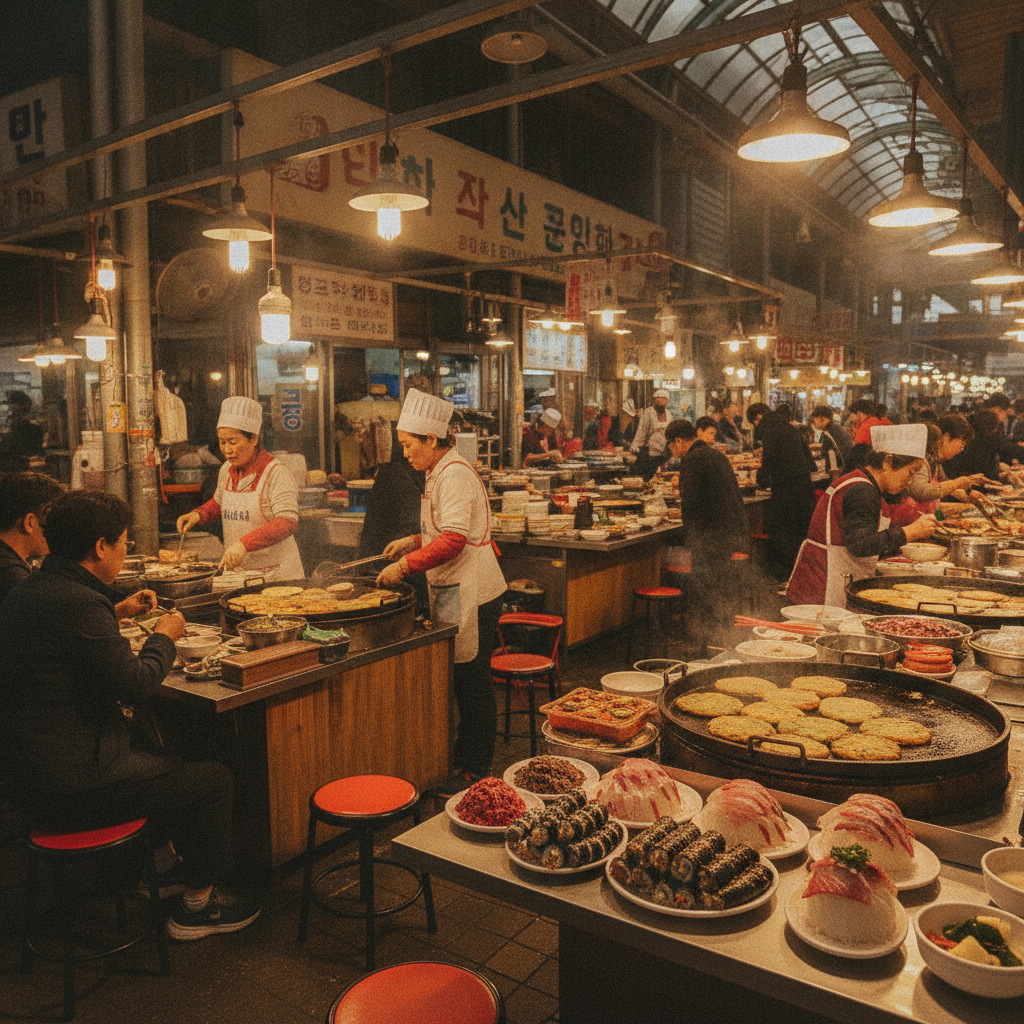
Cultura Gastronomica Coreana — Mercato Gwanjang, Bibimbap, Samgyeopsal e Banchan
Korean cuisine — one of the most distinctive, complex and beloved national cuisines in the world — is centered on the principles of balance (the five flavours of sweet, sour, salty, bitter and spicy; the five colours of red, green, yellow, white and black), fermentation (kimchi, doenjang, ganjang, gochujang), and the communal table (the banchan system of shared small dishes); Seoul is the best place in the world to explore the full range of Korean food culture, from the traditional market food halls of Gwanjang to the Michelin-starred Korean fine dining of Jongno.
- 1
Gwanjang Market — Korea's Most Famous Food Market (1905)
Gwanjang Market (88 Changgyeonggung-ro, Jongno-gu, 1905, the oldest traditional market in Korea still in its original location, daily 9am–6pm, food stalls 10am–10pm) is the primary food market destination in Seoul — the covered food stalls (Row 4, the market's specialty food section) serve: bindaetteok (mung bean pancakes, ₩5,000, the market's defining food), mayak gimbap (tiny seaweed rice rolls with sesame and pickled radish, addictively available for ₩2,000), and yukhoe (raw beef tartare with Asian pear and pine nuts, ₩15,000) — all the most photographed Korean street food in one covered market row.
- 2
Bibimbap — Korea's Most Recognized Dish
Bibimbap (mixed rice bowl, from bibim/'mixing' + bap/'cooked rice', the definitive Korean one-dish meal of white rice topped with seasoned vegetables — namul — raw egg, gochujang/red pepper paste, and optionally beef or tofu, served in a hot stone bowl — dolsot bibimbap — or cold) is Jeonju's signature dish but served across Korea — Jeonju Bibimbap (the original, using local Jeonju rice, 20 types of namul, and yellow bean sprouts grown specifically for bibimbap) is available in Seoul at Jeongjungsik (Insadong, ₩15,000), but the best bibimbap experience requires the 3.5-hour KTX trip to Jeonju.
- 3
Samgyeopsal — Korean BBQ's Most Popular Cut
Samgyeopsal (삼겹살, 'three-layer meat', grilled pork belly, the most commonly ordered Korean BBQ meat) is eaten on a charcoal or gas tabletop grill — the protocol: grill thick slices of pork belly yourself, wrap in lettuce or perilla leaf with garlic, gochujang, and ssamjang paste, eat in one large bite; the accompanying side dishes (banchan: kimchi, bean sprout namul, pickled radish, mackerel braised in gochujang) are refillable without charge; the traditional samgyeopsal experience at Mapo Galmaegi (Mapo, ₩18,000/portion) and in the Mapo district's charcoal grill restaurants is the most authentic.
- 4
Kimchi — Korea's National Fermented Vegetable
Kimchi (fermented vegetables — most commonly cabbage, but also radish, cucumber, and 200+ other varieties — seasoned with gochugaru/Korean red pepper, garlic, ginger, jeotgal/seafood sauce, and spring onion) is served as banchan with every Korean meal — the kimjang tradition (the communal kimchi-making in November–December, preparing the winter supply, a community event listed as UNESCO Intangible Cultural Heritage 2013) is the social event of the Korean culinary year; the National Museum of Korean Kimchi (Insa-dong, ₩5,000) and the commercial kimchi factory tours (Seoul metropolitan area) document the tradition; Korea produces and consumes 1.8 million tonnes of kimchi per year.
- 5
Tteokbokki — Korea's Most Popular Street Food
Tteokbokki (rice cake cylinders in a sweet and spicy gochujang sauce, eaten with eomuk/fish cakes and boiled eggs, ₩3,000–5,000 per portion) is the most eaten Korean street food — the pojangmacha (streetside food tent) tradition and the indoor snack bars (bunsik/fast food restaurants) serve tteokbokki as the default after-school snack; the original restaurant (Ottogi Sindang-dong Tteokbokki Town, the Sindang neighbourhood, the densest concentration of tteokbokki restaurants in Seoul, the 'Original Tteokbokki Town' designation) has 30+ competing restaurants; the standard Seoul tteokbokki portion contains 8–10 rice cake cylinders with broth for dipping.
- 6
Jjimdak — The Braised Chicken From Andong
Andong Jjimdak (braised chicken with glass noodles, potatoes, carrots, and onion in a soy-based sweet and spicy sauce, the specialty dish of Andong city in North Gyeongsang Province, available in Seoul at specialized Andong jjimdak restaurants) is one of the Korean regional dishes that became a Seoul restaurant genre — the Andong Jjimdak Alley (the original restaurant district in Andong, accessible by KTX from Seoul, 2 hours) and the recreated 'Andong Jjimdak' restaurants in Sinchon (the Sinchon Jjimdak Alley, 10+ competing restaurants within 100m on the same street) represent the dish's national expansion.