Casa de Pilatos, Palazzi Mudéjar e il Patrimonio Nobiliare di Siviglia
The Casa de Pilatos (the 'House of Pilate' — the 15th-16th century Mudéjar Renaissance palace of the Dukes of Medinaceli in the Santa Catalina neighbourhood of Seville, the finest private palace in Seville and the best-preserved example of the Mudéjar-Renaissance hybrid style that defined the architecture of 16th-century Seville) and the other noble palaces of the Seville historic centre reveal the extraordinary wealth and cultural ambition of the Sevillian aristocracy at the height of the Spanish Golden Age.
- 1
Casa de Pilatos — The Finest Private Palace in Seville
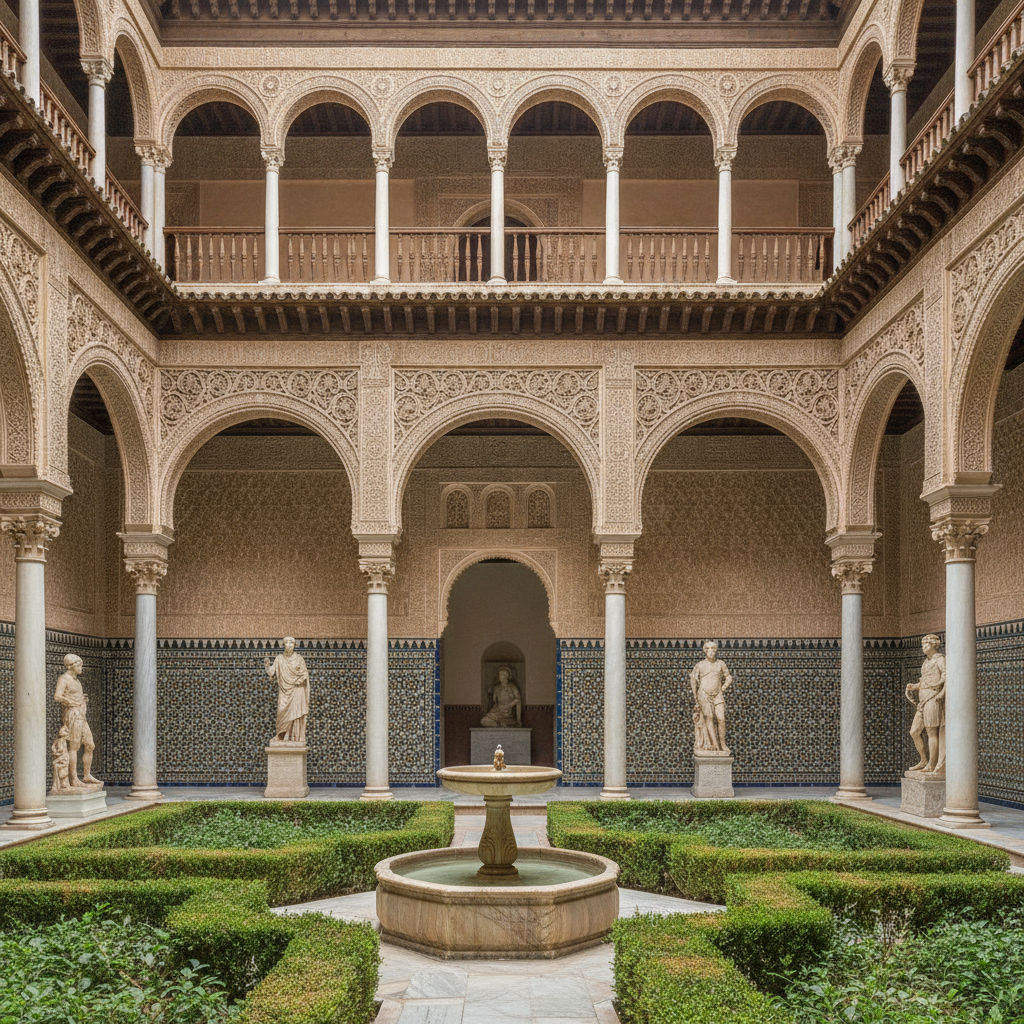
Casa de Pilatos (Plaza de Pilatos, Barrio Santa Catalina, 1483–1529, Duke of Tarifa Fadrique Enríquez de Ribera, still owned by the Medinaceli family, €10 ground floor, €12 upper floors, daily 9am–6pm) is the most complete example of Mudejar palace architecture in Seville — the Patio Principal (the central courtyard with a Genoese marble fountain, 1529, carved in Renaissance style but with Almohad Mudejar tile dado and Nasrid plasterwork arches) represents the synthesis of three cultures; the 28 Roman busts (the collection brought from Rome by Don Fadrique in 1519) are displayed along the galleries.
- 2
Palacio de las Dueñas — The Flamenco Poet's Childhood Home
Palacio de las Dueñas (Calle Dueñas 5, San Lorenzo neighbourhood, 15th-century, Dukes of Alba, €10 adults, May–September Monday–Saturday 10am–8pm) is the childhood home of Antonio Machado (1875–1939, the greatest Spanish poet of the 20th century, author of 'Campos de Castilla') — the palace's garden (one of the finest private gardens in Seville, with orange and lemon trees, flowering bougainvillea, and the 15th-century Mudejar archway) and the Machado memorabilia room (the poet was born in the palace when his father worked as the Dukes' administrator) are the principal attractions.
- 3
Palacio del Marqués de la Algaba — Gothic in Seville
Palacio del Marqués de la Algaba (Plaza Calderón de la Barca, La Macarena, 1470s, the only Gothic secular palace surviving in Seville, the Centro de Interpretación del Arte Mudéjar, free, Tuesday–Saturday 10am–2pm and 5pm–8pm) documents the Mudejar style — the tower staircase (the finest Gothic civil architecture in Seville) and the Mudejar tiles (the largest surviving tile installation from the 15th century in a private palace) are the principal elements; the palace serves as the starting point for the city's Mudejar architecture walking tour.
- 4
Flamenco Dance Museum — Understanding Seville's Art Form
Museo del Baile Flamenco (Manuel Rojas Marcos 3, Santa Cruz neighbourhood, 2006, Christina Hoyos founder, €12 adults, daily 10am–7pm, evening flamenco shows €25) is the most comprehensive museum of flamenco in the world — the 15 rooms cover flamenco's roots (the intersection of Romani, Moorish, Sephardic Jewish, and Afro-Cuban musical traditions in 18th-century Seville), the evolution of the cante (song), baile (dance), and toque (guitar) styles, and the contemporary flamenco fusion scene; the evening flamenco show (1 hour, in the museum's underground stone cellar, 80-person capacity) is the most authentic tourist flamenco in Seville.
- 5
Hospital de los Venerables Sacerdotes — Velázquez and Murillo's Patron's Chapel
Hospital de los Venerables Sacerdotes (Plaza de los Venerables, Santa Cruz, 1687–1697, the hospital for retired priests, now the Focus-Abengoa Foundation arts centre, €8, daily 10am–2pm and 4pm–8pm) houses the finest 17th-century Baroque interior in Seville — the church ceiling (by Juan de Valdés Leal and his son Lucas Valdés, the most elaborate trompe-l'oeil painted vault in Seville) and the Velázquez Room (the ground-floor gallery containing two original Velázquez paintings — Santa Rufina and the Immaculate Conception, €4 additional) make it the most concentrated fine art site in Seville after the Museum of Fine Arts.
- 6
Palacio de los Marqueses de la Mina — The Hidden Courtyard Museum
Seville's noble palaces can be understood through the specific aristocratic architectural tradition of the Sevillano patio — each palace has a different interpretation of the same essential elements (a rectangular or L-shaped patio with a central fountain, a gallery arcade on one or more sides, a staircase to the upper floor) with different proportions, tile choices, plant arrangements, and decorative plasterwork; the Barrio Santa Catalina (the neighbourhood immediately north of the Santa Cruz quarter) contains the highest density of surviving noble palaces per city block in Spain; the 'Noches en los Palacios' program (July–September) opens private palace courtyards for evening concerts.